What Defines Hard Water
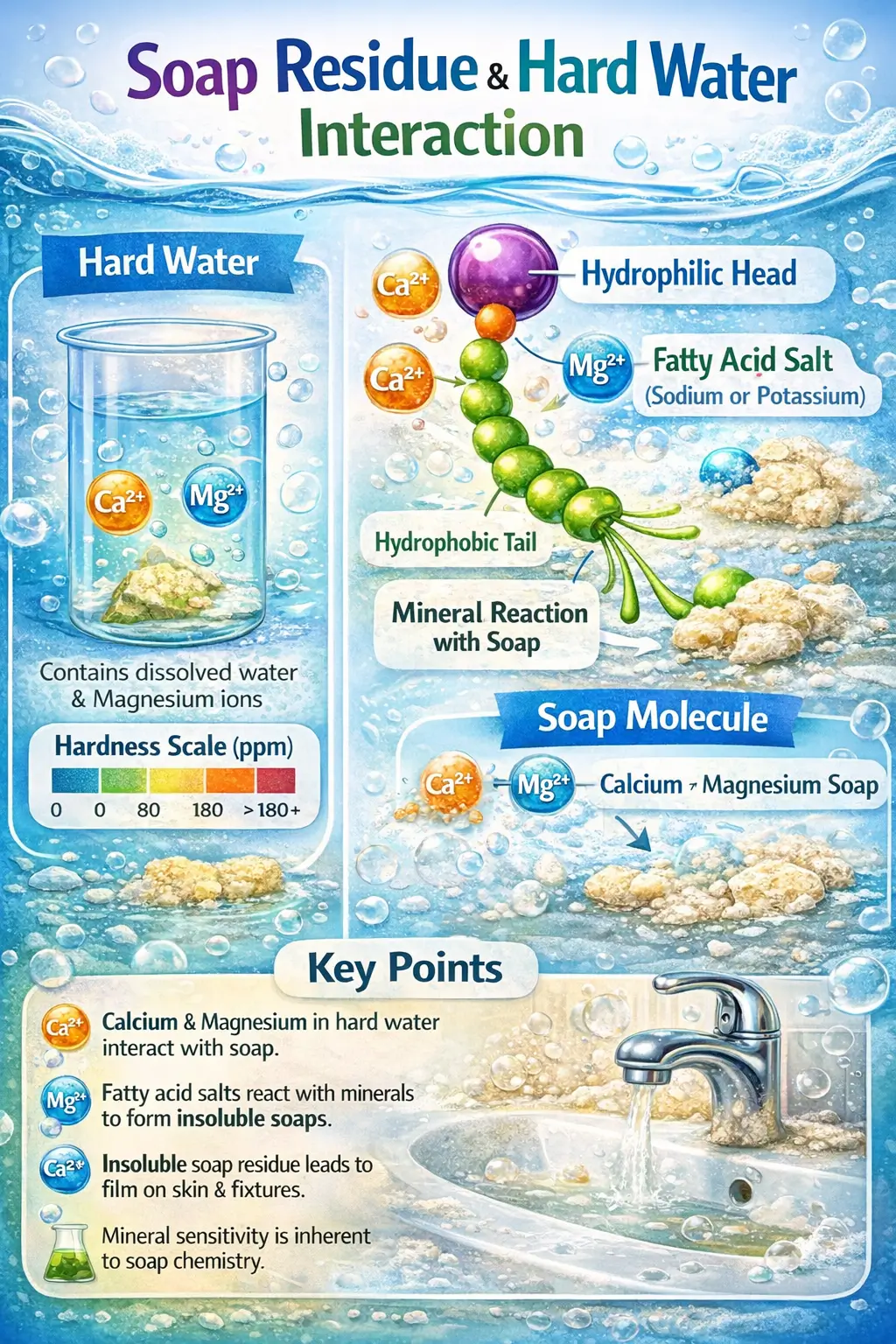
Hard water is characterized by elevated concentrations of dissolved calcium and magnesium ions, a system context defined more broadly in the soap and hard water interaction guide. These minerals originate from geological sources and vary widely across European regions depending on aquifer composition, surface water sourcing, and municipal treatment practices.
From a formulation perspective, water hardness is not a background variable but an active participant in cleansing behavior, interacting with soap systems as outlined in the broader soap and hard water interaction framework. The ions present are chemically reactive and capable of altering how surfactants behave once introduced into solution.
This distinction matters because soap systems, unlike many detergent systems, rely on ionic surfactants that readily interact with these minerals. The result is not reduced cleaning power in isolation, but a shift in how the system partitions between soluble and insoluble forms.
| Classification | Approximate Mineral Content | Household Prevalence |
|---|---|---|
| Soft | Low calcium and magnesium | Limited regions, treated supplies |
| Moderately Hard | Mixed mineral presence | Common across Europe |
| Hard | High mineral concentration | Widespread in limestone regions |
How Soap Interacts With Mineral Ions
Soap molecules are fatty acid surfactants (fatty acid salts) that remain soluble when paired with sodium or potassium ions. When introduced into hard water, calcium and magnesium ions compete for association with the fatty acid component.
This exchange produces calcium or magnesium soaps that are significantly less soluble, initiating the precipitation pathway described in soap scum formation chemistry. Once formed, these compounds no longer participate in micelle formation and instead separate from solution.
The process is not gradual but threshold driven. As mineral concentration rises, a point is reached where precipitation accelerates, often coinciding with visible changes in lather, slip, or surface film.
Residue Formation As A System Outcome
Residue associated with soap use in hard water environments is primarily composed of insoluble fatty acid salts the same mineral-bound compounds defined chemically in the formation of soap scum. These materials deposit on skin, fixtures, or textiles as water evaporates or drains away.
The appearance of residue is influenced by multiple interacting variables, including water temperature, rinse duration, soap concentration, and surface texture. No single factor alone determines whether deposits become visible.
Importantly, residue formation does not indicate that cleansing has failed. Instead, it reflects a redistribution of soap components driven by mineral chemistry and environmental conditions.
How Rinsing Dynamics Influence Residue Visibility
Rinsing is not a neutral final step in soap use but an active phase where dilution, solubility, and mineral interaction continue to evolve, as detailed in soap rinsing behavior and residue dynamics. In hard water conditions, the availability of calcium and magnesium ions remains unchanged during rinsing, even as soap concentration decreases.
As water flows across a surface, soluble soap components are removed first. Insoluble fatty acid salts formed through mineral interaction tend to remain, especially on textured surfaces or areas with slower water movement. This uneven removal contributes to patchy or streak-like residue patterns.
Short rinse durations, common in household handwashing or quick surface cleaning, increase the likelihood that these insoluble components persist, a pattern consistent with observations detailed in soap rinsing behavior and residue formation. The system has not stabilized before water removal occurs.
Water Temperature As A Modifying Factor
Temperature alters soap behavior indirectly by changing solubility and kinetic energy rather than chemical structure. Warmer water generally increases the mobility of soap molecules, improving dispersion and delaying precipitation under otherwise identical mineral conditions.
In colder water, commonly used for energy conservation across many European households, fatty acid salts exhibit reduced solubility. This shifts the precipitation threshold, making residue formation more likely at lower mineral concentrations.
The temperature effect is gradual rather than binary. Small changes can alter tactile perception and residue visibility without producing dramatic visual differences.
Concentration Thresholds And System Balance
Soap systems operate within a narrow concentration range where cleansing, solubility, and rinsability remain balanced. Outside this range, either through excessive dilution or high localized concentration, mineral interaction becomes more pronounced.
In refill or multi-use contexts, inconsistent dilution can create zones of higher soap concentration during initial contact, followed by rapid dilution during rinsing. This fluctuation favors precipitation during the transition phase rather than during active cleansing.
These threshold effects explain why residue may appear inconsistently even when the same soap is used under similar conditions.
| Variable | Lower Influence | Higher Influence |
|---|---|---|
| Rinse Duration | Extended rinsing | Rapid rinsing |
| Water Temperature | Warm | Cold |
| Surface Texture | Smooth | Porous or rough |
| Mineral Load | Low | High |
Why Residue Varies Between Households
Households supplied by the same municipal water source may still experience different residue outcomes. Pipe materials, local storage tanks, and seasonal water blending can subtly shift mineral composition at the point of use.
Usage habits further amplify variability. Differences in flow rate, rinsing patterns, and surface drying all affect whether insoluble soap components remain visible after use.
This variability often leads to incorrect assumptions about formulation changes or quality variation, when the underlying system remains unchanged.
Common Misinterpretations Of Soap Residue
Soap residue is frequently interpreted as incomplete rinsing, excessive product use, or poor formulation quality. These explanations focus on user behavior or product choice rather than system chemistry. In reality, residue formation in hard water environments is often unavoidable once specific mineral thresholds are crossed.
Another recurring misunderstanding involves associating residue with oils, fats, or added ingredients such as glycerin, a confusion that is especially common with mineral-containing bars like Lava soap formulations. While these components influence texture and feel, the dominant contributor to visible deposits remains mineral bound fatty acid salts formed during ion exchange.
These misinterpretations persist because residue appearance varies across households and surfaces, reinforcing the assumption that outcomes are user dependent rather than system driven.
Why Soap Formulations Cannot Eliminate Residue
Soap formulation is constrained by the chemistry of saponification. The same fatty acid salts responsible for cleansing also participate in precipitation reactions with hardness minerals. Altering this behavior fundamentally would require changing the nature of the soap system itself.
Additives can modify secondary characteristics such as bar hardness, lather quality, or rinse feel, but they cannot fully prevent calcium or magnesium from binding to fatty acid chains. Any apparent reduction in residue is typically contextual rather than structural.
This limitation explains why soap systems exhibit consistent mineral sensitivity across formulations despite variation in oil sources or processing methods.
Formulation boundaries are discussed further in our Ingredient Framework.
Boundary Conditions And System Limits
Soap residue behavior changes noticeably at system boundaries. Extremely soft water minimizes mineral interaction, while very hard water accelerates precipitation regardless of other variables. Between these extremes, small changes in temperature, flow, or concentration can shift outcomes.
Surfaces with high porosity or microtexture retain insoluble salts more readily than smooth materials. Drying conditions further influence whether deposits remain visible after use.
These boundary conditions explain why identical soap formulations can produce markedly different visual results without any change in composition.
Summary of Findings
- System Interaction: Soap residue arises from predictable chemical interaction between fatty acid salts and hardness minerals.
- Mineral Role: Calcium and magnesium ions drive precipitation, not oils or additives.
- Environmental Influence: Rinsing, temperature, and surface properties shape residue visibility.
- Formulation Limits: Soap systems cannot fully decouple cleansing from mineral sensitivity.
- Variability: Household and regional differences explain inconsistent residue outcomes.
Interpretations align with our Editorial Policy.
References
- Rosen, M. J. Surfactants and Interfacial Phenomena. Publisher Page
- Schramm, L. L. Surfactants: Fundamentals and Applications. Cambridge Reference
- OECD SIDS Reports – Fatty Acid Salts. OECD Chemical Assessment Portal
- European Commission – Drinking Water Quality Data. Official Resource