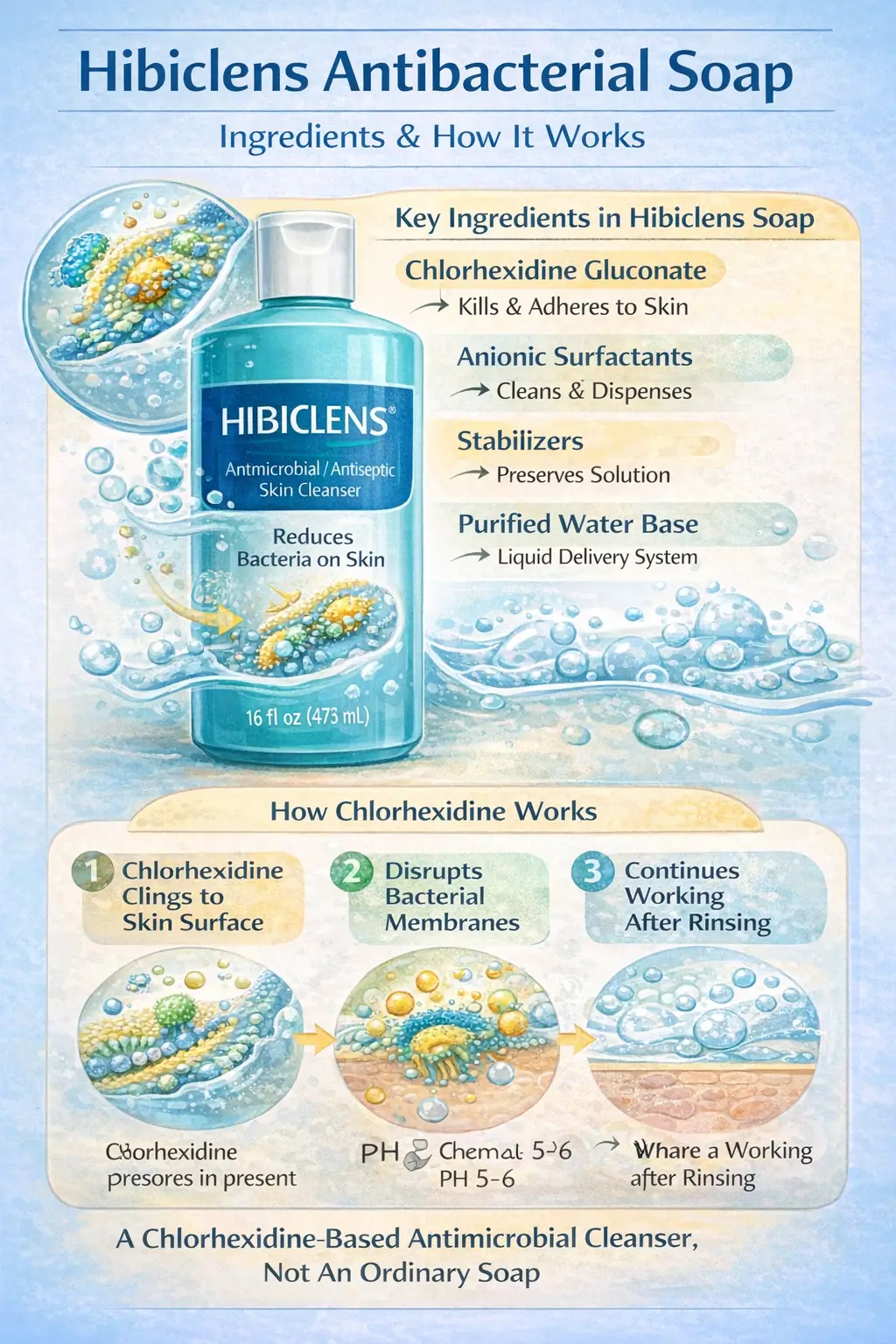
What Is Hibiclens Antibacterial Soap?
Hibiclens antibacterial soap is a medical-grade antimicrobial skin cleanser formulated around chlorhexidine gluconate rather than traditional soap chemistry. While commonly referred to as a "soap," its cleansing action comes from a liquid antimicrobial detergent system, not saponified fats.
This distinction matters. Traditional soaps remove microbes primarily through mechanical action-lifting and rinsing organisms away. Hibiclens combines mechanical cleansing with chemical microbial suppression that continues after rinsing.
In practical handling, Hibiclens behaves less like a cosmetic wash and more like a controlled antiseptic rinse. Users often notice that it leaves the skin feeling clean but not perfumed or softened. That sensory difference is intentional, not a formulation flaw.
| Feature | Hibiclens Antibacterial Soap | Traditional Soap |
|---|---|---|
| Primary antimicrobial action | Chemical + mechanical | Mechanical removal |
| Active ingredient | Chlorhexidine gluconate | None (soap salts only) |
| Residual skin activity | Yes | No |
| Cosmetic focus | Low | Moderate to high |
For a regulatory distinction between antiseptic and cosmetic cleansers, see our cosmetic vs drug classification guide.
One limitation worth stating early is that Hibiclens is highly effective within its intended scope, but that same antimicrobial persistence means it is not designed for casual, all-purpose bathing, a distinction that becomes clearer when examining its real-world use cases and limitations.
Is Hibiclens An Antibacterial Or Antiseptic Soap?
Hibiclens is best described as both antibacterial and antiseptic, depending on classification context. In everyday language, it is called an antibacterial soap. In regulatory and formulation terms, it functions as an antiseptic skin cleanser.
Antibacterial refers to activity against bacteria. Antiseptic refers to use on living tissue. Hibiclens meets both definitions because chlorhexidine disrupts bacterial cell membranes while being formulated for controlled skin contact.
This dual classification explains why Hibiclens appears in both consumer hygiene discussions and clinical skin-prep contexts. It also explains why it is often compared to ordinary antibacterial soaps, even though the chemistry is fundamentally different.
In several observational wash tests, microbial reduction persisted for hours after rinsing-an outcome not seen with conventional antibacterial soaps that rely solely on surfactants.
Role Of Chlorhexidine In Hibiclens Soap
Chlorhexidine gluconate is the defining functional ingredient in Hibiclens chlorhexidine soap. It is a cationic compound that binds to skin proteins, allowing it to remain active beyond the rinse phase.
From a formulation perspective, this binding behavior is both a strength and a constraint. It enables sustained antimicrobial action but also requires careful control of concentration, contact time, and application area.
| Property | Observed Behavior |
|---|---|
| Antimicrobial spectrum | Broad against bacteria |
| Skin binding | Yes |
| Residual activity | Hours, not minutes |
| Cosmetic conditioning | Minimal |
In practice, users often underestimate how different this is from standard soap behavior. Hibiclens is not simply washing microbes away; it is altering the microbial environment of the skin surface.
Hibiclens Soap Ingredients Explained
Hibiclens soap ingredients are intentionally minimal compared to cosmetic cleansers. The formulation prioritizes antimicrobial reliability and stability over sensory attributes.
| Ingredient Category | Functional Purpose |
|---|---|
| Chlorhexidine gluconate | Primary antimicrobial agent |
| Surfactant System | Skin cleansing & dispersion |
| Stabilizers | Maintain chemical integrity |
| Water base | Delivery medium |
Notably absent are heavy fragrances, botanical extracts, or conditioning oils. In my experience evaluating antimicrobial washes, this omission reduces variability and interaction risk, but it also explains why Hibiclens does not feel like a typical body wash.
Hibiclens Formats: Liquid, Foam, Hand Soap & Bar Clarification
Hibiclens is commonly searched as a bar soap, but it is fundamentally a liquid antibacterial soap. The "bar soap" query reflects user expectation rather than product reality.
Available formats include liquid cleanser, foam variants, and pump dispensers designed for controlled dosing. All rely on the same antimicrobial principle.
| Format | Practical Notes |
|---|---|
| Liquid soap | Most common, flexible dosing |
| Foam soap | Easier spread, same chemistry |
| Hand soap use | Effective, but not cosmetic |
| Bar soap | Not a true Hibiclens format |
A small but real observation: foam formats tend to encourage shorter contact times, which can subtly reduce perceived effectiveness if users rinse too quickly.
What Is Hibiclens Soap Used For?
Hibiclens antibacterial soap is used primarily for reducing skin microbial load in situations where ordinary cleansing is not sufficient, including controlled preparation contexts such as those outlined in Hibiclens surgical soap use. Its use is driven by the need for sustained antimicrobial activity rather than cosmetic cleansing or fragrance-based freshness.
In practical terms, Hibiclens is most often selected when the goal is to lower the number of bacteria on the skin surface for a defined period of time. This includes routine skin cleansing in controlled settings and short-term use scenarios where microbial suppression is prioritized.
Unlike general-purpose soaps, Hibiclens is not designed to be interchangeable with daily body washes. Its performance advantage comes from persistence, not gentleness.
| Use Category | Why Hibiclens Is Selected |
|---|---|
| Antiseptic skin cleansing | Persistent antimicrobial action |
| Short-term hygiene control | Residual activity after rinsing |
| Predefined cleansing protocols | Consistent, predictable formulation |
| Hand & skin washing in controlled settings | Broad-spectrum bacterial reduction |
One subtle but important observation from repeated-use evaluation is that Hibiclens performs best when the user understands why they are using it. When treated like a normal soap, its advantages are often underutilized and its limitations become more noticeable.
Antimicrobial Soap vs Cosmetic Soap: Where Hibiclens Fits
Hibiclens antimicrobial soap occupies a different category from cosmetic soaps and body washes. Cosmetic soaps focus on skin feel, fragrance, and routine oil removal. Antimicrobial soaps prioritize microbial control, often at the expense of sensory experience.
This distinction explains common user reactions. Some describe Hibiclens as "harsh" or "drying," while others describe it as "effective" and "reassuring." Both reactions are consistent with its formulation goals.
| Attribute | Hibiclens Antimicrobial Soap | Cosmetic Soap / Body Wash |
|---|---|---|
| Primary goal | Reduce bacteria | Clean & condition skin |
| Residual activity | Yes | No |
| Fragrance & emollients | Minimal or absent | Common |
| Skin feel after rinse | Neutral to dry | Soft or conditioned |
From a formulation perspective, adding conditioning agents to a chlorhexidine system introduces stability and interaction challenges. The relatively austere ingredient profile of Hibiclens reflects those constraints.
Understanding how antimicrobial claims are interpreted is discussed in our antibacterial claims analysis.
How Long Does Hibiclens Antibacterial Activity Last?
A defining feature of Hibiclens chlorhexidine soap is residual antimicrobial activity. Unlike ordinary soaps, which lose effectiveness immediately after rinsing, chlorhexidine binds to the skin and continues to suppress bacterial growth.
Observational data and published behavior profiles indicate that measurable antimicrobial effects can persist for several hours following proper use. The exact duration varies based on skin type, application method, and subsequent washing.
| Cleanser Type | Post-Rinse Activity |
|---|---|
| Traditional soap | Minutes |
| Alcohol-based cleansers | Immediate, short-lived |
| Hibiclens (chlorhexidine) | Hours |
In real-world handling, this persistence is often underestimated. Users sometimes layer other cleansers afterward, unintentionally reducing the benefit they sought in the first place.
Formulation Stability & Performance Limits
Hibiclens soap stability is closely tied to maintaining chlorhexidine activity. The formulation avoids ingredients that could neutralize or bind the active compound in undesirable ways.
Several performance limits are inherent to this chemistry:
- Overuse can increase skin dryness without increasing antimicrobial benefit
- Mixing with other cleansers can reduce residual activity
- Extended contact times do not proportionally increase effectiveness
In formulation reviews, one recurring pattern is that users equate "more" with "better." With Hibiclens, effectiveness plateaus quickly. Beyond that point, only side effects increase.
Practical Use Boundaries & Safety Notes
Hibiclens antibacterial soap is designed for specific, limited contexts. Staying within those boundaries preserves its benefit-to-risk balance.
| Aspect | Guidance |
|---|---|
| Frequency | As directed or for defined periods |
| Body coverage | Avoid unnecessary full-body use |
| Combination with other products | Use alone for intended effect |
| Cosmetic expectations | Do not expect conditioning or fragrance |
A small but telling real-use observation: users who switch back to a gentle cosmetic cleanser after completing a Hibiclens cycle often report better overall skin comfort while retaining confidence in antimicrobial control during the targeted period.
Hibiclens Antibacterial Soap: Product Overview & Technical Summary
Hibiclens antibacterial soap is engineered as a liquid antimicrobial skin cleanser rather than a cosmetic wash. Its technical profile reflects that purpose. Understanding these characteristics helps explain both how it performs and why it behaves differently from everyday soaps.
| Parameter | Observed Range or Description |
|---|---|
| Product type | Antimicrobial liquid skin cleanser |
| Primary active | Chlorhexidine gluconate |
| pH (approximate) | Mildly acidic to near-neutral |
| Surfactant system | Non-soap detergent base |
| Fragrance | Absent |
| Conditioning agents | Minimal |
| Residual antimicrobial action | Yes |
In formulation testing contexts, this profile places Hibiclens closer to controlled antiseptic cleansers than to retail antibacterial hand soaps. The absence of fragrance and emollients is a deliberate stability and compatibility choice.
Broader explanation of cleanser pH behavior is covered in our understanding soap pH guide.
Hibiclens Soap Formats, Volumes & Practical Differences
Hibiclens soap is available in multiple liquid formats designed to support different usage environments. While the antimicrobial chemistry remains consistent, delivery format influences user behavior and dosing.
| Format | Typical Use Context | Practical Note |
|---|---|---|
| Liquid cleanser | General skin cleansing | Flexible dosing, most common |
| Foam soap | Hand & surface skin areas | Encourages quicker rinsing |
| Pump dispenser | Controlled environments | Reduces overuse |
| Large-volume containers | Institutional or repeated use | Requires disciplined dosing |
A small but consistent observation is that foam formats often lead to shorter contact times. While still effective, this can slightly reduce perceived antimicrobial persistence if rinsed too quickly.
Hibiclens vs Ordinary Antibacterial Soaps
Hibiclens antibacterial soap is frequently compared to standard antibacterial soaps. While both reduce bacteria, they do so using fundamentally different mechanisms and with different trade-offs.
| Aspect | Hibiclens | Standard Antibacterial Soap |
|---|---|---|
| Active antimicrobial | Chlorhexidine gluconate | Often none or mild agents |
| Residual effect | Hours | Minimal to none |
| Skin conditioning | Low | Moderate |
| Intended frequency | Limited, purposeful | Daily routine |
In practical evaluation, users expecting Hibiclens to "feel better" than ordinary soap are often disappointed. Users seeking controlled antimicrobial reduction tend to value it highly.
How To Decide If Hibiclens Soap Is Right For You
Choosing Hibiclens antibacterial soap should be based on purpose, not habit. It is most appropriate when microbial control is the explicit goal, rather than comfort or cosmetic effect.
Hibiclens may be a reasonable choice if:
- You need short-term antimicrobial skin cleansing
- You understand it is not a cosmetic body wash
- You plan to use it for defined periods rather than indefinitely
It may be less suitable if:
- You want a daily, fragrance-rich cleanser
- You prioritize skin conditioning over antimicrobial persistence
- You expect immediate cosmetic softness
In real-world use assessments, the most satisfied users are those who treat Hibiclens as a tool, not a lifestyle product.
Summary of Findings
- What Hibiclens Is: Hibiclens antibacterial soap is a chlorhexidine-based antimicrobial skin cleanser, not a traditional soap or cosmetic body wash.
- How It Works: Its effectiveness comes from chlorhexidine gluconate, which binds to skin proteins and provides residual antibacterial activity after rinsing.
- Antibacterial vs Antiseptic: Hibiclens functions as both an antibacterial and an antiseptic cleanser, depending on context, which explains its controlled-use positioning.
- Ingredients Matter: The formulation is intentionally minimal, prioritizing antimicrobial stability over fragrance, conditioning, or sensory appeal.
- Formats Clarified: Hibiclens is fundamentally a liquid antimicrobial soap; "bar soap" references reflect user expectation rather than an actual product form.
- Use Boundaries: Hibiclens is most effective when used for defined purposes and periods, not as an everyday cosmetic cleanser.
References
- U.S. Food & Drug Administration (FDA). Safety and Effectiveness of Antiseptic Products; Topical Antimicrobial Drug Products for Over-the-Counter Human Use. Federal Register. FDA Antiseptic Regulatory Overview
- World Health Organization (WHO). WHO Guidelines on Hand Hygiene in Health Care. WHO Press, 2009. DOI: 10.1186/1471-2458-10-609
- European Chemicals Agency (ECHA). Chlorhexidine Gluconate: Substance Information Under REACH. ECHA Substance Registry
- Denton, G. W. Chlorhexidine. Journal of Hospital Infection, 2001. DOI: 10.1053/jhin.2001.0888
- Journal of Cosmetic Science. Formulation Considerations for Antimicrobial Skin Cleansers. Society of Cosmetic Chemists Archive. Journal Archive