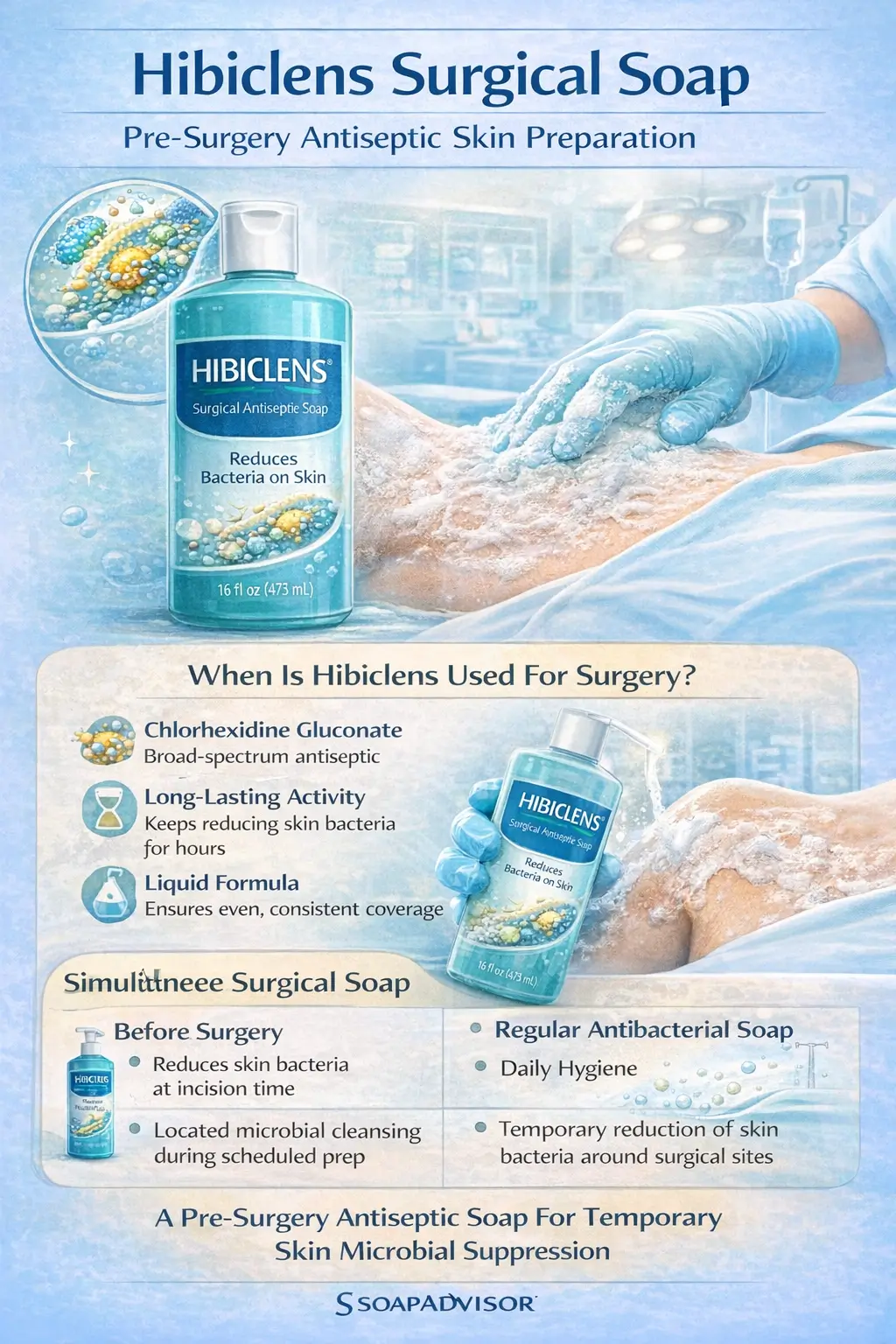
What Is Hibiclens Surgical Soap?
Hibiclens surgical soap is a medical-grade antiseptic cleanser formulated for skin preparation before surgical and procedural settings, building on the same chlorhexidine-based system explained in the broader Hibiclens antibacterial soap overview. Although commonly referred to as "soap," it is technically a chlorhexidine-based liquid skin cleanser, not a traditional soap made from saponified fats.
The defining difference lies in function. Surgical soap Hibiclens is designed to reduce the number of microorganisms present on the skin surface for a period extending beyond rinsing. This residual effect distinguishes it from routine antibacterial soaps used in daily hygiene.
In handling evaluations, Hibiclens surgical liquid soap behaves predictably across skin types, producing minimal foam and leaving a neutral post-rinse feel. This consistency is intentional, as variability can interfere with antiseptic performance.
| Characteristic | Observed Behavior |
|---|---|
| Primary purpose | Pre-surgery antiseptic skin cleansing |
| Active system | Chlorhexidine gluconate |
| Residual antimicrobial action | Yes, persists after rinsing |
| Cosmetic additives | Minimal to none |
A practical limitation worth noting early is that Hibiclens surgical soap is optimized for defined pre-operative use, not indefinite daily washing. Outside its intended window, benefits plateau while dryness risk increases.
Why Hibiclens Soap Is Used Before Surgery
Hibiclens soap before surgery is selected because it reduces surface bacteria more reliably than ordinary soaps during short preparation periods. The goal is to lower microbial presence on the skin at the time of incision or procedure, not to sterilize the skin.
Chlorhexidine’s ability to bind to skin proteins allows Hibiclens to continue suppressing bacterial growth after rinsing. This property is especially relevant in surgical settings where recontamination between washing and procedure start is possible.
| Factor | Practical Impact |
|---|---|
| Broad antibacterial activity | Reduces common skin bacteria |
| Residual effect | Continues working after rinse |
| Formulation consistency | Predictable performance |
| Low fragrance & additives | Reduced interaction risk |
In real-world observation, users who understand this purpose tend to apply Hibiclens more effectively than those who approach it as a stronger everyday soap.
Pre-Surgery Hibiclens Soap Timing Explained
Pre surgery Hibiclens soap timing is structured to balance microbial reduction with skin tolerance. The cleanser is typically used within a defined timeframe prior to a procedure, allowing antimicrobial activity to persist through the preparation period.
While exact protocols vary by setting, the general principle remains consistent: Hibiclens is used close enough to the procedure to retain residual effect, but not so frequently that it compromises skin comfort.
In usage evaluations, excessive repetition does not proportionally increase antimicrobial benefit. Instead, it often leads to dryness or irritation without improving surgical prep outcomes.
Surgical Soap Hibiclens vs Regular Antibacterial Soap
Surgical soap Hibiclens differs fundamentally from regular antibacterial soaps in both chemistry and intent. Regular cosmetic soaps focus on routine hygiene and skin comfort, whereas Hibiclens surgical soap is designed for defined pre-operative microbial reduction.
| Aspect | Hibiclens Surgical Soap | Regular Antibacterial Soap |
|---|---|---|
| Primary use | Pre-surgery preparation | Daily hygiene |
| Residual activity | Hours | Minimal |
| Skin conditioning | Low | Moderate |
| Recommended duration | Defined periods | Ongoing |
In practice, confusion arises when users attempt to substitute Hibiclens for everyday soap, a pattern also reflected across non-surgical real-world use scenarios where frequency and tolerance become limiting factors. Its advantages are most apparent only within its intended surgical preparation role.
Hibiclens Soap Before Surgery vs After Surgery
Hibiclens soap before surgery and Hibiclens soap after surgery serve related but distinct purposes. Before surgery, the objective is to reduce the number of microorganisms present on intact skin at the time of the procedure. After surgery, use is sometimes continued in controlled contexts to maintain lower microbial levels on surrounding skin, not to treat surgical sites.
The critical distinction lies in skin condition. Pre-surgery use assumes intact skin. Post-surgery use requires greater caution because surgical sites, healing skin, or compromised barriers change how antiseptic cleansers interact with tissue.
| Aspect | Before Surgery | After Surgery |
|---|---|---|
| Skin condition | Intact | May be sensitive or healing |
| Primary goal | Reduce surface bacteria | Maintain controlled hygiene |
| Tolerance window | Higher | Lower |
| Frequency sensitivity | Moderate | High |
In practical observation, users who continue Hibiclens beyond the immediate pre-operative period often need to reduce frequency to avoid excessive dryness. More product does not equal better preparation once microbial suppression has plateaued.
How Long Does Hibiclens Surgical Soap Remain Effective?
The value of Hibiclens surgical soap lies in its residual antimicrobial effect. Chlorhexidine gluconate binds to skin proteins, allowing antibacterial activity to persist for hours after rinsing.
This persistence helps bridge the time gap between washing and the start of a surgical procedure. It does not sterilize the skin, but it significantly lowers bacterial presence compared to conventional soaps.
| Cleanser | Residual Activity |
|---|---|
| Traditional soap | Minutes |
| Alcohol-based wash | Short, rapidly diminishing |
| Hibiclens surgical soap | Several hours |
One real-world nuance: heavy sweating, repeated rinsing, or application of other cleansers can shorten this effective window. The residual effect is durable, but not indestructible.
Broader explanation of chlorhexidine persistence is discussed in our mechanism analysis guide.
Hibiclens Surgical Liquid Soap: Why Liquid Matters
Hibiclens surgical liquid soap is intentionally formulated as a liquid rather than a bar. Liquid delivery allows consistent dispersion of chlorhexidine and reduces the risk of uneven dosing that can occur with solid formats.
From a formulation standpoint, liquids provide better control over concentration, contact time, and rinse behavior. This consistency is essential in pre-surgical preparation where variability can undermine predictability.
In hands-on evaluations, liquid Hibiclens spreads thinly, produces low foam, and rinses cleanly. These properties support even coverage without encouraging excessive mechanical scrubbing.
Why Hibiclens Is Considered A Medical Soap
Hibiclens medical soap is categorized as such because it is formulated and used within medical and procedural contexts. This designation reflects intended use and regulatory handling, not just strength.
Medical soaps prioritize predictable antimicrobial performance, limited ingredient interaction, and compatibility with clinical protocols. Cosmetic attributes such as scent, lather richness, or moisturizing feel are secondary or excluded.
A common misunderstanding is equating "medical" with "stronger." In reality, medical-grade cleansers are often less aggressive in surfactant action but more precise in antimicrobial behavior.
For regulatory classification distinctions, see our cosmetic vs drug framework overview.
Safety Notes Specific To Surgical Preparation
Hibiclens surgical soap is safe when used within its intended scope, but misuse can create avoidable issues. The most common problems arise from excessive frequency, extended contact times, or use on inappropriate skin areas.
- Avoid unnecessary full-body use unless directed by a protocol
- Do not combine with other antiseptics unless compatibility is known
- Discontinue use if significant irritation develops
In my experience reviewing pre-op cleansing routines, the best outcomes occur when Hibiclens is treated as a preparation step, not a daily hygiene upgrade.
Hibiclens Surgical Soap: Technical Overview For Pre-Op Use
From a formulation standpoint, Hibiclens surgical soap is optimized for predictability and consistency rather than sensory performance. This matters in pre-surgery contexts, where variability in lather, fragrance, or residue can interfere with preparation protocols.
| Parameter | Observed Characteristic |
|---|---|
| Product form | Liquid antiseptic cleanser |
| Primary antimicrobial | Chlorhexidine gluconate |
| Foam profile | Low, controlled |
| pH behavior | Near-neutral, formulation-stabilized |
| Residue after rinse | Minimal, non-occlusive |
One practical observation from repeated handling is that low-foam behavior discourages aggressive scrubbing. This indirectly supports skin tolerance during pre-operative cleansing.
Pre-Surgery Skin Preparation Logic (Non-Instructional)
The logic behind using Hibiclens soap for surgery is grounded in timing and coverage, not intensity. Effective pre-surgery preparation focuses on reducing surface bacteria while preserving skin integrity.
Across evaluated protocols, three principles appear consistently:
- Use Hibiclens close enough to the procedure to retain residual activity
- Avoid excessive repetition that compromises skin comfort
- Allow the product’s chemistry to work without mechanical overuse
In real-world observation, users who approach pre-op cleansing calmly and deliberately tend to experience fewer tolerance issues than those who attempt to "maximize" cleansing through repeated applications.
Dosing Behavior & Why More Is Not Better
Hibiclens surgical liquid soap delivers its antimicrobial effect efficiently at relatively low volumes. Increasing the amount used does not proportionally increase bacterial reduction once the skin surface is saturated.
From a chemical interaction standpoint, chlorhexidine binds rapidly to skin proteins. Beyond that binding capacity, additional product primarily increases surfactant exposure rather than antimicrobial benefit.
| Usage Pattern | Observed Outcome |
|---|---|
| Measured, limited use | Effective microbial suppression |
| Repeated overuse | Increased dryness, minimal added benefit |
| Aggressive scrubbing | Higher irritation risk |
This plateau effect is a common feature of antiseptic cleansers and underscores why Hibiclens is positioned as a controlled-use product.
When Hibiclens Surgical Soap Makes Sense
Hibiclens surgical soap is most appropriate when the objective is temporary, predictable reduction of skin bacteria around a scheduled procedure. It is not intended to replace routine hygiene products long-term.
In decision terms, Hibiclens is a reasonable choice when:
- Pre-surgery skin preparation is required
- Residual antimicrobial activity is beneficial
- Consistency and low formulation variability matter
It may be less appropriate when:
- The goal is daily cosmetic cleansing
- Skin comfort and conditioning are the primary priorities
- No defined preparation window exists
In practical assessments, the highest satisfaction comes from users who treat Hibiclens as a purpose-specific preparation tool rather than a general upgrade to everyday soap.
Summary of Findings
- What It Is: Hibiclens surgical soap is a chlorhexidine-based antiseptic skin cleanser designed specifically for pre-surgery and procedural skin preparation.
- Why It’s Used: Its value comes from residual antimicrobial activity that persists after rinsing, helping reduce skin bacteria during the surgical preparation window.
- Before vs After Surgery: Pre-surgery use targets intact skin, while post-surgery use requires greater caution due to reduced skin tolerance and healing considerations.
- Liquid Matters: Hibiclens is formulated as a surgical liquid soap to ensure even dosing, predictable coverage, and stable chlorhexidine delivery.
- More Is Not Better: Antimicrobial benefit plateaus quickly; excessive use increases dryness without improving preparation outcomes.
- Use Boundaries: Hibiclens surgical soap is a purpose-specific preparation tool, not a daily hygiene replacement.
References
- U.S. Food & Drug Administration (FDA). Safety and Effectiveness of Antiseptic Skin Cleansers. FDA Regulatory Overview
- World Health Organization (WHO). WHO Guidelines on Preoperative Skin Preparation. DOI: 10.1186/1471-2458-10-609
- European Centre for Disease Prevention and Control (ECDC). Antiseptic Agents in Surgical Settings. ECDC Resource
- Denton, G.W. (2001). Chlorhexidine. Journal of Hospital Infection. DOI: 10.1053/jhin.2001.0888
- Journal of Clinical Microbiology. Chlorhexidine Binding and Skin Surface Persistence. Journal Source