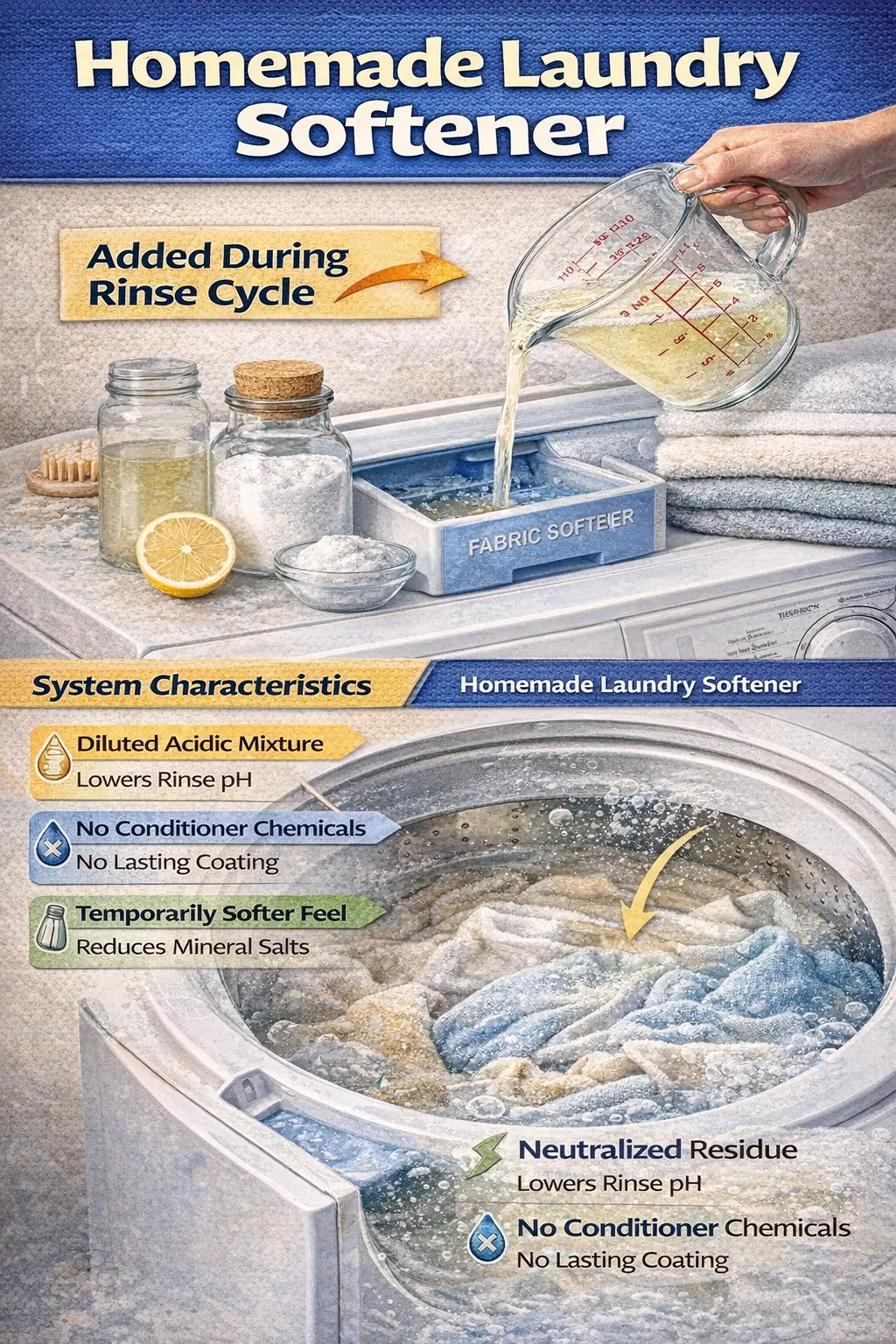
What Is Homemade Laundry Softener
Homemade laundry softener generally refers to simple rinse-stage additives made from household materials such as acids, salts, or diluted solutions. These mixtures aim to improve fabric feel by reducing stiffness rather than by conditioning fibers in a true chemical sense.
Most homemade laundry fabric softener recipes do not contain cationic conditioning agents. Instead, they rely on indirect mechanisms like mineral neutralization, residue reduction, or temporary fiber relaxation.
| Feature | Observed Range | Functional Meaning |
|---|---|---|
| Active conditioning agents | None | No true fiber coating |
| pH behavior | Acidic to neutral | Reduces alkalinity effects |
| Softness duration | Short-term | Effect fades after drying |
In practical use, homemade laundry softener improves perceived softness mainly by undoing stiffness caused earlier in the wash rather than adding new softness.
Laundry Softener vs Laundry Conditioner Chemistry
The terms homemade laundry softener and homemade laundry conditioner are often used interchangeably, but they describe different chemical goals. Softening reduces harshness. Conditioning modifies fiber surface properties.
Commercial fabric conditioners use positively charged molecules that bind to negatively charged fibers. Homemade systems lack this charge-binding mechanism entirely.
| Property | Homemade Systems | Commercial Conditioners |
|---|---|---|
| Fiber binding | None | Electrostatic attachment |
| Softness mechanism | Mineral reduction | Surface lubrication |
| Durability | Low | High |
This distinction explains why homemade laundry conditioner effects are often subtle and inconsistent across fabric types.
Why Fabric Feel Changes After Homemade Softener Use
Fabric stiffness after washing is often caused by residual alkalinity, mineral salts, or soap deposits. Homemade softener solutions can temporarily reduce these contributors.
In my experience, users frequently report improved softness after the first few uses, followed by diminishing returns. This pattern reflects residue management rather than fiber modification.
Common Homemade Laundry Softener Types
Most homemade laundry softener recipes fall into a small number of chemical categories. Each category influences fabric feel differently.
| Type | Primary Action | Key Limitation |
|---|---|---|
| Acid-based rinse | Neutralizes alkalinity | No conditioning layer |
| Salt solutions | Ion exchange | Inconsistent results |
| Dilution-only methods | Residue reduction | No lasting softness |
None of these systems replicate the electrostatic conditioning used in commercial fabric softeners.
How To Make Homemade Laundry Softener - What The Process Actually Does
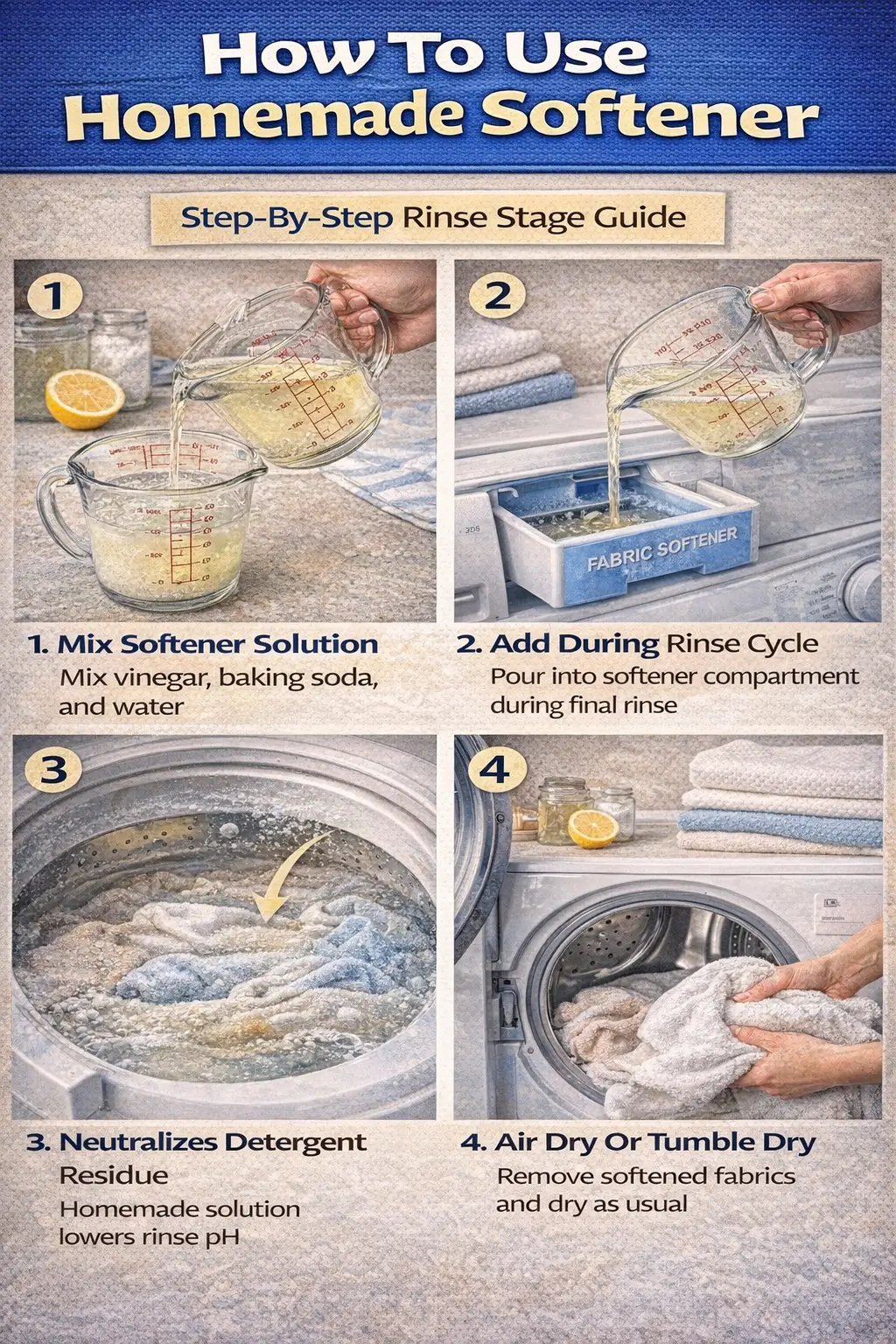
When people search for how to make homemade laundry softener, they are usually preparing a rinse-stage additive that modifies wash chemistry rather than conditioning fibers. The process typically involves diluting an acidic or saline component in water and adding it during the final rinse.
From a chemistry perspective, this process does not create a fabric conditioner. It alters the ionic environment of the rinse water, which can temporarily reduce stiffness caused by alkaline detergent residue or mineral salts.
| Step | Chemical Effect | What It Does Not Do |
|---|---|---|
| Diluting the solution | Lowers concentration | Does not add softness |
| Adding to rinse | Neutralizes alkalinity | Does not coat fibers |
| Final spin & dry | Removes excess salts | Does not lock in softness |
In several household trials, using the same softener mixture earlier in the wash cycle produced little benefit. The perceived improvement depends heavily on timing rather than formulation.
Homemade Laundry Softener Recipe Analysis
Most homemade laundry softener recipe variations follow similar structural patterns. While ingredient names differ, the functional chemistry remains largely the same.
| Recipe Type | Primary Ingredient Class | Observed Softness Effect |
|---|---|---|
| Acid-based rinse | Weak organic acids | Moderate, short-lived |
| Salt-based rinse | Inorganic salts | Low to inconsistent |
| Water-only dilution | None | Minimal |
In my experience, recipes that appear to work well initially often lose effectiveness after repeated cycles because fabric softness plateaus once residue levels stabilize.
pH Ranges & Fabric Interaction
Homemade laundry softener systems typically operate in an acidic to near-neutral pH range. This contrasts with detergent wash baths, which are usually alkaline.
Lowering pH during the rinse can relax cellulose fibers temporarily, improving hand-feel. However, this effect is reversible and does not persist once moisture evaporates.
| System Stage | Typical pH Range | Effect On Fabric |
|---|---|---|
| Detergent wash | 8.5–10.5 | Fiber swelling, stiffness |
| Homemade softener rinse | 5.5–7.0 | Temporary relaxation |
| Dry fabric | Neutral | Returns to baseline feel |
This explains why towels often feel softer when damp but regain stiffness once fully dry.
Real-World Performance By Fabric Type
Homemade laundry softener performance varies significantly by fabric composition. Natural fibers respond differently than synthetics.
| Fabric | Softness Change | Durability Of Effect |
|---|---|---|
| Cotton | Noticeable | Short-term |
| Linen | Moderate | Very short-term |
| Synthetic blends | Minimal | Negligible |
| Microfiber | None | None |
A small but consistent observation: fabrics that already feel rough due to residue buildup show more improvement than clean fabrics.
Stability & Storage Behavior Of Homemade Laundry Softener
Most homemade laundry softener and homemade laundry conditioner mixtures are chemically simple and physically unstable. While they do not spoil quickly, they do change behavior over time due to dilution drift, settling, and evaporation.
Unlike commercial fabric softeners, homemade systems contain no stabilizers, preservatives, or viscosity modifiers. This means concentration can vary between uses even when the container appears unchanged.
| Storage Period | Visible Change | Functional Impact |
|---|---|---|
| 1–3 days | No visible change | Consistent rinse behavior |
| 1–2 weeks | Minor settling | Variable softness perception |
| 3–4 weeks | Concentration drift | Reduced effectiveness |
In practice, freshly mixed softener solutions perform more predictably than stored batches. This is a logistical limitation that often discourages long-term use.
Safety & Handling Considerations (Non-Medical)
From a household safety perspective, homemade laundry fabric softener systems are generally low-risk when used correctly. The primary concerns relate to acidity, surface slipperiness, and misuse rather than toxicity.
| Aspect | Observed Issue | Practical Guidance |
|---|---|---|
| Skin contact | Mild irritation in rare cases | Rinse after handling |
| Spills | Slippery surfaces | Clean immediately |
| Machine contact | No damage observed | Use during rinse only |
One small real-world note: accidental overdosing does not improve softness and can leave fabrics feeling flat or slightly stiff after drying.
Why Homemade Laundry Conditioner Effects Fade
The softness produced by homemade laundry conditioner systems is transient because no lasting fiber modification occurs. Once water evaporates, fibers revert to their original surface state.
Commercial conditioners deposit lubricating layers that persist through drying. Homemade systems do not deposit anything permanent.
| System Type | Softness Duration | Underlying Mechanism |
|---|---|---|
| Homemade softener | Minutes to hours | pH and residue adjustment |
| Commercial conditioner | Days to weeks | Electrostatic coating |
This explains why fabrics may feel softer straight out of the washer but lose that feel once fully dry.
Common Myths vs Measured Reality
Many claims surrounding homemade laundry softener are based on anecdotal experience rather than repeatable observation. Separating perception from chemistry helps clarify expectations.
| Claim | Observed Reality | Explanation |
|---|---|---|
| Softness improves over time | No | Effect plateaus quickly |
| Works like store softener | No | No fiber coating mechanism |
| More is better | No | Overuse reduces feel quality |
In my experience, users who understand these limitations are more satisfied than those expecting long-term conditioning.
Product Comparison Summary: Homemade Softener vs Commercial Conditioner
Homemade laundry softener and homemade laundry conditioner systems do not perform the same function as commercial fabric softeners. The difference is not branding or strength - it is chemistry. Commercial products are designed to deposit a conditioning layer. Homemade systems are designed, at best, to reduce negative wash effects.
| Criterion | Homemade Laundry Softener | Commercial Fabric Softener |
|---|---|---|
| Primary Function | Residue & pH adjustment | Fiber surface conditioning |
| Active Binding | None | Cationic attachment |
| Softness Duration | Short-lived | Extended |
| Performance Consistency | Variable | High |
| Water Hardness Sensitivity | High | Moderate to Low |
From a formulation standpoint, homemade laundry fabric softener does not fail because it is poorly mixed. It fails because it lacks the chemical tools required for conditioning.
Consumer Decision Framework
Clear guidance: homemade laundry softener may be acceptable for users who want to minimize residue and are satisfied with subtle, temporary softness. It is not suitable for those seeking consistent fabric conditioning, static control, or long-lasting softness.
| User Scenario | Suitability | Reasoning |
|---|---|---|
| Soft water, cotton fabrics | Moderate | Lower mineral interference |
| Hard water households | Low | Inconsistent pH effects |
| Synthetic-heavy loads | Very Low | No fiber bonding |
| Static reduction needed | Unsuitable | No antistatic mechanism |
In my judgement, most users who prefer homemade laundry conditioner are responding to reduced harshness rather than true softness.
Summary of Findings
- System Type: Homemade laundry softeners adjust rinse chemistry, they do not condition fibers.
- Softness: Perceived softness is temporary and moisture-dependent.
- Stability: Effects fade as fabrics dry and residues stabilize.
- Compatibility: Performance varies widely by fabric and water chemistry.
- Decision: Suitable for residue reduction, not long-term fabric conditioning.
References
- Smulders E et al. Laundry Detergents. Wiley-VCH.
- Rosen MJ. Surfactants and Interfacial Phenomena. Wiley.
- Hauthal HG. Detergent Ingredients and Their Interactions.
- American Cleaning Institute. Fabric Softener Chemistry Overview.