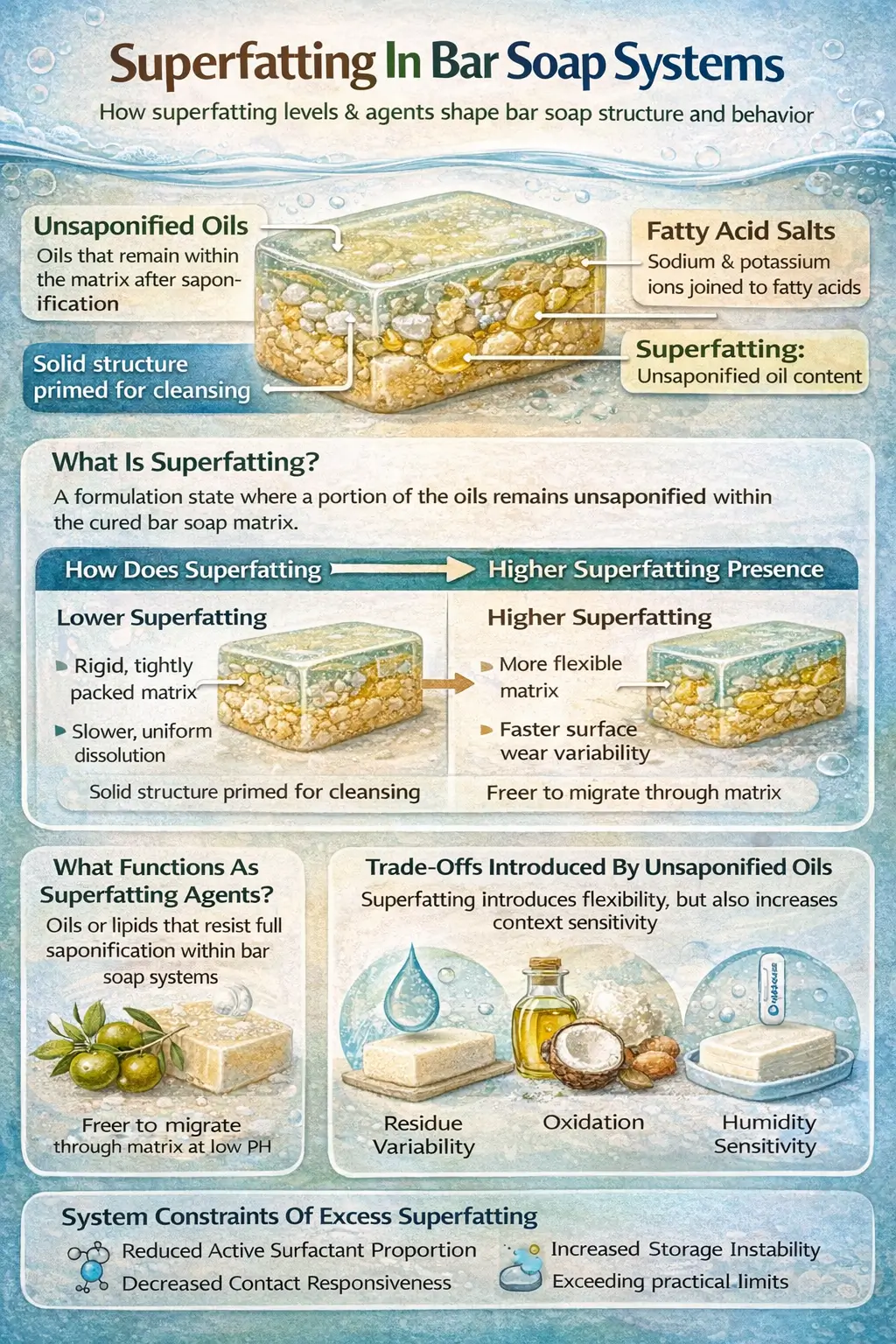
What Superfatting Means In Soap Systems
In a bar soap system, superfatting describes the condition where a portion of the oils present in the formulation does not convert into fatty acid surfactants. These unsaponified components remain embedded within the solid matrix after curing.
Superfatting is not an additive step applied after formulation. It emerges from how oils, alkali, and reaction completion are balanced during system design. Whether intentional or incidental, superfatting alters how the soap matrix organizes and interacts with water during use.
A common misunderstanding is that superfatting represents a separate ingredient category. In practice, it is a state of the system rather than a discrete component.
Similar misinterpretations appear when comparing soap systems with synthetic cleansers, as discussed in the Soap vs Syndet Cleansers Guide.
How Superfatting Level Influences Soap Behavior
Superfatting level in soap making refers to the proportion of oil that remains unsaponified relative to the total formulation. As this level changes, the balance between fatty acid salts and free oils shifts.
At lower levels, unsaponified oils may be distributed thinly within the matrix, exerting limited influence on hardness or dissolution. As the proportion rises, the soap structure becomes more interrupted, altering wear rate and rinsing behavior.
Small changes in superfatting level can sometimes produce noticeable differences in surface feel or residue, particularly in hard water environments where mineral interaction is already present, as described in the Soap and Hard Water Interaction Guide.
What Functions As A Superfatting Agent
Superfatting agents are oils or lipid materials that remain unsaponified within the soap matrix, consistent with the ingredient roles and fatty-acid classifications explained in the Soap Ingredients Guide. Their behavior depends not only on chemical identity but also on how readily they integrate into or separate from the crystalline soap structure.
Oils commonly discussed as best oils for superfatting soap are typically those that resist rapid saponification or remain mobile within the matrix after curing. Their contribution is structural, influencing lubrication and internal phase separation rather than cleansing chemistry.
The presence of these agents introduces trade-offs. While they can moderate bar rigidity and surface interaction, they also increase sensitivity to storage conditions and oxidation over time.
Superfatting Behavior Across Usage Contexts
Superfatting does not behave identically across all environments. Water composition, storage conditions, and use patterns influence how unsaponified oils interact with the soap matrix over time. The table below summarizes commonly observed contextual shifts without implying control or optimization.
| Contextual Factor | Typical System Response | Interpretation Risk |
|---|---|---|
| Hard Water Regions | Increased interaction with mineral-bound soap residues | Misattributed to excessive oil or formulation imbalance |
| High Humidity Storage | Surface oil migration or sheen development | Interpreted as spoilage rather than matrix redistribution |
| Cold Water Use | Slower surfactant release with more visible oil influence | Assumed reduction in cleansing effectiveness |
| Frequent Wet-Dry Cycles | Uneven surface wear and localized oil concentration | Seen as inconsistent formulation performance |
These contextual responses illustrate why superfatting outcomes should be interpreted as system interactions rather than fixed formulation attributes.
Why Superfatting Exists As A Formulation Design Choice
Superfatting exists because bar soap systems operate at the intersection of chemistry and solid-state structure. Achieving complete conversion of all oils into fatty acid salts is neither always practical nor structurally optimal for every bar format.
From a formulation perspective, allowing a controlled portion of oils to remain unsaponified introduces flexibility into an otherwise rigid crystalline matrix. This flexibility can moderate brittleness, influence surface interaction, and affect how the bar responds to repeated wetting and drying.
Importantly, superfatting is not added to improve a single outcome. It represents a compromise between structural integrity, wear behavior, and long-term stability within the constraints of soap chemistry.
Structural Trade-Offs Introduced By Superfatting
Introducing unsaponified oils into a bar soap system alters how fatty acid salts pack and crystallize. These oils occupy spaces within the matrix that would otherwise be filled by soap crystals, changing internal cohesion.
As superfatting level increases, the bar may exhibit reduced hardness and faster surface wear. At the same time, internal lubrication can increase, affecting how the bar glides across surfaces during use.
These changes are not universally positive or negative. They represent trade-offs that must be balanced against water quality, expected contact duration, and storage conditions.
Boundary Conditions Where Superfatting Behavior Changes
The effects of superfatting become more pronounced at system boundaries. In hard water regions, unsaponified oils can interact indirectly with mineral-bound soap residues, altering surface feel and visibility of deposits.
High humidity environments introduce another boundary condition. Free oils within the matrix can migrate more readily under warm, moist storage conditions, changing surface appearance over time without altering formulation chemistry.
These boundary behaviors explain why identical superfatting levels may appear stable in one context and variable in another.
Common Misinterpretations Around Superfatting
Superfatting is frequently interpreted as an enhancement added for a specific benefit. This framing obscures its role as a structural adjustment rather than a functional upgrade.
Another common misunderstanding is equating higher superfatting levels with better formulation quality. In practice, excessive unsaponified oil can destabilize the bar, shorten shelf life, or increase variability between uses.
These interpretations persist because the effects of superfatting are subtle, context dependent, and easily conflated with unrelated formulation factors.
Long-Term Stability And Storage Effects
Superfatting influences not only immediate bar behavior but also how the system evolves over time. Unsaponified oils remain chemically distinct from fatty acid salts and respond differently to oxygen exposure, temperature variation, and humidity.
Over extended storage, these oils may oxidize or migrate within the bar matrix, subtly changing surface appearance or scent without altering the underlying cleansing mechanism. These changes are often attributed to formulation failure when they instead reflect expected system aging.
The rate at which these effects appear varies widely. Oil type, matrix density, and environmental conditions all interact, making long-term behavior inherently variable across otherwise similar formulations.
System Constraints And Design Limits
Superfatting operates within defined chemical limits. Because bar soap systems depend on fatty acid salts for cleansing, increasing unsaponified oil beyond a certain threshold reduces the proportion of active surfactant available during use.
At higher levels, this shift can lead to uneven dissolution, increased residue formation in mineralized water, or reduced structural integrity. These outcomes mark the boundary where superfatting transitions from structural adjustment to system imbalance.
These constraints explain why superfatting levels are treated as a design variable within the broader structural logic described in the Soap vs Detergent Formulation Guide.
Superfatting Role And System Effects Summary
The table below summarizes how superfatting interacts with key aspects of bar soap formulation. It links superfatting level and agent behavior to observable system outcomes without implying optimization targets or usage guidance.
| System Aspect | Lower Superfatting Presence | Higher Superfatting Presence |
|---|---|---|
| Bar Structure | More rigid, tightly packed matrix | More interrupted, flexible matrix |
| Wear Behavior | Slower, more uniform dissolution | Faster surface wear variability |
| Water Interaction | Soap-dominant rinsing behavior | Increased oil influence during rinsing |
| Environmental Sensitivity | Lower sensitivity to humidity | Greater response to heat and moisture |
Summary of Findings
- System State: Superfatting describes the presence of unsaponified oils within a bar soap matrix.
- Design Variable: Superfatting level in soap making adjusts structure and wear, not cleansing chemistry.
- Agent Role: Superfatting agents function as internal modifiers rather than active surfactants.
- Trade-Offs: Increased superfatting introduces flexibility alongside stability constraints.
- Context Dependence: Environmental conditions strongly influence how superfatting effects appear.
References
- Rosen, M. J. Surfactants and Interfacial Phenomena. Publisher Reference
- Schramm, L. L. Surfactants: Fundamentals and Applications. Cambridge University Press
- OECD SIDS Initial Assessment Reports – Fatty Acid Salts. OECD Chemical Portal
- European Commission Cosmetic Ingredient Database (CosIng). Official Database