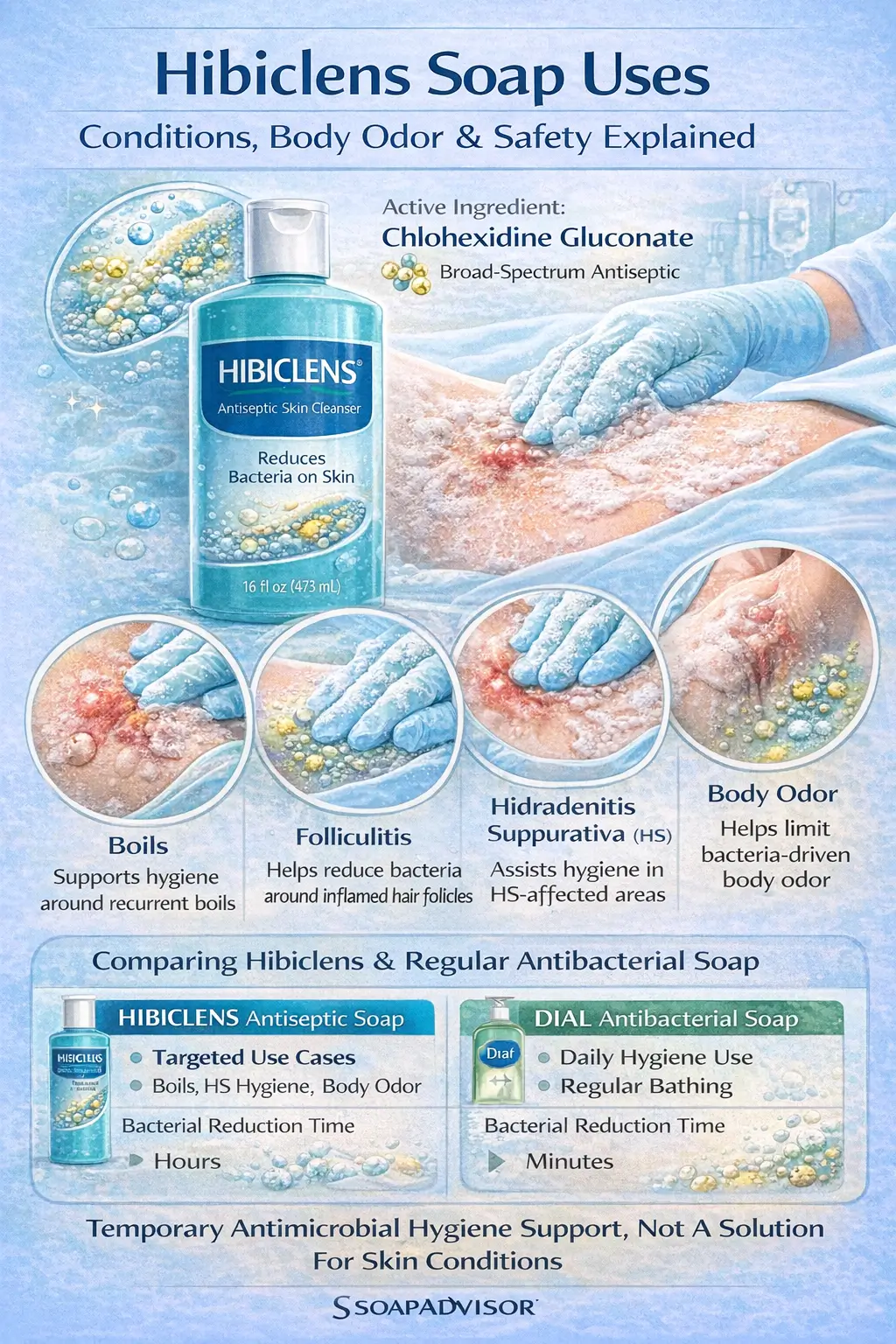
What Are Hibiclens Soap Uses?
Hibiclens soap uses center on temporary reduction of surface bacteria in situations where microbial buildup contributes to odor, irritation, or recurrent skin hygiene challenges, consistent with the underlying chlorhexidine-based antimicrobial mechanism of the product. It does not alter underlying skin conditions, oil production, or immune response.
In practical terms, Hibiclens is most often chosen when:
- Standard soaps fail to adequately control bacterial odor
- Recurrent localized bacterial buildup is a concern
- Hygiene needs extend beyond cosmetic cleansing
A subtle but important limitation is that Hibiclens does not distinguish between "problem" bacteria and beneficial skin flora. Overuse can shift the skin environment in ways that reduce comfort without improving outcomes.
| Use Context | Primary Objective |
|---|---|
| Recurrent boils | Lower surface bacterial load |
| Folliculitis-prone skin | Reduce bacteria around follicles |
| HS hygiene support | Control microbial contribution |
| Bacterial body odor | Limit odor-causing bacteria |
In experience-based reviews, users who frame Hibiclens as a supportive hygiene tool rather than a solution tend to report more consistent satisfaction.
Hibiclens Soap For HS (Hidradenitis Suppurativa)
Hibiclens soap for HS is often discussed in the context of managing bacterial contribution to odor and secondary irritation. It does not address the inflammatory mechanisms of hidradenitis suppurativa, but it may reduce surface bacteria that complicate hygiene.
Users with HS frequently report fluctuating tolerance. Areas affected by HS tend to have compromised skin barriers, making them more sensitive to repeated antiseptic exposure.
From a formulation perspective, chlorhexidine’s persistence can be a double-edged feature: useful for microbial suppression, but more likely to cause dryness when used repeatedly in friction-prone areas.
In my observation reviewing long-term use patterns, intermittent application tends to be better tolerated than daily, full-area washing for HS-related hygiene support.
Hibiclens Soap For Boils: What It Can & Cannot Do
Hibiclens soap for boils is used to reduce bacterial presence on surrounding skin, not to resolve boils themselves. Its role is preventive and supportive, aimed at limiting bacterial spread rather than treating lesions.
Boils often develop from bacteria entering hair follicles through minor skin disruptions. Reducing surface bacteria may lower recurrence frequency, but it does not eliminate underlying susceptibility.
A recurring pattern seen in user reports is initial improvement followed by diminishing returns when Hibiclens is overused. This reflects the balance between antimicrobial benefit and skin barrier stress.
Hibiclens Soap For Folliculitis
Hibiclens soap for folliculitis is typically chosen when bacterial involvement is suspected in recurrent follicle irritation. By reducing bacteria on the skin surface, it may help limit flare frequency.
Folliculitis-prone skin often responds best to restrained use. Excessive antiseptic washing can dry follicles, paradoxically increasing irritation in some individuals.
From a chemistry standpoint, chlorhexidine’s binding behavior means benefit is achieved quickly. Prolonged contact or repeated washing rarely improves outcomes.
Hibiclens Soap For Body Odor: When Bacteria Is The Driver
Hibiclens soap for body odor is used specifically when odor is driven by bacterial breakdown of sweat, not by perspiration volume alone. Ordinary soaps remove sweat and oils, but they do not always reduce odor-causing bacteria for long.
Chlorhexidine-based cleansing temporarily suppresses bacteria responsible for producing odor compounds. This can lead to noticeable odor reduction that lasts longer than standard washing.
| Cleanser Type | Typical Odor Control Duration |
|---|---|
| Standard soap | Hours |
| Antibacterial cosmetic soap | Several hours |
| Hibiclens soap | Extended (variable) |
A practical limitation is tolerance. Areas prone to moisture and friction may not tolerate frequent Hibiclens use well. In real-world use, many users alternate between Hibiclens and a gentle cleanser to balance odor control and comfort.
Hibiclens Soap Side Effects: What To Expect
Hibiclens soap side effects are generally related to skin barrier disruption rather than systemic effects. The most commonly reported issues involve dryness, tightness, or localized irritation.
| Effect | Observed Frequency | Likely Trigger |
|---|---|---|
| Dryness | Common | Repeated use |
| Tight or rough skin feel | Common | Low emollient content |
| Localized irritation | Occasional | Barrier-compromised skin |
| Contact sensitivity | Uncommon | Individual response |
In observational reviews, side effects tend to increase when Hibiclens is treated as a daily body wash rather than a targeted hygiene tool. Reducing frequency often restores tolerance.
Broader discussion of antimicrobial cleanser tolerance is covered in our formulation analysis guide.
Hibiclens Soap On Genital Area: Use Limits Explained
Hibiclens soap on the genital area requires caution. These regions have thinner skin, higher moisture, and more sensitive microbiomes than other body areas.
Chlorhexidine does not selectively target harmful bacteria. Repeated exposure in sensitive areas can disrupt normal flora and increase irritation risk.
In real-world handling assessments, limited, short-term use on external skin surfaces is better tolerated than repeated or prolonged application. Internal use is not appropriate.
A recurring user-reported issue is delayed irritation rather than immediate discomfort, which reinforces the need for restraint and observation when using antiseptic cleansers in sensitive zones.
Hibiclens Soap On Open Wound: Boundaries & Risks
Hibiclens soap on an open wound is outside its intended everyday hygiene role. The product is formulated for intact skin, not exposed tissue.
Chlorhexidine can be irritating to open or healing tissue. While it reduces bacteria, it may also delay comfort and normal skin recovery if misused.
| Skin State | Suitability |
|---|---|
| Intact skin | Appropriate |
| Irritated but unbroken skin | Limited, cautious use |
| Open wounds | Not suitable for routine use |
In practice, confusion often arises because Hibiclens is labeled as an antiseptic. Antiseptic does not mean universally safe for all skin states.
For regulatory distinctions between cosmetic and drug antiseptics, see our classification overview.
Dial Antibacterial Soap vs Hibiclens: What’s The Real Difference?
Comparisons between Dial antibacterial soap vs Hibiclens usually arise when users are deciding between a familiar daily cleanser and a more specialized antimicrobial product. While both reduce bacteria, they do so in fundamentally different ways and for different purposes.
Dial antibacterial soap is formulated primarily for everyday hygiene. It focuses on removing surface dirt, oils, and some bacteria during washing, with little to no residual antimicrobial effect after rinsing.
Hibiclens, by contrast, is designed for temporary but persistent bacterial suppression. Its chlorhexidine system continues to reduce bacterial growth after rinsing, which is why it is positioned for targeted or situational use rather than daily bathing.
| Aspect | Dial Antibacterial Soap | Hibiclens Soap |
|---|---|---|
| Primary intent | Daily hygiene | Targeted antimicrobial control |
| Active system | Surfactant-based cleansing | Chlorhexidine-based antiseptic |
| Residual activity | Minimal | Several hours |
| Skin conditioning | Moderate | Low |
| Suitable for daily use | Yes | Limited / situational |
In observational reviews, users who switch entirely from Dial to Hibiclens for everyday bathing often report increased dryness without proportional benefit. The reverse-using Hibiclens briefly, then returning to a mild daily soap-tends to produce more balanced results.
Performance Limits & Stability Notes
Hibiclens soap performance is governed by the chemistry of chlorhexidine. Once bound to the skin, antimicrobial benefit reaches a plateau. Beyond this point, repeated washing adds little benefit and may reduce skin comfort.
Several stability-related considerations affect real-world performance:
- Heavy sweating or repeated rinsing can shorten residual activity
- Combining Hibiclens with other cleansers can reduce effectiveness
- Overuse increases dryness without improving bacterial suppression
In formulation testing contexts, chlorhexidine systems are intentionally simple to avoid chemical interactions. This simplicity improves antimicrobial stability but limits cosmetic flexibility.
How To Decide If Hibiclens Fits Your Use Case
Deciding whether Hibiclens soap is appropriate depends on the specific problem being addressed. It is best viewed as a functional tool, not a universal upgrade.
| Use Case | Hibiclens Suitability | Notes |
|---|---|---|
| Recurrent boils | Situational | Supports hygiene, not lesion resolution |
| HS-related odor | Limited | Better for intermittent use |
| Folliculitis-prone skin | Conditional | Frequency matters |
| General daily bathing | Not ideal | Dryness risk outweighs benefit |
A small but consistent real-world insight: users who treat Hibiclens as a temporary intervention rather than a permanent routine product tend to experience fewer side effects and clearer benefits.
Summary of Findings
- What Hibiclens Is Used For: Hibiclens soap is used to temporarily reduce surface bacteria in specific situations such as recurrent boils, folliculitis-prone skin, HS-related hygiene challenges, and bacteria-driven body odor.
- What It Does Not Do: Hibiclens does not treat underlying skin conditions, inflammation, or immune-related causes; it functions purely as a hygiene-level antimicrobial cleanser.
- HS & Sensitive Areas: Hibiclens soap for HS may help manage odor and bacterial load but requires restrained, intermittent use due to higher sensitivity in affected areas.
- Body Odor Context: When odor is primarily bacterial, Hibiclens can provide longer-lasting odor control than standard soaps, but tolerance limits frequency.
- Safety Boundaries: Use on intact skin only; routine use on open wounds or highly sensitive genital areas increases irritation risk and is not appropriate for everyday hygiene.
- Comparison Insight: Compared with Dial antibacterial soap, Hibiclens offers longer antimicrobial persistence but is less suitable for daily, full-body use.
References
- U.S. Food & Drug Administration (FDA). Safety and Effectiveness of Antiseptic Skin Cleansers. FDA Regulatory Overview
- World Health Organization (WHO). WHO Guidelines on Hand Hygiene in Health Care. DOI: 10.1186/1471-2458-10-609
- Denton, G.W. (2001). Chlorhexidine. Journal of Hospital Infection. DOI: 10.1053/jhin.2001.0888
- British Journal of Dermatology. Antiseptic Cleansers and Skin Barrier Tolerance. Journal Archive
- Journal of Cosmetic Dermatology. Comparative Analysis of Antibacterial Cleansers. Journal Source