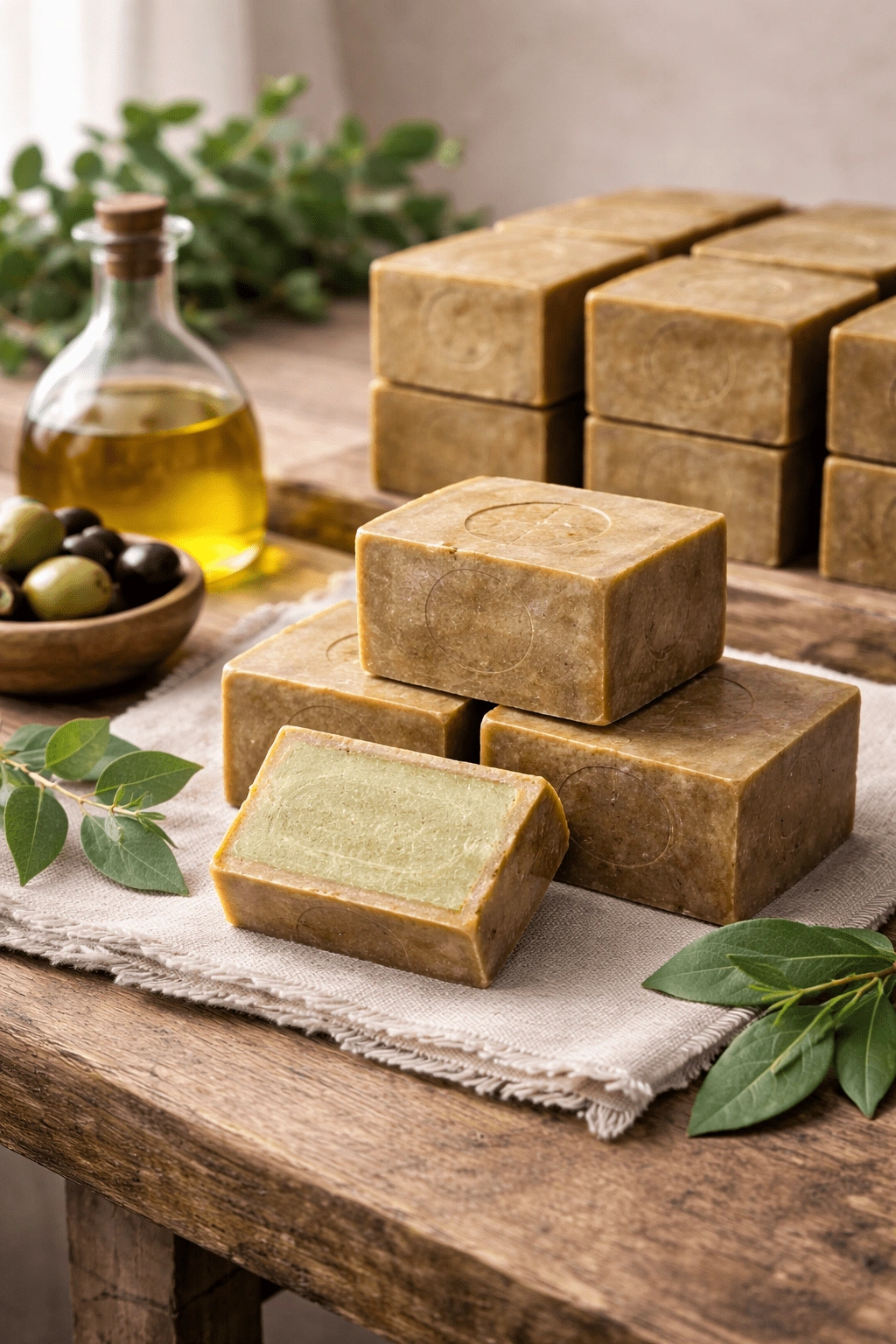
Aleppo Soap Ingredients: What They Do & What They Don’t
Aleppo soap ingredients are intentionally limited, usually consisting of olive oil, laurel oil, water, and an alkaline agent consumed during saponification. This simplicity is often cited as a benefit, but it is only meaningful when paired with realistic expectations about soap chemistry.
Olive oil provides the bulk of the soap structure. It contributes mild cleansing, a dense bar texture, and slow dissolution. Laurel oil, by contrast, modifies cleansing strength, firmness, and sensory sharpness depending on its percentage.
| Ingredient | Typical Range | Observed Functional Role |
|---|---|---|
| Olive Oil | 60–90% | Mild cleansing, bar longevity |
| Laurel Oil | 5–40% | Cleansing intensity, firmness |
| Water | Evaporates during curing | Processing medium |
A small real-use observation: two soaps with identicalingredient lists can behave very differently if their curing times differ. Cure duration quietly influences hardness, lather control, and tolerance.
Understanding "Benefits" In A Soap Context
The phrase "health benefits of Aleppo soap" appears frequently, but soap benefits are functional rather than therapeutic. Aleppo soap benefits primarily relate to cleansing efficiency, reduced ingredient complexity, and predictable wear over time.
In practical terms, users often describe benefits as: less residue, fewer added inputs, and consistent performance. These outcomes are not guaranteed for everyone and depend on matching laurel oil percentage to actual usage frequency.
| Benefit Category | What Users Notice | Key Limitation |
|---|---|---|
| Cleansing | Efficient oil removal | Can feel drying |
| Simplicity | Few ingredients | Less formulation buffering |
| Longevity | Slow bar wear | Requires dry storage |
A restrained conclusion helps: Aleppo soap is beneficial when its limitations are understood, not when it is treated as universally gentle or corrective.
Laurel Oil vs Olive Oil: Benefit Trade-Offs
Laurel oil benefits in Aleppo soap are often overstated. While laurel increases cleansing strength and firmness, it also raises the likelihood of dryness with frequent use. Olive oil counters this by softening the overall cleansing profile.
In observational use, lower-laurel soaps feel more forgiving across repeated washes, while higher-laurel soaps behave more like targeted cleansers. Neither approach is inherently better; suitability depends on how often and where the soap is used.
| Aspect | Olive Oil Dominant | Laurel Oil Dominant |
|---|---|---|
| Cleansing Feel | Gentler | Stronger |
| Daily Tolerance | Higher | Lower |
| Bar Hardness | Moderate | High |
One limitation worth stating plainly: no laurel percentage eliminates the need for technique adjustment and moderation.
Aleppo Soap For Sensitive Skin: Where It Helps & Where It Fails
Aleppo soap for sensitive skin is often chosen because of its short ingredient list, but sensitivity does not respond only to ingredient count. It responds to cleansing force, contact duration, and recovery time between washes.
In practical observation, soaps with lower laurel oil percentages (typically under 15%) tend to feel more predictable on sensitive skin. Higher laurel concentrations increase cleansing efficiency, but also raise the chance of post-rinse tightness or surface irritation when used frequently.
| Laurel Oil % | Short-Term Feel | Repeat-Use Tolerance | Suitability |
|---|---|---|---|
| 5–10% | Soft, calm | High | Most sensitive users |
| 15–20% | Clean, slightly taut | Moderate | Intermittent use |
| 30%+ | Very clean, dry | Low | Usually unsuitable |
A subtle but recurring pattern: users who report good tolerance often reduce lather time rather than reducing frequency. Technique matters more than switching bars.
Baby Aleppo Soap Benefits: Practical Limits & Use Boundaries
Baby Aleppo soap benefits are usually framed around ingredient simplicity. While fewer additives reduce exposure risk, soap alkalinity remains a factor regardless of age.
In observed use, very low-laurel formulations (often under 5%) behave more gently, but even these require careful handling. Short contact time and thorough rinsing are essential.
| Aspect | Observation | Practical Guidance |
|---|---|---|
| Cleansing Strength | Mild at low laurel % | Use sparingly |
| Skin Response | Variable | Monitor dryness |
| Frequency | Less is better | Not daily for all infants |
A conservative conclusion: Aleppo soap may suit occasional baby cleansing, but it does not replace gentler non-soap options in all cases.
Aleppo Soap For Face: Benefits, Drawbacks & Usage Reality
Aleppo soap for face use delivers efficient oil removal and leaves little residue. This characteristic is often described as a benefit, though it comes with trade-offs.
On facial skin, lower laurel soaps tend to perform more consistently. Higher laurel levels increase cleansing force, but repeated daily use frequently results in tightness.
| Use Pattern | Observed Benefit | Observed Limitation |
|---|---|---|
| Short contact, low laurel | Clean feel, low residue | Needs moisturization |
| Long contact, high laurel | Strong oil removal | Dryness risk |
A micro real-use note: facial tolerance improves noticeably when Aleppo soap is not used in both morning and evening routines.
Aleppo Soap For Acne: Functional Context Without Medical Claims
Aleppo soap for acne is often discussed as a corrective solution. In functional terms, its benefit lies in surface cleansing as described in the soap cleansing mechanism guide, not treatment.
Users with congestion-prone skin often report a cleaner surface feel and reduced oil buildup. However, excessive dryness from overuse can counteract these benefits.
| Usage Style | Common Outcome | Risk |
|---|---|---|
| Moderate frequency | Balanced oil feel | Needs follow-up care |
| High frequency | Initial clarity | Rebound dryness |
In practice, Aleppo soap works best as one part of a restrained routine, not as a sole intervention.
Antibacterial Aleppo Soap: Claim vs Functional Reality
Antibacterial Aleppo soap is a common search phrase, but Aleppo soap does not contain regulated antibacterial agents. Its cleansing action is mechanical rather than targeted.
Laurel oil contributes to assertive cleansing, which may be interpreted as antibacterial behavior, but this should not be confused with disinfecting action.
| Function | Aleppo Soap | Antibacterial Products |
|---|---|---|
| Microbe Removal | Physical rinse-off | Chemical inhibition |
| Added Actives | None | Present |
Interpreting Aleppo soap as antibacterial risks misuse and unrealistic expectations.
Aleppo Soap For Hair: Cleansing Behavior, Benefits & Limits
Aleppo soap for hair behaves very differently from liquid shampoos. As a true soap, it relies on alkaline cleansing rather than surfactant systems. This distinction explains both the benefits some users experience and the adjustment difficulties others report.
In observed use, Aleppo soap removes scalp oils efficiently, often leaving hair strands feeling lighter after rinsing. However, the same mechanism can also lead to roughness, particularly in hard water conditions where soap residue forms more easily, a behavior examined in the soap and hard water interaction guide.
| Factor | Observed Effect | Practical Impact |
|---|---|---|
| Alkaline Cleansing | Strong oil removal | May increase dryness |
| Water Hardness | Residue formation | Dull or coated feel |
| Cure Quality | Stable lather | More predictable results |
A real-use observation: hair outcomes improve when Aleppo soap is used intermittently rather than as a daily shampoo replacement.
Aleppo Soap Benefits For Hair Growth: What The Claim Really Means
Aleppo soap benefits for hair growth are often described indirectly. Soap itself does not stimulate hair growth, but it can influence scalp conditions that affect hair appearance.
In functional terms, Aleppo soap may reduce heavy buildup on the scalp, which some users associate with improved hair manageability. This is a surface-level effect rather than a biological change.
| Claimed Benefit | Functional Reality | Limitation |
|---|---|---|
| Improved Growth | Cleaner scalp feel | No growth stimulation |
| Reduced Shedding | Less residue-related breakage | Water & technique dependent |
A careful interpretation helps avoid disappointment: Aleppo soap may support a cleaner scalp environment, but it does not alter hair growth cycles.
Olive Oil vs Laurel Oil Benefits In Hair Use
In hair applications, olive oil and laurel oil play distinct roles. Olive oil-based soap tends to feel milder, while laurel oil increases cleansing strength. The balance between the two determines scalp comfort.
Lower laurel formulations generally feel easier to rinse from hair, whereas higher laurel soaps can leave hair squeaky if not followed by thorough rinsing.
| Dominant Oil | Scalp Feel | Hair Texture After Drying |
|---|---|---|
| Olive Oil | Balanced | Softer, sometimes flat |
| Laurel Oil | Very clean | Drier, more textured |
In mixed routines, alternating Aleppo soap with other cleansers often produces more consistent hair comfort.
Variant-Based Benefit Claims: Ghar, Neem, Alum & Branded Soaps
Variant-based benefit claims expand significantly when additional materials are introduced, including traditional pairings explored in the Aleppo soap and alum stone guide. Terms such as ghar soap, neem Aleppo soap, or alum stone combinations often suggest enhanced performance.
In practice, these variants modify cleansing feel rather than fundamentally changing soap behavior. Added components typically influence scent, firmness, or perceived freshness.
| Variant Type | Claimed Benefit | Observed Effect |
|---|---|---|
| Ghar Soap | Traditional strength | Higher cleansing force |
| Neem Aleppo Soap | Purifying feel | Stronger scent, dryness risk |
| Alum Stone Pairing | Freshness | Astringent sensation |
A practical judgement: additional ingredients tend to narrow suitability rather than broaden it.
Branded Aleppo Soap Benefit Claims: How To Interpret Them
Brand-associated terms such as "doctor," "extra," or "premium" often imply performance advantages. However, Aleppo soap behavior remains governed by oil ratios, curing, and handling.
In comparative use, differences between brands are usually subtle unless formulation ratios differ meaningfully.
| Label Term | What It Suggests | What Actually Matters |
|---|---|---|
| Extra / Xtra | Stronger cleansing | Laurel oil % |
| Doctor / Dr | Special formulation | Curing & usage |
| Premium | Higher quality | Consistency & age |
A consistent finding: labels rarely outperform technique and moderation.
Aleppo Soap Spiritual & Cultural Benefits: Context Without Claims
References to "Aleppo soap spiritual benefits" often blending tradition, personal meaning, and cultural continuity. From a research perspective, these benefits are experiential rather than functional. They arise from ritual, routine, and the perceived simplicity of use rather than measurable formulation effects.
In households where Aleppo soap has been used for generations, the act of using the same bar for body, hair, and household tasks carries symbolic weight. This continuity can create a sense of calm and familiarity that users describe as grounding. The benefit here is not chemical; it is contextual.
| Interpretation | What It Represents | What Is Actually Happening |
|---|---|---|
| Purity | Minimal ingredients | Reduced formulation complexity |
| Balance | Ritual consistency | Predictable cleansing behavior |
| Tradition | Cultural continuity | Long-established soapmaking method |
A light author judgement: these interpretations matter to users, but they should not be mistaken for performance guarantees.
Aleppo Soap Side Effects: Why They Happen & How To Reduce Them
Aleppo soap side effects are usually predictable once soap chemistry is understood. The most common issues dryness, tightness, or surface roughness stem from alkaline cleansing behavior explained in the soap pH interpretation guide combined with frequent use or high laurel oil content.
In real-world observation, side effects rarely appear suddenly. They tend to accumulate over days as the skin’s surface oils are repeatedly removed faster than they are replenished.
| Side Effect | Primary Trigger | Reduction Strategy |
|---|---|---|
| Dryness | High laurel %, frequent use | Lower % or alternate days |
| Tightness | Long contact time | Shorten lather duration |
| Rough hair feel | Hard water residue | Intermittent hair use |
One practical insight: many users resolve side effects by changing how they use the soap, not by abandoning it altogether.
Safety Boundaries & Non-Medical Use Precautions
Aleppo soap is a cleansing product, not a treatment. Safe use depends on respecting its strength and avoiding over-application. The soap does not require special handling, but it benefits from conservative use.
Areas with thinner skin-such as around the eyes or scalp edges-are more sensitive to repeated alkaline exposure. Limiting contact in these areas improves comfort.
| Use Aspect | Guideline | Reasoning |
|---|---|---|
| Contact Time | 10–40 seconds | Prevents over-cleansing |
| Frequency | Adjust to tolerance | Limits cumulative dryness |
| Eye Area | Avoid direct application | Higher sensitivity zone |
A limitation worth stating clearly: Aleppo soap is not suitable for every skin or hair type, and discontinuation is sometimes the most appropriate choice.
Handling, Storage & Stability Notes
Proper storage extends the life of Aleppo soap and preserves its performance. Because the bar continues to lose moisture slowly over time, exposure to air between uses is beneficial.
In humid environments, insufficient drying can soften the bar and reduce longevity. A ventilated soap dish noticeably improves wear consistency.
| Storage Method | Observed Effect | Recommendation |
|---|---|---|
| Ventilated dish | Slower dissolution | Preferred |
| Standing water | Softening | Avoid |
| Dry storage between uses | Extended bar life | Ideal |
A final micro observation: older, well-dried bars tend to feel gentler over time, even when laurel percentage remains unchanged.
Product Comparison & Selection Guidance
Choosing Aleppo soap is less about chasing the highest stated benefit and more about matching formulation strength to actual use. When buyers align laurel oil percentage, curing quality, and usage frequency, satisfaction rates increase markedly.
| Primary Goal | Laurel Oil Range | Expected Benefit | Primary Side Effect Risk |
|---|---|---|---|
| Sensitive skin & baby use | ≤10% | Gentler cleansing, predictability | May feel under-cleansing |
| Daily face cleansing | 10–15% | Balanced oil removal | Needs moisturization |
| Occasional deep cleanse | 20–30% | Stronger surface cleansing | Dryness with overuse |
| Targeted, infrequent use | 30–40% | High cleansing efficiency | Low daily tolerance |
A restrained selection insight: most users benefit more from lowering frequency than from increasing laurel oil percentage.
Product Label Information: What Helps & What Misleads
Labels often highlight benefit-oriented terms such as "antibacterial," "extra," or ingredient additions. In practice, Aleppo soap performance remains governed by oil ratios, cure duration, and handling.
| Label Element | Decision Value | Why |
|---|---|---|
| Laurel Oil % | High | Directly affects cleansing strength |
| Curing Time | High (often undisclosed) | Influences hardness & tolerance |
| Added Ingredients | Moderate | Changes scent & feel more than function |
| Marketing Descriptors | Low | Rarely change core behavior |
Summary of Findings
- Benefits Are Functional: Aleppo soap benefits relate to cleansing efficiency, simplicity, and longevity-not therapy.
- Laurel Oil Drives Outcomes: Higher percentages increase cleansing strength and side-effect risk.
- Sensitive Use Requires Restraint: Low laurel, short contact, and adjusted frequency matter more than brand.
- Hair Claims Are Indirect: Cleaner scalp feel does not equal hair growth stimulation.
- Side Effects Are Predictable: Dryness and tightness usually reflect overuse, not defects.
References
- Journal of Surfactants and Detergents – Soap Cleansing Mechanisms
- International Journal of Cosmetic Science – Soap pH & Skin Interaction
- European Commission CosIng Database – Ingredient Functional Profiles
- Regulation (EC) No 1223/2009 – Cosmetic Safety Framework