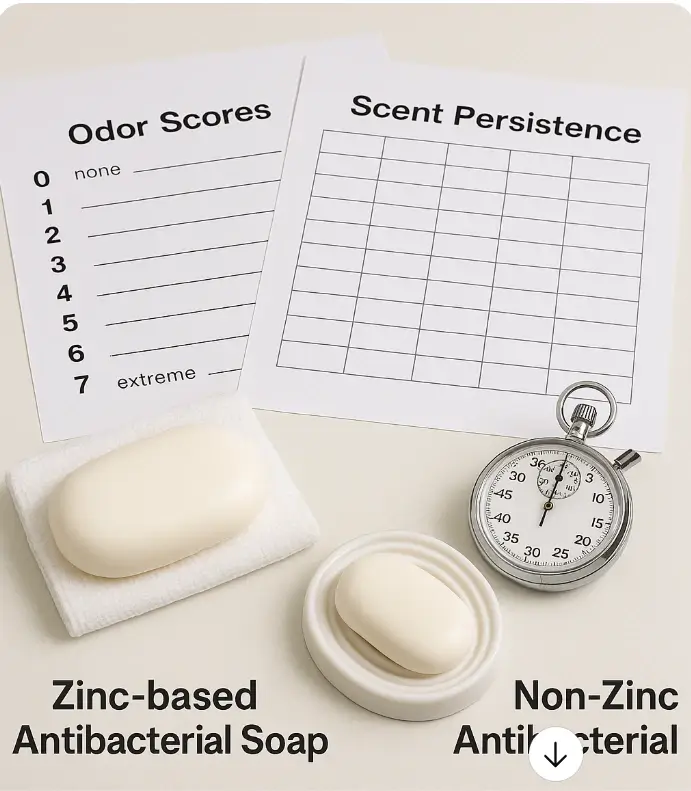
Protocol #5: Zinc vs Non-Zinc Deodorizing Effectiveness Test
This protocol compares how zinc-based antibacterial soaps and traditional non-zinc antibacterial soaps perform in preventing and reducing real-world foot odor under controlled daily-use conditions. It does not claim medical outcomes; it observes practical deodorizing performance over time.
Zinc soaps often contain zinc pyrithione, zinc ricinoleate, or zinc carbonate, which neutralize volatile odor compounds differently compared to non-zinc antibacterial soaps that rely on triclocarban alternatives, benzalkonium chloride, or essential oil blends. This protocol measures which class performs better in realistic odor conditions.
Objective
To evaluate deodorizing power, scent stability, and odor suppression duration of zinc-based vs non-zinc soaps across repeated daily use periods.
What This Test Reveals
- Whether zinc formulas maintain stronger odor-neutralization activity
- How long deodorizing effects last after washing
- Which soap maintains scent better across the day
- How residue and skin feel differ between the two families
Equipment Needed
- Zinc-based antibacterial soap
- Non-zinc antibacterial soap
- Odor scoring card (0–5 scale)
- Timer
- Wash basin or shower setup
- Two identical microfiber towels
- Daily log sheet
Procedure
- Apply zinc soap to one foot and non-zinc soap to the other (left/right randomized).
- Use identical washing time: 15 seconds lather + 20 seconds rinse.
- Air-dry using separate microfiber towels.
- Record odor levels:
- Immediately after washing
- After 4 hours
- After 8 hours
- Repeat for 7–10 consecutive days.
- Record scent persistence, dryness, residue feel, and any soap texture changes.
- Compile results into comparison charts.
Workbook: Zinc vs Non-Zinc Observation Charts
| Property | Zinc-Based Soap | Non-Zinc Soap |
|---|---|---|
| Soap Type | ||
| Texture | ||
| Initial Scent Strength (0–5) | ||
| Foam Behavior |
| Day | Zinc – Immediately | Zinc – 4 Hours | Zinc – 8 Hours | Non-Zinc – Immediately | Non-Zinc – 4 Hours | Non-Zinc – 8 Hours |
|---|---|---|---|---|---|---|
| 1 | ||||||
| 2 | ||||||
| 3 | ||||||
| 4 | ||||||
| 5 | ||||||
| 6 | ||||||
| 7 |
| Metric | Zinc-Based Soap | Non-Zinc Soap |
|---|---|---|
| Scent Strength After Wash | ||
| Scent Strength After 4 Hours | ||
| Scent Strength After 8 Hours | ||
| Overall Scent Stability |
Download Workbook Files (Protocol 5)
You can download all templates used in this protocol for personal testing, data recording, and research reproducibility.
Download Complete Workbook (ZIP)
📦 Download Full Workbook (ZIP)Example Results (Demonstration Only)
This dataset shows a typical real-world pattern: zinc soaps maintain lower odor scores for longer periods.
| Day | Zinc (8h) | Non-Zinc (8h) |
|---|---|---|
| 1 | 1.4 | 2.9 |
| 2 | 1.3 | 3.0 |
| 3 | 1.2 | 3.2 |
| 4 | 1.1 | 3.1 |
| 5 | 1.0 | 3.3 |
| 6 | 1.1 | 3.2 |
| 7 | 1.0 | 3.4 |