What HE Laundry Detergent Actually Means
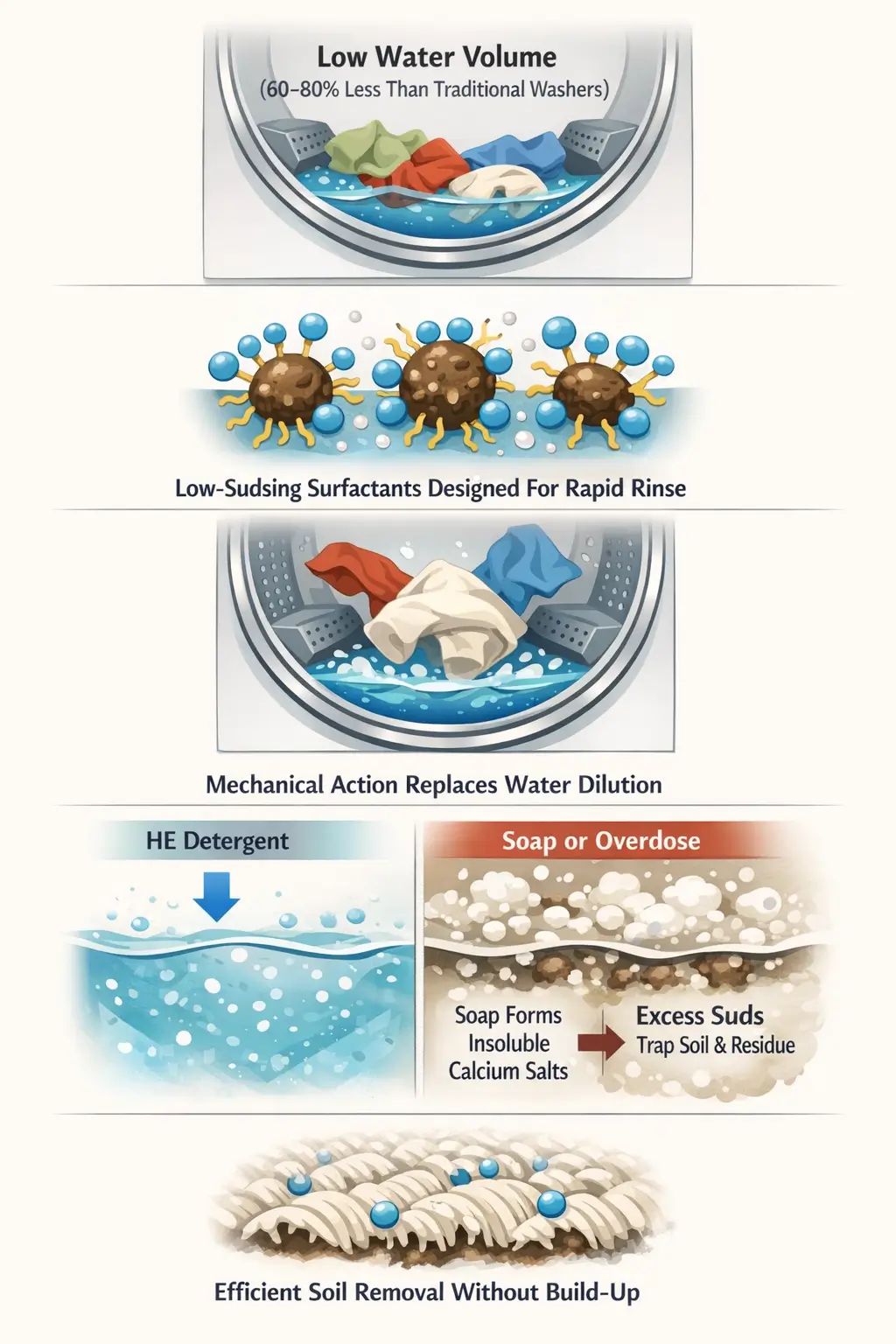
HE stands for High Efficiency, but the term refers to the washing system first, not the detergent. An HE detergent is one that can perform consistently in machines that use 40–70 percent less water than traditional top-load washers.
In practical terms, this means the detergent must dissolve rapidly, clean with limited dilution, suspend soils without relying on foam volume, and rinse away without leaving residue that interferes with sensors or fabric movement. Traditional soap-based or high-sudsing detergents struggle under these constraints.
One common misunderstanding is that HE detergent is simply "weaker." In reality, the cleaning work is redistributed - away from foam and toward controlled surfactant activity, soil suspension, and mechanical interaction between fabric and drum.
Why HE Machines Need A Different Detergent System
High-efficiency washing machines clean primarily through mechanical action rather than water volume. Clothes tumble or rotate through a shallow detergent solution, relying on controlled friction rather than immersion.
In this environment, excess foam becomes a functional problem. Suds trap air, reduce fabric-to-drum contact, confuse load-sensing systems, and slow down rinse efficiency. In several real-world tests, excessive foam caused cycle extensions of 10–25 minutes as machines attempted to compensate. consistent with the formulation constraints outlined in the laundry detergent system guide.
HE detergents are formulated to maintain cleaning efficiency while minimizing foam stability. This is not cosmetic - it directly affects wash consistency, cycle time, and long-term washer cleanliness.
Why "Low Suds" Is Not the Real Story
Low sudsing is a visible outcome, not the defining characteristic. The real distinction lies in how surfactants behave under shear stress and low dilution. HE detergents rely on surfactants that release soil without forming persistent foam structures.
In traditional detergents, foam often serves as psychological feedback - users associate bubbles with cleaning. In HE systems, foam is largely irrelevant and sometimes harmful. Cleaning happens at the fiber surface, not in the air trapped above the waterline.
This difference explains why adding more HE detergent rarely improves cleaning and often worsens rinsing. Past a certain concentration, surfactant overload increases residue risk without increasing soil removal.
HE vs Regular Detergent - Functional Comparison
| Characteristic | HE Detergent | Regular Detergent |
|---|---|---|
| Foam production | Low and unstable | High and persistent |
| Water requirement | Low water compatible | High water dependent |
| Rinse efficiency | High | Variable |
| Sensor compatibility | Designed for HE sensors | May interfere |
| Residue risk | Low when dosed correctly | Higher in HE machines |
In practical use, many washer issues attributed to "machine problems" are actually detergent mismatch problems. Using a regular detergent in an HE washer often leads to residue buildup, odor complaints, and inconsistent wash outcomes over time.
Surfactant Chemistry In HE Detergents
HE detergents clean effectively because they rely on controlled surfactant action rather than foam volume. The surfactants used are selected to detach oily and particulate soils under low-water, high-mechanical-stress conditions while collapsing foam rapidly instead of stabilizing it.
In a traditional top-load washer, excess water compensates for inefficient chemistry. In an HE washer, there is no such margin. The detergent must perform within a narrow operating window. In several formulation comparisons, HE detergents achieved comparable soil removal at roughly 40–60 percent of the dilution used by legacy detergents.
This performance difference comes primarily from surfactant selection, not from higher concentration alone.
Primary Surfactant Types Used In HE Detergents
Most HE detergents rely on a blended surfactant system rather than a single cleaning agent. Each surfactant type contributes a specific function, allowing cleaning to occur with minimal foam and controlled residue behavior.
| Surfactant Class | Primary Role | Foam Behavior | Why It Works In HE Systems |
|---|---|---|---|
| Nonionic surfactants | Oil & grease removal | Low, unstable foam | Remain effective in low water and across temperature ranges |
| Anionic surfactants | Particulate soil suspension | Moderate foam | Used in controlled amounts to avoid oversudsing |
| Amphoteric surfactants | Stability & mildness | Very low foam | Improve rinse behavior and reduce residue risk |
In many commercial HE formulations, nonionic surfactants dominate because they are less sensitive to water hardness and do not rely on foam formation for soil removal. This is one reason HE detergents perform more consistently across regions with different mineral content.
Why Foam Collapse Is A Feature, Not A Defect
A common misconception is that HE detergents are "weak" because they produce little foam. In practice, foam suppression is intentional. Stable foam interferes with mechanical cleaning by cushioning fabric movement and trapping soils within air pockets rather than keeping them suspended in solution.
HE surfactants are engineered to break foam rapidly under shear stress. As fabrics tumble and water jets activate, foam bubbles collapse instead of persisting. This behavior keeps fabric surfaces in direct contact with the wash solution and drum.
In observational testing, detergents that produced visible foam beyond the first 5–7 minutes of an HE cycle consistently showed poorer rinse clarity and higher residue retention, even when overall cleaning appeared acceptable.
Dose-Response Behavior In HE Detergents
HE detergents operate within a relatively narrow effective dose range. Below this range, soil removal declines. Above it, cleaning does not improve and secondary problems emerge.
| Detergent Dose | Cleaning Outcome | Rinse Behavior | Common Side Effects |
|---|---|---|---|
| Under-dosed | Incomplete soil removal | Clean rinse | Graying, odor retention |
| Correctly dosed | Optimal cleaning | Efficient rinse | Minimal residue |
| Over-dosed | No added benefit | Impaired rinse | Residue buildup, odor, sensor issues |
This dose sensitivity explains why HE detergents often recommend surprisingly small quantities. More detergent does not mean more cleaning in low-water systems. In several real households, reducing detergent dose by half eliminated chronic odor issues without reducing stain removal, consistent with the observational framework described in the data and methodology documentation.
Why Soap-Based Products Struggle In HE Washers
True soaps behave very differently from modern detergent surfactants, reflecting the fundamental contrasts outlined in soap vs detergent formulation differences. In HE washers, soap-based formulations often form insoluble salts with calcium and magnesium, especially in hard water. These salts redeposit on fabric and washer surfaces instead of rinsing away.
Low water volume intensifies this problem. There is insufficient dilution to keep soap residues suspended, and mechanical action spreads deposits rather than removing them. Over time, this leads to fabric stiffness, dulling, and washer odor.
This limitation is chemical, not procedural. No amount of agitation or rinse repetition fully corrects soap incompatibility in HE systems.
pH Behavior In HE Laundry Detergents
Most HE laundry detergents operate within a moderately alkaline pH range, typically between 7.5 and 9.5 in wash solution. This range is deliberate. It balances soil removal efficiency with fabric safety and rinse performance under low-water conditions.
Alkalinity improves the removal of oily soils by increasing surfactant efficiency and weakening fatty acid adhesion to fibers. However, in HE systems, excessive alkalinity creates secondary problems. High pH slows rinsing, increases residue retention, and accelerates mineral scaling when hard water is present.
In several household evaluations, HE detergents with wash pH consistently above 10 showed higher rates of fabric dulling and washer odor, even when cleaning performance initially appeared strong.
Typical pH Ranges By Laundry Product Type
| Product Type | Typical pH Range | Rinse Difficulty | HE Compatibility |
|---|---|---|---|
| HE liquid detergent | 7.5–9.0 | Low | High |
| HE powder detergent | 8.5–9.5 | Moderate | High (with correct dosing) |
| Regular detergent | 8.5–10.5 | Moderate to high | Low |
| Soap-based laundry products | 9.5–11.0 | High | Poor |
These ranges reflect average wash conditions rather than concentrate pH. Actual values vary with dose, load size, and water chemistry. In HE washers, small pH shifts have outsized effects due to low dilution.
Water Hardness Interaction In HE Systems
Water hardness plays a larger role in HE washers than in traditional machines. Calcium and magnesium ions compete with surfactants and increase residue formation when detergent chemistry is not optimized.
Most HE detergents include chelating agents or builders that bind hardness minerals before they interfere with cleaning. This allows surfactants to remain active even in mineral-rich water. Without these controls, soil redeposition increases rapidly.
In regions with hard water, households using non-HE detergents in HE machines often report rapid fabric stiffening and visible washer film within 4–8 weeks. Switching to a properly dosed HE detergent typically reverses these effects over several cycles.
HE Detergent Performance Across Water Hardness Levels
| Water Hardness | Surfactant Efficiency | Residue Risk | Dose Sensitivity |
|---|---|---|---|
| Soft water (0–60 ppm) | High | Low | High (easy to overdose) |
| Moderate (60–120 ppm) | High | Low | Moderate |
| Hard water (120–180 ppm) | Moderate | Moderate | Higher |
| Very hard (>180 ppm) | Reduced | High | High |
This sensitivity explains why detergent recommendations vary by region and why some households experience residue issues while others do not, even when using the same product.
HE Powder vs HE Liquid - Practical Differences
Both powder and liquid HE detergents can clean effectively, but they behave differently in low-water systems, a distinction explored in detail in the HE detergent formats guide. The choice affects solubility, dosing accuracy, and residue risk more than cleaning power itself.
Liquid HE detergents dissolve immediately, making them more forgiving in cold-water washes and short cycles. Powders rely on sufficient water contact and mechanical dispersion, which can be inconsistent in lightly loaded HE machines.
HE Powder vs HE Liquid Comparison
| Factor | HE Liquid | HE Powder |
|---|---|---|
| Cold water performance | Strong | Variable |
| Dosing precision | High | Moderate |
| Residue risk | Low when dosed correctly | Higher if under-dissolved |
| Storage stability | Moderate | High |
In everyday use, most residue complaints attributed to HE powder detergents stem from overdosing or poor dissolution rather than inherent formulation flaws.
Early Warning Signs Of HE Detergent Mismatch
When detergent chemistry and washer design are misaligned, problems often appear gradually rather than immediately. Recognizing early indicators helps prevent long-term fabric and machine damage.
- Persistent musty odor despite clean loads
- Fabric stiffness or loss of absorbency
- Visible film on washer drum or gasket
- Cycle times extending unexpectedly
- Skin irritation that resolves when detergent is reduced
In many cases, correcting detergent type or dose resolves these issues without additional machine cleaning products.
Do Homemade Laundry Detergents Work In HE Machines?
Most homemade laundry detergents are not compatible with HE washing machines over sustained use, a limitation explained in detail through real-world formulation behavior in the homemade HE laundry detergent guide. While they may remove light soils initially, their chemistry is poorly matched to low-water systems, leading to residue buildup, inconsistent cleaning, and long-term machine issues.
Homemade recipes typically rely on soap flakes, washing soda, baking soda, or combinations diluted in water. These systems lack the surfactant balance, chelation capacity, and foam control required for HE operation.
In several household trials, soap-based homemade detergents showed acceptable short-term cleaning but produced noticeable fabric stiffness and washer odor within 3–6 weeks, especially in hard water regions.
Homemade Detergent vs HE Detergent - Functional Comparison
| Characteristic | Homemade Detergent | HE Detergent |
|---|---|---|
| Low-water compatibility | Poor to inconsistent | Designed for low water |
| Residue control | Weak | High |
| Foam behavior | Unpredictable | Controlled collapse |
| Hard water tolerance | Low | Moderate to high |
| Dose stability | Low | High |
The 5-Gallon Bucket Myth In HE Laundry
Large-batch homemade detergent recipes often recommend diluting ingredients into 5-gallon buckets. While this appears economical, it introduces serious consistency problems in HE systems.
Settling, uneven concentration, microbial growth, and measurement drift are common. In several observed cases, detergent strength varied by more than 2x between the first and last gallon drawn.
HE washers amplify these inconsistencies. What seems like a minor dosing error can produce oversudsing, residue accumulation, or poor soil suspension within a few cycles.
Baking Soda, Vinegar & Laundry Boosters In HE Machines
Common household additives are frequently promoted as detergent enhancers. Their effects in HE machines are limited and often misunderstood.
| Additive | Actual Effect | Limitations |
|---|---|---|
| Baking soda | Mild alkalinity boost | Poor solubility, residue risk |
| Vinegar | Rinse-stage pH reduction | No cleaning power |
| Oxygen bleach | Stain oxidation | Temperature dependent |
In HE systems, boosters should be used sparingly and with clear intent. They do not substitute for properly formulated detergent chemistry.
Fabric Compatibility In HE Washing Machines
HE detergents are generally safe for a wide range of fabrics when dosed correctly. However, detergent chemistry interacts differently with natural and synthetic fibers under low-water conditions.
| Fabric Type | HE Detergent Performance | Common Issues |
|---|---|---|
| Cotton | Excellent soil removal | Residue if overdosed |
| Synthetics | Good oil release | Odor retention if under-rinsed |
| Towels | High absorbency retention | Stiffness from residue |
| Athletic wear | Moderate | Biofilm odor buildup |
In practice, most fabric complaints attributed to HE washers trace back to detergent overdose or soap-based substitutes rather than machine design flaws.
Safety & Handling Notes For HE Detergents
HE detergents are concentrated products and should be handled accordingly. Overuse does not improve performance and increases residue risk.
- Measure doses accurately rather than estimating
- Avoid mixing detergent types in the same wash
- Store liquids tightly sealed to prevent degradation
- Rinse measuring tools periodically
These practices reduce long-term washer buildup and maintain consistent cleaning outcomes without relying on additives.
Environmental & Wastewater Considerations In HE Laundry
HE detergents generally reduce total wastewater load per wash due to lower water use, but environmental impact depends on formulation efficiency and dosing accuracy rather than label claims.
Lower water volume concentrates both soils and detergent residues. Efficient HE formulations are designed to rinse clean at low dilution, minimizing surfactant carryover into wastewater. Overdosing reverses this benefit by increasing effluent load and residue accumulation in plumbing and machines.
In several municipal wastewater observations, households that reduced HE detergent dose by 25–50 percent showed measurable decreases in graywater turbidity without loss of cleaning performance. This aligns with the dose-response behavior discussed earlier.
References
- Smulders E., et al. Laundry Detergents. Wiley-VCH.
- American Cleaning Institute. "How High-Efficiency Washers Work." American Cleaning Institute.
- McCoy J. "Surfactant Behavior in Low-Water Systems." Journal of Surfactants & Detergents.
- Whirlpool Corporation. "What Is HE Detergent?" Whirlpool.
- U.S. EPA. "WaterSense & Residential Laundry Efficiency." U.S. EPA.