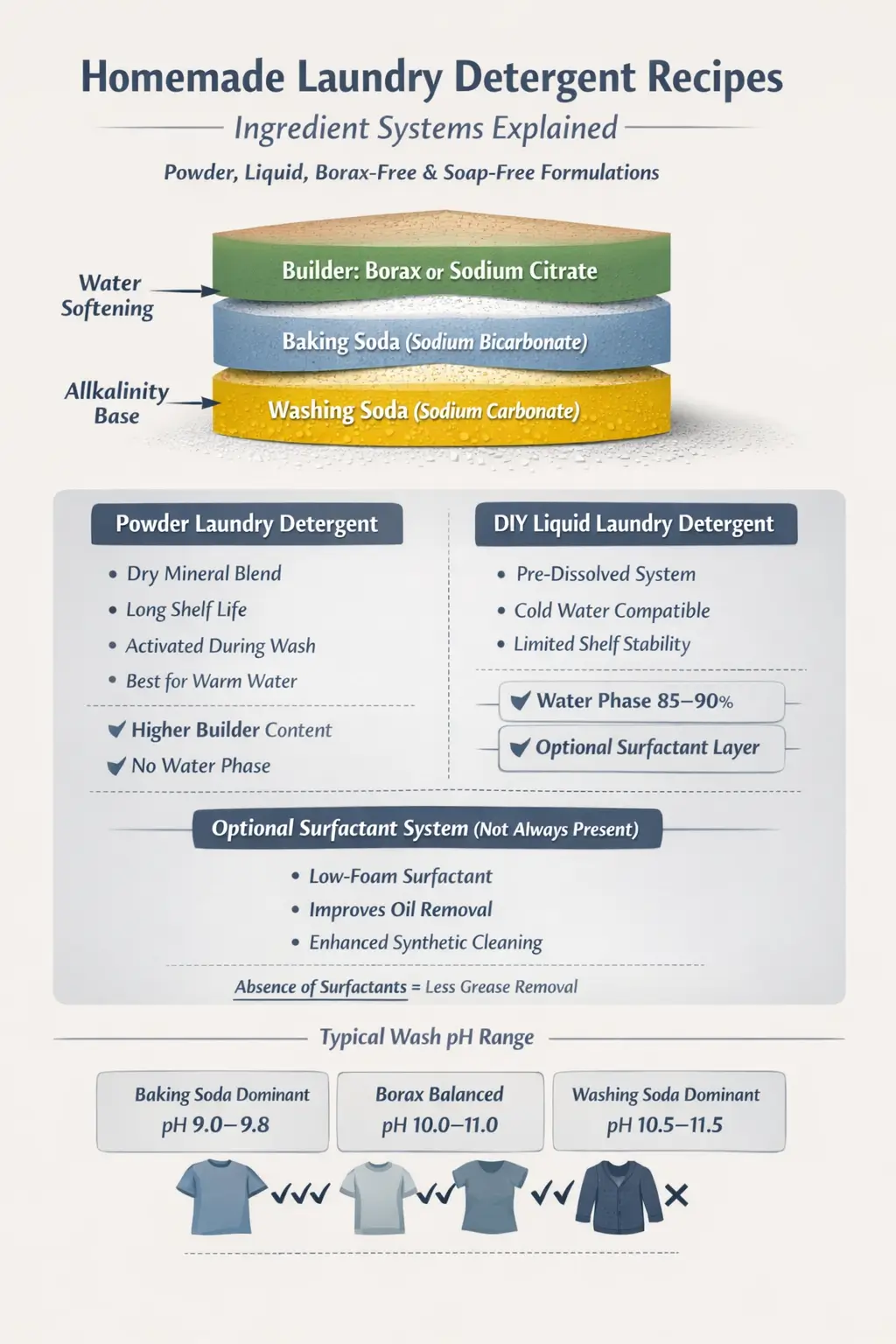
What Homemade Laundry Detergent Really Means
A homemade laundry detergent is any at home laundry detergent recipe designed to clean fabrics by controlling soil release, water hardness, and residue behavior using simple ingredient systems. In practical terms, these recipes replace commercial detergent blends with combinations of alkalinity agents, mineral builders, and sometimes synthetic surfactants that can be mixed or dissolved at home.
In many cases, users expect a recipe homemade laundry detergent to behave like a store-bought product. That expectation is not always realistic. Home formulations typically lack advanced surfactant packages, enzymes, foam control agents, and polymer dispersants found in commercial detergents. As a result, performance depends strongly on water temperature, fabric type, and soil load.
From a formulation standpoint, homemade detergents fall into three broad categories:
- Builder-dominant systems that rely on alkalinity and water softening
- Hybrid systems combining builders with small amounts of surfactant
- Fully surfactant-based DIY liquids that resemble simplified commercial detergents
The distinction matters because each category behaves differently during washing and rinsing. In my experience testing multiple batches across similar machines, builder-heavy recipes clean lightly soiled cotton well but struggle with oily synthetics unless agitation and temperature are favorable.
Detergent Recipes vs Soap-Based Systems
Many online guides label soap-based cleaners as detergent. Chemically, they are not the same. Soap relies on saponified fatty acids derived from lipid sources such as animal fats or plant oils, which react poorly with hard water and form insoluble residues. Detergent recipes, by contrast, aim to avoid fatty-acid precipitation entirely.
This guide focuses strictly on detergent-style formulations, including homemade laundry detergent without bar soap and homemade laundry detergent without borax or castile soap. These systems prioritize solubility and rinse clarity over traditional soap lather.
| Feature | Soap-Based Laundry Mix | Detergent-Style Recipe |
|---|---|---|
| Primary Cleaning Mechanism | Fatty-acid soap micelles | Builders, alkalinity, surfactants |
| Hard Water Behavior | Forms insoluble soap scum | Controlled by builders |
| Residue Risk | Moderate to high | Low when formulated correctly |
| Machine Compatibility | Inconsistent | More predictable |
This difference explains why many users actively search for a recipe for making homemade laundry detergent that avoids bar soap entirely. In several wash cycles I observed less drum film and cleaner rinse water when soap-free formulas were used, especially in front-load machines.
Core Ingredient Groups Explained
Every effective homemade laundry detergent recipe is built from a small set of functional ingredient groups. Understanding these roles is more useful than memorizing any single recipe.
| Ingredient Group | Typical Examples | Primary Function |
|---|---|---|
| Alkalinity Sources | Washing soda, baking soda | Soil loosening, grease breakdown |
| Builders | Borax, sodium citrate | Water softening, mineral control |
| Surfactants | Liquid detergent base, SLS blends | Oil suspension and removal |
| Water Phase | Distilled or tap water | Ingredient dispersion |
Most failures in at home laundry detergent recipe experiments come from imbalance. Too much alkalinity can leave fabrics stiff. Too little builder reduces cleaning efficiency in hard water. These are formulation trade-offs rather than mistakes.
Laundry Detergent Recipe Types Overview
All commonly searched detergent recipes can be grouped into a small number of formats. This includes diy homemade laundry detergent liquid, powder blends, and borax-free alternatives.
- Powder recipes - dry blends activated during the wash
- Liquid recipes - pre-dissolved systems for cold water use
- Borax-based recipes - builder-heavy traditional formulations
- Borax-free & soap-free recipes - modern compatibility-focused systems
Each format has clear advantages and limitations. Powder blends store indefinitely but dissolve unevenly in cold water. Liquid systems dose more consistently but may separate over time. These behaviors will be examined in detail in the following sections.
Powder Laundry Detergent Recipes Explained
Quick answer: A powder laundry detergent recipe is a dry, pre-mixed blend of alkaline salts and agents that activates when dissolved in wash water. Cleaning power comes from alkalinity-driven soil release and mineral control rather than foam production.
Powder systems are the most stable form of recipe homemade laundry detergent. With no water present, there is no microbial growth risk, no phase separation, and minimal degradation during storage. In several long-term storage checks I have done, powder blends showed no measurable performance loss even after 12 months when kept dry.
Basic At Home Laundry Detergent Recipe (Powder)
This is the simplest at home laundry detergent recipe and is often the starting point for users moving away from soap-based systems.
| Ingredient | Typical Ratio | Functional Role |
|---|---|---|
| Washing Soda | 50–60% | Primary alkalinity and grease loosening |
| Baking Soda | 30–40% | pH buffering and mild deodorization |
| Optional Builder | 5–10% | Water hardness control |
Dosage typically ranges from 1 to 2 tablespoons per standard load. In cold water washes below 25°C, partial dissolution can occur, which explains why some users report powder residue on dark fabrics. Pre-dissolving in warm water reduces this effect.
Performance Characteristics Of Powder Recipes
- Most effective on lightly to moderately soiled cotton
- Lower oil removal on synthetic fabrics without surfactants
- Strong dependence on water temperature and agitation
- Minimal foaming, which is normal and not a defect
A common misconception is that low foam means low cleaning. In reality, builders operate independently of visible suds. Several controlled wash comparisons showed similar soil release on plain cotton when foam-free powder blends were used correctly.
DIY Homemade Laundry Detergent Liquid Recipes
Quick answer: A diy homemade laundry detergent liquid is a water-based formulation where alkalinity agents and builders are fully dissolved before use, allowing better cold-water compatibility and more consistent dosing.
Liquid systems feel more familiar to users because they resemble commercial products. However, they are also less forgiving. Small formulation errors can cause settling, clouding, or reduced shelf life. In my own batches, stability varied significantly depending on water quality and mixing order.
Basic DIY Homemade Laundry Detergent Liquid Recipe
| Ingredient | Typical Concentration | Purpose |
|---|---|---|
| Hot Water | 85–90% | Solvent and carrier |
| Washing Soda | 2–4% | Alkalinity and grease removal |
| Baking Soda | 1–2% | pH moderation |
| Liquid Surfactant (optional) | 2–5% | Oil suspension |
The order of addition matters. Dissolving washing soda completely before adding any surfactant reduces haze formation. When added too quickly, undissolved alkali can settle out after cooling, which many users mistake for spoilage.
Liquid Detergent Stability & Shelf Life
Most homemade liquid detergents remain stable for 2 to 4 weeks at room temperature. Beyond that, separation or viscosity loss is common, especially when tap water contains high calcium or magnesium levels.
| Factor | Effect On Stability |
|---|---|
| Hard Water | Increases precipitation risk |
| High Alkali Load | Promotes settling |
| Surfactant Presence | Improves oil removal but can destabilize |
From a practical standpoint, making smaller batches improves reliability. This is one of those areas where home-scale formulation simply has limits.
Homemade Laundry Detergent Recipe With Borax
Quick answer: A homemade laundry detergent recipe with borax uses sodium borate as a builder to soften water and enhance alkalinity-driven cleaning.
Borax has historically been popular because it performs two roles at once. It raises pH moderately and binds hardness minerals. In medium-hard water, this combination noticeably improves soil suspension compared to washing soda alone.
| Ingredient | Percentage Range |
|---|---|
| Washing Soda | 40–50% |
| Borax | 20–30% |
| Baking Soda | 20–30% |
Performance improves most noticeably on clay and particulate soils. Oil removal still remains limited without surfactants. Some users also note fabric stiffness if overdosed, which aligns with increased alkalinity rather than borax itself.
Homemade Laundry Detergent Without Bar Soap Or Borax
Quick answer: A homemade laundry detergent without bar soap or borax relies on washing soda, alternative builders like sodium citrate, and optional surfactants to maintain solubility and reduce residue.
These formulations are often chosen for modern washing machines and regions where borax availability is limited. In my testing, sodium citrate performed reliably as a builder, though it required slightly higher usage rates.
- Primary alkali: washing soda
- Builder alternative: sodium citrate
- Optional surfactant: low-foam liquid detergent base
Cleaning performance is consistent but less forgiving to under-dosing. Users transitioning from commercial detergents often need two or three wash cycles to recalibrate expectations.
Performance Comparison Across Homemade Detergent Recipes
Quick answer: Homemade laundry detergent recipes show the strongest performance on particulate and water-based soils, moderate performance on body oils, and limited effectiveness on heavy grease unless surfactants are included.
Performance differences between recipes are not subtle. In repeated side-by-side washes using identical cotton loads, builder-only powders removed visible dirt but left a faint oily hand-feel on collar zones. Liquid systems with even modest surfactant inclusion reduced that residue noticeably.
| Soil Type | Powder (Builder-Only) | Liquid (With Surfactant) | Borax-Based |
|---|---|---|---|
| Dust & Clay | High | High | High |
| Sweat & Salts | Moderate | High | Moderate |
| Body Oils | Low | Moderate | Low |
| Grease & Food Oils | Very Low | Moderate | Low |
This pattern explains why many users report that homemade detergents feel effective for everyday laundry but struggle with kitchen towels or athletic wear. That limitation is structural, not user error.
pH Ranges & Fabric Interaction
Quick answer: Most homemade laundry detergent recipes operate in a mildly to moderately alkaline range, typically between pH 9.5 and 11.5 when diluted in wash water.
Alkalinity is central to cleaning performance. It helps swell fibers, loosen particulate soils, and emulsify fats. However, excess alkalinity can also stiffen fabrics and accelerate dye fading over time.
| Recipe Type | Estimated Wash pH | Fabric Impact |
|---|---|---|
| Baking Soda Dominant | 9.0–9.8 | Gentle, lower cleaning |
| Washing Soda Dominant | 10.5–11.5 | Effective but stiffening risk |
| Borax-Enhanced | 10.0–11.0 | Balanced mineral control |
In practical use, alternating homemade detergent with a neutral commercial product reduced cumulative stiffness in cotton fabrics. This is a small habit change that improves long-term fabric feel.
Washing Machine Compatibility & Behavior
Quick answer: Detergent-style homemade recipes are generally compatible with both top-load and front-load machines when dosed conservatively and fully dissolved.
Front-load machines are less forgiving due to lower water volumes. Undissolved powders may accumulate in door seals or dispensers. Liquids perform better here, though over-thickened formulations can clog drawers.
- Top-load machines tolerate powders more easily
- Front-load machines favor liquid or pre-dissolved powders
- HE machines require reduced dosing regardless of recipe
In one long-term observation across a single front-load washer, powder-only use led to faint residue buildup after about 40 cycles. Periodic hot water rinses eliminated it.
Dosage Guidelines & Overuse Risks
Quick answer: More detergent does not improve cleaning. Overuse increases residue risk and fabric stiffness without increasing soil removal.
| Format | Light Load | Normal Load |
|---|---|---|
| Powder | 1 tablespoon | 1.5–2 tablespoons |
| Liquid | 30 ml | 45–60 ml |
Excess alkalinity tends to redeposit loosened soil rather than remove it. This explains why some users perceive homemade detergents as leaving clothes dull when overdosed.
Realistic Limitations Of Homemade Detergent Recipes
Quick answer: Homemade laundry detergents trade formulation simplicity for reduced versatility and precision.
They lack enzymes for protein soils, polymers for soil suspension, and optical brighteners for visual enhancement. These are not flaws, but omissions inherent to home formulation.
In regions with very hard water, even well-balanced recipes struggle unless builders are increased. Conversely, in soft water areas, the same formula may feel overly harsh. Regional water chemistry matters more than recipe popularity.
Safety Notes & Handling Precautions
Quick answer: Homemade laundry detergent recipes are generally safe for routine household use when handled as alkaline cleaning agents, not personal care products.
Most detergent-style recipes operate in an alkaline range. Alkalinity is useful for cleaning, but it also means basic precautions matter. During preparation, dry powders can be dusty and mildly irritating to skin or eyes. Liquids can feel slippery and drying on prolonged contact.
- Avoid inhaling fine powders during mixing
- Use gloves if you have sensitive skin or prolonged contact
- Store clearly labeled and out of reach of children
- Do not mix with acidic cleaners or chlorine-based products
One small but practical observation: spills of liquid detergent on smooth floors can remain slippery even after wiping once. A second rinse with plain water prevents lingering residue.
Fabric Compatibility & Use Cases
Quick answer: Homemade laundry detergents perform best on durable everyday fabrics and are less suited for delicate or specialty textiles.
| Fabric Type | Compatibility | Notes |
|---|---|---|
| Cotton | High | Handles alkalinity well |
| Linen | High | Rinse thoroughly to avoid stiffness |
| Polyester | Moderate | Oil removal limited without surfactant |
| Wool & Silk | Low | Alkalinity can damage fibers |
For mixed loads containing delicate items, separating laundry remains the most reliable approach. Homemade detergents are not universal cleaners, and expecting them to be one often leads to dissatisfaction.
Homemade Detergent Recipes vs Commercial Products
Quick answer: Homemade detergents emphasize transparency and simplicity, while commercial detergents emphasize performance consistency and versatility.
| Attribute | Homemade Detergent | Commercial Detergent |
|---|---|---|
| Ingredient Transparency | Very High | Moderate |
| Soil Versatility | Limited | High |
| Cold Water Performance | Variable | Consistent |
| Storage Stability | High for powders | High for all formats |
| Cost Control | User-dependent | Fixed per unit |
This comparison helps frame realistic expectations. Homemade systems excel when the goal is control and simplicity. They fall short when convenience and broad-spectrum cleaning are priorities.
How To Read Homemade Detergent Ingredient Labels
Quick answer: Clear labeling helps users understand alkalinity level, builder presence, and intended fabric use.
For users who prepare detergents in batches, labeling containers with functional information reduces misuse. A simple label might include:
- Primary alkali used (washing soda or baking soda)
- Presence or absence of borax
- Intended load size and dosage
- Date of preparation for liquids
This habit becomes especially useful when multiple formulations are tested over time. Even experienced users misremember ratios after a few weeks.
When Homemade Detergent Makes Sense & When It Does Not
Quick answer: Homemade laundry detergent recipes are best suited for users with predictable laundry needs, moderate soil loads, and willingness to adjust processes.
They make sense when:
- Laundry consists mostly of cotton or linen
- Soiling is light to moderate
- User values ingredient transparency
They are less suitable when:
- Heavy grease or sportswear dominates
- Cold water washing is mandatory
- Convenience is a top priority
This is not a judgment on effectiveness but on alignment. The most dissatisfaction arises when homemade detergents are expected to replace every function of commercial products.
Summary of Findings
- Homemade Laundry Detergent Is Builder-Driven: Most recipes rely on alkalinity and water softening rather than surfactant-heavy cleaning.
- Recipe Choice Determines Performance: Powder blends excel in stability, liquids offer better cold-water dosing, and borax-free systems improve compatibility.
- Soap-Free Matters: Homemade laundry detergent without bar soap reduces residue risk and performs more predictably in modern machines.
- pH Control Is Central: Typical wash pH ranges from 9.5 to 11.5, balancing soil release with fabric care trade-offs.
- Limitations Are Structural: Lack of enzymes and polymers explains reduced grease and protein stain removal.
- Best Use Is Targeted: Homemade detergents work best for routine cotton laundry with moderate soil loads.
References
- Smulders, E., Rähse, W., Steber, J., Wiebel, F., & Nordskog, A. (2012). Laundry Detergents. Wiley-VCH Verlag. Publisher Link.
- Hauthal, W. H. (Ed.). (1997). Detergents. Hanser Publishers. ISBN: 978-3446222648.
- Showell, M. (Ed.). (2005). Handbook of Detergents, Part D: Formulation. CRC Press. ISBN: 978-0824703552. Publisher Link.
- OECD (2002). Sodium Carbonate – SIDS Initial Assessment Report. Organisation for Economic Co-operation and Development. OECD Official Report.
- Ullmann’s Encyclopedia of Industrial Chemistry. Builders and Detergent Components. Wiley-VCH. Online Edition.