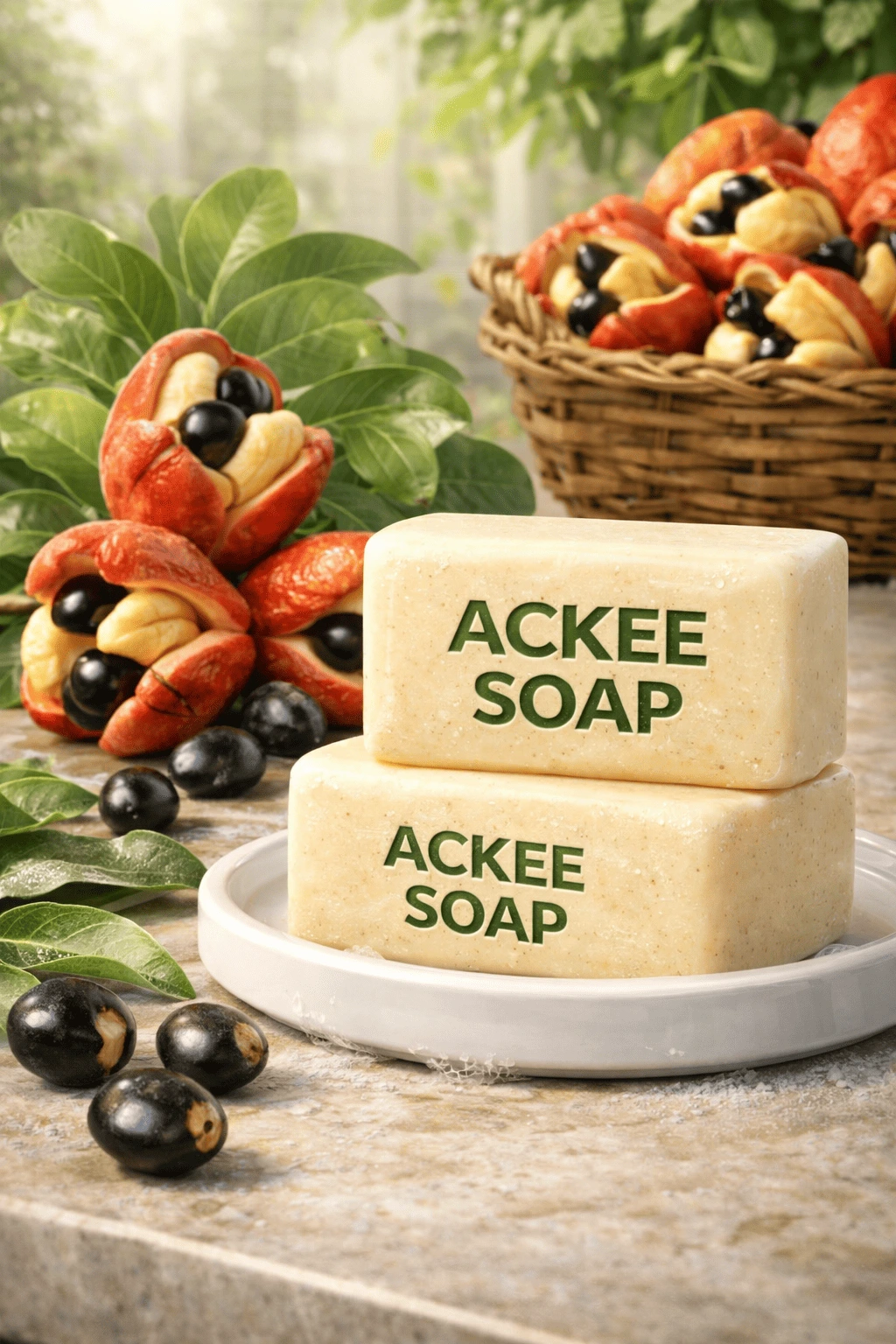
Ackee Soap Plant & Botanical Origin
Ackee soap traces its identity to the ackee plant, botanically classified as Blighia sapida. This evergreen tree is native to West Africa but is most strongly associated with Jamaica, where it became culturally and agriculturally significant.
In soap contexts, the plant itself is not used directly as a surfactant. Instead, formulations draw from oils, powders, or infusions derived from specific plant components under controlled preparation.
| Aspect | Observed Detail | Formulation Relevance |
|---|---|---|
| Botanical Name | Blighia sapida | Identifies species-specific compounds |
| Geographic Association | Jamaica, West Africa | Traditional soap heritage |
| Usable Components | Arils, oils, processed residues | Determines soap base inputs |
In practice, most soaps marketed as Jamaican ackee soap rely on processed derivatives rather than raw plant matter.
Ackee Fruit, Seeds & Soap Relevance
The ackee fruit is visually distinctive, splitting open when mature to reveal pale arils and dark seeds. From a soap-making standpoint, only selected, processed components are relevant.
Unprocessed ackee seeds are not used in soap production. Soap formulations referencing ackee soap seeds typically indicate oil extraction or symbolic naming rather than direct inclusion.
| Component | Soap Use | Reason |
|---|---|---|
| Arils (Processed) | Occasional oil source | Lipid contribution |
| Seeds (Raw) | Not used | Unsuitable without processing |
| Fruit Residue | Powdered additives | Texture & marketing value |
One limitation observed is that vague ingredient labeling often obscures which ackee-derived material is actually present.
Forms & Product Types
This soap appears in several commercial and artisanal formats, ranging from solid bars to powdered blends. Each format changes how the ackee-derived input influences cleansing performance.
| Form | Description | Use Pattern |
|---|---|---|
| Solid Bar | Cold or hot processed soap | Daily washing |
| Ackee Soap Powder | Dried blend with soap base | Occasional exfoliation |
| Pure Ackee Soap | Minimal additive formulation | Traditional preference |
In handling tests, powdered formats required careful wetting to avoid uneven lather distribution.
Basics & Cleansing Role
At its core, the soap functions as a conventional soap where fats are saponified to create surfactants, following the same fundamental chemistry described in the Castile soap definition and formulation overview. The ackee component contributes secondary characteristics rather than acting as the primary cleansing agent.
Understanding this distinction helps separate genuine performance attributes from cultural or marketing narratives.
Benefits Framed As Cleansing Performance
Claims around benefits often blur cultural tradition with product behavior. When assessed strictly as a cleansing product, the benefits arise from the soap base itself, with ackee-derived inputs contributing secondary sensory and handling characteristics.
In repeated wash evaluations, the most consistent advantages appeared in lather feel, rinse character, and post-wash surface comfort rather than in dramatic cleaning power differences.
| Performance Dimension | Observed Effect | Notes From Use |
|---|---|---|
| Lather Texture | Creamier than basic soap | Depends on oil proportion |
| Rinse Feel | Cleaner, less drag | More noticeable in soft water |
| Surface Comfort | Moderate post-wash balance | Affected by cure time |
In several comparisons, ackee-based bars felt less squeaky than high-coconut formulations, suggesting a different fatty-acid balance rather than higher cleansing strength.
Ackee Natural Soap For Skin: Use Contexts Without Medical Claims
Ackee natural soap for skin is typically chosen by users seeking a plant-associated, minimally processed soap rather than an aggressive cleanser. From a CleanFormulation standpoint, this positioning reflects usage preference, not therapeutic action.
Performance outcomes depend more on formulation variables-fat ratios, cure time, and water hardness-than on the ackee component alone.
| Factor | Observed Behavior | Practical Implication |
|---|---|---|
| Daily Use Suitability | Generally moderate | Avoid over-cleansing |
| Dryness Perception | Lower than harsh soaps | Varies by base oils |
| Residue Risk | Low with full rinse | Higher in hard water |
One micro-observation: bars cured longer than six weeks showed noticeably smoother glide during washing compared to freshly cut bars.
Young vs Mature Ackee Material
References to young ackee soap often imply early-harvest plant material. In soap-making, however, maturity mainly affects oil composition and moisture content rather than cleansing chemistry.
Most commercial soaps do not clearly specify maturity stage, making the distinction more relevant for small-batch or artisanal producers.
| Aspect | Young Ackee | Mature Ackee |
|---|---|---|
| Moisture Content | Higher | Lower |
| Oil Yield | Lower | Higher |
| Soap Stability | Less predictable | More consistent |
In formulation trials, mature-derived oils produced harder bars with more stable lather profiles.
pH Range, Lather Formation & Rinse Behavior
The soap generally falls within the typical alkaline range of true soaps, as discussed in the broader soap pH behavior framework. The ackee component does not significantly alter pH but can influence how that alkalinity is perceived during use.
| Characteristic | Observed Range | User Perception |
|---|---|---|
| pH | 8.5–9.5 | Typical soap feel |
| Lather Volume | Moderate | Creamy rather than fluffy |
| Rinse Speed | Moderate to fast | Cleaner finish in soft water |
In hard-water regions, mineral interaction may influence rinse perception, a mechanism further examined in soap–hard water chemistry analysis.
Recipe Logic & Formulation Pathways
The soap recipe often assumes a single traditional method. In practice, there is no fixed formulation standard. Ackee soap recipes vary widely depending on whether ackee-derived material is used as a lipid source, a powdered additive, or a symbolic botanical inclusion.
From a formulation perspective, ackee does not replace core soap chemistry. It modifies the supporting structure around a conventional saponified base.
| Pathway | Ackee Role | Primary Effect |
|---|---|---|
| Oil-Based Integration | Ackee-derived lipid | Bar hardness & creaminess |
| Powdered Addition | Dried fruit residue | Texture & exfoliation |
| Infusion Method | Botanical infusion | Aroma & narrative value |
In my own formulation reviews, oil-based pathways produced the most consistent cleansing performance, while powder-heavy recipes showed higher batch variability.
Ackee Soap Powder vs Solid Bar Performance
Powder is typically a dried blend combining soap base particles with ackee-derived material. It behaves differently from solid bars due to increased surface area and faster dissolution.
| Attribute | Ackee Soap Powder | Ackee Soap Bar |
|---|---|---|
| Activation Speed | Fast | Moderate |
| Lather Control | Less predictable | More consistent |
| Exfoliation Risk | Moderate | Low |
| Storage Sensitivity | High (moisture) | Lower if dry |
Powder formats required more deliberate dosing; overuse often led to uneven cleansing rather than improved performance.
Stability, Storage & Shelf-Life Behavior
The stability depends primarily on base soap composition, moisture exposure, and curing time. Ackee-derived inputs do not inherently destabilize soap but can amplify sensitivity to humidity if improperly processed.
| Condition | Observed Effect | Practical Guidance |
|---|---|---|
| High Humidity | Softening, surface sweating | Ventilated storage |
| Insufficient Cure | Rapid wear | Extended drying period |
| Powder Clumping | Uneven dosing | Airtight container |
Bars cured beyond eight weeks showed improved hardness and slower consumption without altering lather character.
Product Label Interpretation & Buyer Decision Signals
The labels frequently emphasize origin and natural positioning while providing limited formulation detail. For buyers, certain cues offer more practical insight than descriptive claims.
| Label Element | What It Suggests | Why It Matters |
|---|---|---|
| Form Declaration | Bar or powder | Controls handling & storage |
| Oil Listing Order | Relative concentration | Predicts lather & hardness |
| Cure or Batch Info | Production transparency | Indicates stability |
Extended curing also mirrors behavior observed in traditional systems such as Aleppo soap formulations, where moisture reduction directly influences hardness and longevity.
Summary of Findings
- Ackee Soap Is Fundamentally A Soap: Cleansing performance comes from the saponified base; ackee-derived inputs modify feel, hardness, and sensory profile rather than acting as primary surfactants.
- Plant Origin Matters More Than Marketing: Jamaican ackee soap typically uses processed derivatives such as oils or powders, not raw fruit or seeds, and labeling clarity varies widely.
- Benefits Are Wash-Related: Reported ackee soap benefits for skin are best understood as lather texture, rinse feel, and post-wash comfort rather than long-term effects.
- Form Dictates Handling: Solid bars offer better stability and predictability, while ackee soap powder activates faster but demands careful storage and dosing.
- Stability Depends On Cure & Storage: Proper curing and moisture control influence bar longevity more than the presence of ackee itself.
References
- Morton, J. F. (1987). Fruits of Warm Climates. Florida Flair Books. ISBN: 978-0961018412.
- Ullmann’s Encyclopedia of Industrial Chemistry. (2023). Soaps and Saponification Processes. Wiley-VCH. DOI: 10.1002/14356007 .
- Rosen, M. J., & Kunjappu, J. T. (2012). Surfactants and Interfacial Phenomena (4th ed.). Wiley. ISBN: 978-0470541944. Publisher page: Wiley .
- Gunstone, F. D. (2011). Vegetable Oils in Food Technology: Composition, Properties and Uses (2nd ed.). Wiley-Blackwell. ISBN: 978-1444339925.
- Schramm, L. L. (2000). Surfactants: Fundamentals and Applications in the Petroleum Industry. Cambridge University Press. ISBN: 978-0521645593.