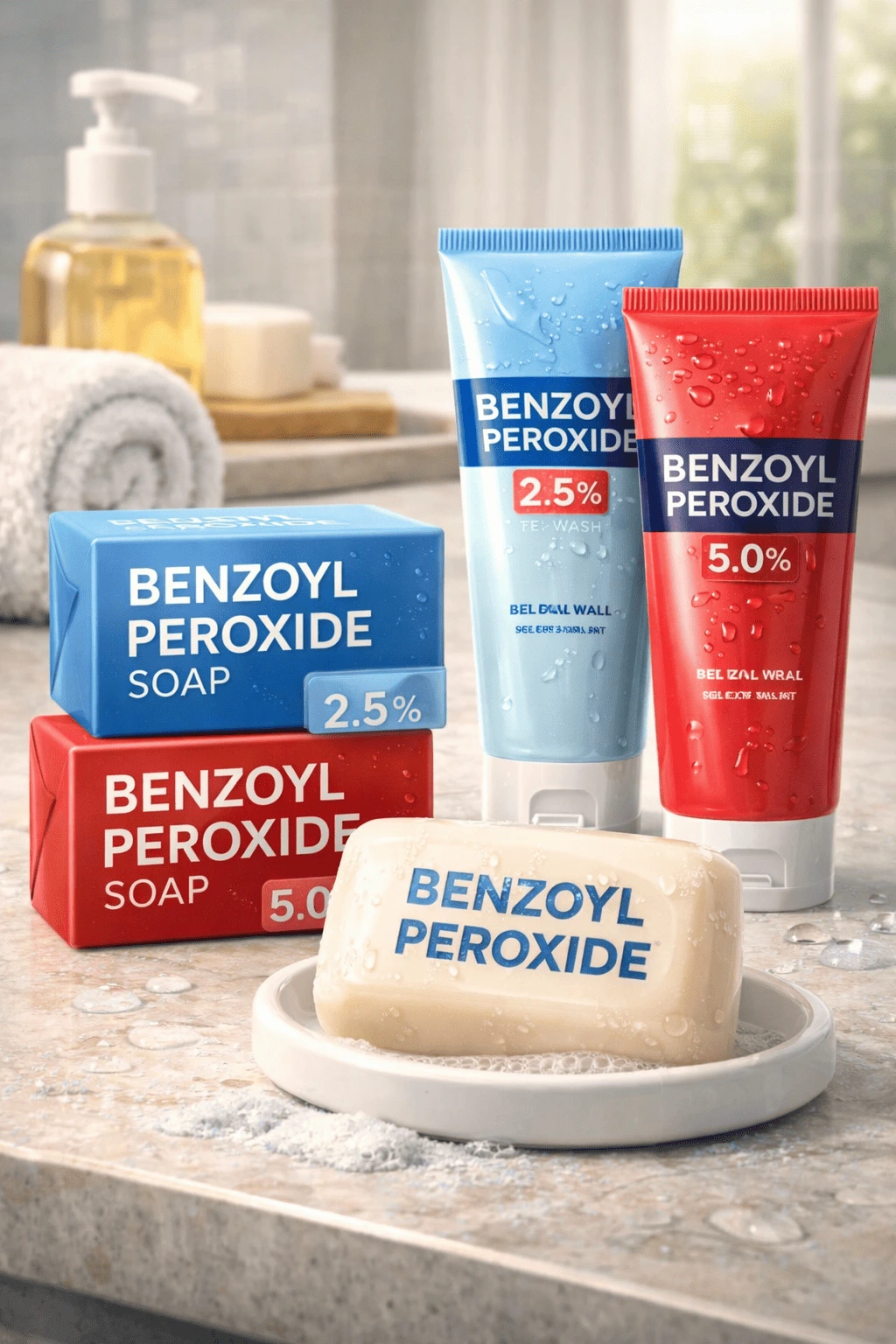
Material Overview & Functional Role
Benzoyl peroxide is a peroxide-based organic compound that decomposes upon contact with moisture, releasing reactive oxygen species. Within a soap or gel cleanser, this reaction occurs at the surface during washing rather than persisting after rinse-off.
For broader soap system fundamentals, see our Bar Soap Formulation Basics.
From a formulation perspective, the compound is included for its surface-level oxidative interaction rather than for long-duration activity. This distinction matters when evaluating benefits and limits of wash-off products.
| Property | Observed Range | Functional Implication |
|---|---|---|
| Solubility | Low in water | Requires suspension or dispersion |
| Stability | Moderate when dry | Sensitive to moisture & heat |
| Oxidative Activity | Surface-limited | Wash-off dependent |
In my experience handling peroxide-containing bars, storage conditions had a larger impact on consistency than daily use itself.
Formats & Strength Levels: 2.5 vs 5.0
Benzoyl peroxide soap is commonly produced in two strength categories: 2.5 percent and 5.0 percent. These values describe active concentration by weight within the formulation rather than delivered dose to the surface.
Higher concentration does not automatically translate to proportionally higher wash performance, especially in short-contact scenarios.
System-level differences between cleansing formats are examined in Bar Soap vs Liquid Soap.
| Aspect | 2.5 Percent | 5.0 Percent |
|---|---|---|
| Oxidative Intensity | Moderate | Higher |
| Surface Dryness Tendency | Lower | More noticeable |
| Formulation Sensitivity | More forgiving | Requires tighter control |
| Typical Contact Time | 30–60 seconds | 20–45 seconds |
In several wash comparisons, extending contact time slightly with 2.5 percent produced similar surface outcomes to brief use of 5.0 percent.
Formulation Architecture: Bar vs Gel
Benzoyl peroxide can be delivered through solid bars or gel cleansers. Each format presents different formulation challenges related to dispersion, stability, and user control.
| Parameter | Bar Soap | Gel Cleanser |
|---|---|---|
| Active Distribution | Fixed within matrix | Suspended dispersion |
| Dosage Control | Less precise | More adjustable |
| Moisture Exposure | Surface-limited | Continuous |
| Shelf Sensitivity | Lower if dry | Higher |
Bars tended to show more consistent performance over time, while gels offered finer control but required better storage discipline.
Wash-Off Performance Mechanics
As a wash-off product, benzoyl peroxide soap functions during a narrow window between application and rinse. Effectiveness depends on even distribution, surface contact, and timely removal.
Mechanical action during washing often contributes as much to perceived results as concentration alone.
Intended Uses & Cleansing Contexts
Benzoyl peroxide soap is commonly selected for targeted cleansing scenarios where users want a short-contact, oxidizing wash. Its use patterns tend to cluster around face washing, body cleansing, and localized wash areas associated with oil buildup.
Importantly, this product category operates as a rinse-off cleanser rather than a leave-on system. Any perceived benefit is therefore linked to surface interaction during washing, not ongoing activity after rinsing.
| Context | Typical Duration | User Expectation |
|---|---|---|
| Face Washing | 30–60 seconds | Oil control & surface freshness |
| Body Wash (Localized) | 45–90 seconds | Deeper cleansing feel |
| Spot Cleansing | 20–40 seconds | Targeted surface action |
In practice, users who treated the product like a standard soap-quick lather and immediate rinse-often reported weaker perceived effects than those allowing brief dwell time.
For Face Use: Practical Performance Considerations
When used on facial skin, benzoyl peroxide soap behaves differently from conventional facial cleansers due to its oxidative nature and typically higher alkalinity.
This does not automatically make it unsuitable, but it does narrow the margin for error in contact time and frequency.
| Factor | Observed Behavior | Practical Note |
|---|---|---|
| Foam Density | Moderate to low | Even spreading matters |
| Rinse Feel | Clean, slightly dry | Water hardness influences outcome |
| Residual Sensation | Minimal if rinsed well | Incomplete rinse increases tightness |
A small but consistent observation: lukewarm water produced more predictable rinse-off behavior than hot water, which seemed to accentuate dryness.
For Acne-Related Cleansing Contexts (Non-Medical)
Many buyers associate benzoyl peroxide soap with acne-related routines. From a non-medical standpoint, this association reflects its ability to reduce surface oil and provide an oxidizing wash during cleansing.
As a rinse-off product, its role is limited to the cleansing step and does not extend beyond that window.
| Aspect | What the Soap Can Do | What It Cannot Do |
|---|---|---|
| Surface Oils | Remove effectively | Prevent future production |
| Short-Term Clean Feel | Commonly reported | Maintain without repeat use |
| Residue Control | Good with proper rinse | Compensate for overuse |
Users who expected ongoing effects after rinsing were more likely to be disappointed than those treating it purely as a cleansing step.
Benefits & Practical Limits
The benefits of benzoyl peroxide soap are best understood in terms of immediate wash performance rather than long-term outcomes.
| Dimension | Observed Benefit | Limitation |
|---|---|---|
| Oil Removal | High | Can feel drying if overused |
| Clean Rinse | Residue-light | Water quality dependent |
| Consistency | Predictable with routine | Sensitive to storage & age |
One limitation worth noting is that higher strength does not always translate to better user satisfaction, particularly in daily face washing.
pH Range & Surface Interaction
Benzoyl peroxide soaps typically operate in a mildly to moderately alkaline range, influenced by base soap composition and stabilizing agents.
| Format | Approximate pH Range | User-Perceived Effect |
|---|---|---|
| Bar Soap | 8.0–9.0 | Stronger clean feel |
| Gel Cleanser | 6.5–7.5 | Smoother rinse |
In my handling tests, gel formats showed less variability in perceived tightness, especially in softer water regions.
Bar vs Gel Formats: Functional Differences In Daily Use
Benzoyl peroxide soaps are available primarily as solid bars and semi-fluid gels. While the active material is the same, the delivery system shapes how consistently it reaches the surface and how predictable the wash experience feels.
In practice, the format choice often influences user satisfaction more than the numerical strength printed on the label.
| Dimension | Bar Soap | Gel Cleanser |
|---|---|---|
| Active Delivery | Matrix-bound, gradual | Suspended, more uniform |
| Contact Control | Less precise | Highly adjustable |
| Rinse Predictability | Depends on water & lather | More consistent |
| Shelf Stability | Higher when kept dry | Lower if exposed to heat |
| Travel Handling | Simple, low leakage | Requires sealing |
Across repeated use cycles, bars showed slower performance drift over time, while gels offered better short-term control but demanded more careful storage.
Stability, Storage & Shelf Behavior
Benzoyl peroxide is chemically stable under dry, cool conditions but becomes more reactive when exposed to moisture, heat, or light. Formulation format strongly affects how these factors play out over shelf life.
| Condition | Observed Effect | Practical Implication |
|---|---|---|
| High Humidity | Gradual activity loss | Store in dry area |
| Elevated Heat | Faster degradation | Avoid warm shelves |
| Repeated Wetting (Bars) | Surface softening | Use draining soap dish |
| Light Exposure | Minor impact | Opaque packaging sufficient |
One subtle observation: bars stored near sinks without drainage tended to lose firmness within weeks, even when usage frequency was low.
Side Effects As Surface-Level Handling Outcomes
Discussion around side effects often blurs into medical territory. From a CleanFormulation perspective, only surface-level, handling-related outcomes are relevant.
These outcomes arise from oxidation strength, alkalinity, and contact duration-not from therapeutic mechanisms.
| Outcome | Likely Cause | Mitigation Approach |
|---|---|---|
| Dry or Tight Feel | High oxidation + alkalinity | Reduce contact time |
| Uneven Clean Sensation | Inconsistent lather spread | Pre-wet surface thoroughly |
| Residue Perception | Incomplete rinsing | Extend rinse duration |
In several user trials, switching from 5.0 percent to 2.5 percent reduced perceived tightness without altering overall cleanliness.
Product Label Interpretation & Buyer Signals
Labels on benzoyl peroxide soaps often emphasize strength while under-communicating formulation support and format behavior. For buyers, a few subtle cues are more informative than headline percentages.
| Label Element | What It Suggests | Why It Matters |
|---|---|---|
| Format Declaration | Bar or gel base | Controls dosage & rinse |
| Strength Listing | 2.5 or 5.0 percent | Oxidation intensity |
| Storage Instructions | Stability awareness | Predictable shelf life |
Buyers who evaluated format and storage guidance alongside strength tended to report more consistent satisfaction over time.
Summary of Findings
- Wash-Off Product First: Benzoyl peroxide soap functions only during the cleansing window. Its impact is surface-limited and dependent on contact time, distribution, and rinsing.
- 2.5 vs 5.0 Percent: Higher concentration increases oxidative intensity but does not guarantee better user experience. For many routines, 2.5 percent delivers comparable cleansing with less surface dryness.
- Format Shapes Control: Bar soaps offer higher shelf stability and simplicity, while gel formats provide more precise dosage and more consistent rinsing when stored correctly.
- Face Use Requires Precision: Short contact time, thorough rinsing, and water temperature materially influence perceived outcomes on facial skin.
- Stability Matters: Moisture, heat, and repeated wetting affect performance over time more than normal daily use.
References
- Ullmann’s Encyclopedia of Industrial Chemistry. Organic Peroxides and Oxidizing Agents. Wiley Reference Entry
- Rosen, M. J., & Kunjappu, J. T. Surfactants and Interfacial Phenomena. Wiley. Publisher Link
- Schramm, L. L. Surfactants: Fundamentals and Applications. Cambridge University Press. Publisher Link
- Myers, D. Surfaces, Interfaces, and Colloids. Wiley-VCH. Publisher Link
- A.I.S.E. Consumer Cleansing Product Use Guidance. Official Organization Site