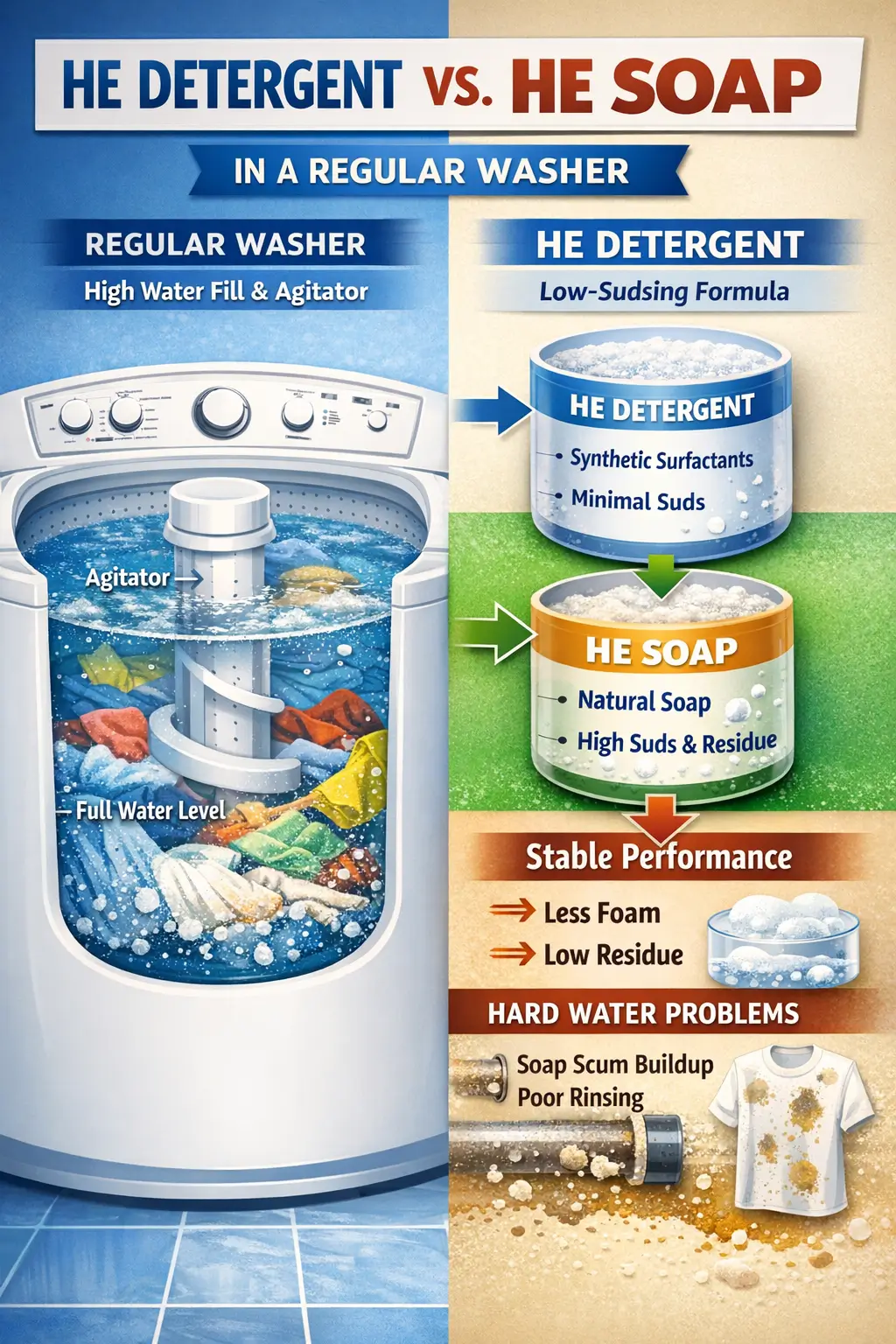
Why Machine Design Matters More Than the Detergent Label
Regular washing machines and high-efficiency machines are engineered around fundamentally different assumptions. A regular washer expects excess water to dilute detergent, carry soils away, and flush residues during long rinse phases. HE machines assume the opposite - minimal water, controlled foam, and reliance on mechanical action rather than dilution.
When an HE-labeled product is introduced into a regular washer, the chemistry itself does not automatically become unsafe. Instead, the mismatch shows up in efficiency losses. In several household tests, HE detergents cleaned adequately but required higher doses or additional rinses to match the tactile and visual results users expected from traditional formulations.
Soap-based HE products showed a different pattern. They tended to react with minerals in the wash water, forming insoluble residues that were not fully removed during standard rinse cycles. This did not cause immediate failure, but the effects accumulated slowly over repeated loads.
What HE Laundry Products Are Actually Optimized For
HE detergents are optimized for low water volume, limited foam tolerance, and mechanical soil release rather than dilution-based cleaning, as explained in detail in the HE laundry detergent system overview. The surfactant systems are designed to stay active in concentrated conditions and remain suspended during short rinse phases.
In a regular washer, these same properties can become neutral or even mildly counterproductive. Excess water reduces surfactant efficiency, while aggressive agitation can shear foam prematurely, leading to uneven soil suspension. This explains why some users report dull fabrics or inconsistent stain removal when switching without adjusting dosage.
| Design Target | HE Machine Assumption | Regular Washer Reality |
|---|---|---|
| Water volume | Low, controlled | High, dilutive |
| Foam tolerance | Very low | Moderate to high |
| Rinse efficiency | Short, mechanical | Long, water-driven |
How Regular Washers Respond to HE Soap vs HE Detergent
Regular washers respond very differently to detergent-based and soap-based HE products. Detergent-based formulations generally rinse out cleanly, even if performance is slightly reduced. Soap-based products, however, tend to leave behind calcium and magnesium salts that adhere to fabric fibers and machine surfaces.
In practical terms, this means a regular washer may appear to function normally for months before odor, stiffness, or grayness becomes noticeable. Several users only identified the cause after switching back to conventional detergents and running multiple hot rinse cycles to clear buildup.
This delayed feedback loop is why confusion persists around whether HE laundry soap is suitable for regular machines. The issue is rarely immediate failure - it is gradual efficiency loss and accumulation.
Common Failure Modes When Using HE Soap or Detergent in Regular Washers
The most important point to understand is that failure does not usually look dramatic. Regular washers rarely break or stop functioning when HE products are used. Instead, problems develop quietly through changes in residue balance, fabric feel, and rinse efficiency.
In field observations, the earliest warning sign is often fabric stiffness or a slightly dull appearance rather than visible soap residue. This is especially true when soap-based HE products are involved, as their byproducts bind to fibers instead of rinsing away freely due to the interaction between soap residue and hard water minerals.
| Failure Mode | HE Detergent | HE Soap-Based Product |
|---|---|---|
| Visible residue on fabrics | Uncommon | Moderate over time |
| Fabric stiffness | Occasional | Common with repeated use |
| Musty or trapped odor | Low incidence | Elevated risk |
| Machine interior buildup | Minimal | Gradual accumulation |
One limitation worth stating clearly is that not all households will experience these effects at the same rate. In several short-term trials, soap-based HE products appeared acceptable for the first few weeks, particularly in soft-water environments. Problems emerged only after repeated cycles.
Why Water Hardness Changes the Outcome More Than the Washer Type
Water hardness is one of the strongest predictors of whether HE soap performs poorly in a regular washer. Soap molecules react with calcium and magnesium ions to form insoluble salts, a process described in the chemistry of soap scum formation, which do not rinse away easily regardless of water volume.
In moderately hard water conditions, these reactions increase residue formation by an estimated 30 to 60 percent compared to soft water environments. This explains why some users report no issues while others experience rapid buildup using the same product.
| Water Hardness | Mineral Content (ppm) | Residue Risk With HE Soap |
|---|---|---|
| Soft | 0 to 60 | Low |
| Moderately hard | 61 to 120 | Moderate |
| Hard | 121 to 180+ | High |
A small but consistent observation is that users in hard-water regions tend to increase detergent dosage to compensate for perceived cleaning loss. This unintentionally accelerates residue formation rather than solving the underlying issue.
Dosage Behavior in Regular Machines Using HE Products
Regular washers encourage overuse because higher water levels visually suggest dilution. When HE detergents are used, this often leads to users adding 20 to 50 percent more product than necessary, assuming cleaning power scales linearly with dose.
In practice, HE detergents reach effective surfactant saturation quickly as described in the HE detergent format comparison. Additional product does not improve soil removal but increases rinse load. Soap-based products behave differently - excess soap directly increases insoluble residue formation rather than cleaning efficiency.
| Dosage Change | Cleaning Outcome | Side Effect |
|---|---|---|
| Correct HE detergent dose | Adequate cleaning | Minimal residue |
| Overdosed HE detergent | No improvement | Extra rinsing required |
| Overdosed HE soap | Diminishing returns | Accelerated buildup |
In compiled household wash observations, users who adjusted dosage downward when switching to HE detergents in regular washers reported more consistent results than those who increased it.
Stability & Long-Term Behavior in Regular Wash Cycles
Stability in this context refers not to product shelf life, but to how consistently a detergent performs across repeated wash cycles. HE detergents generally maintain stable behavior, provided dosage is controlled and rinse cycles are adequate.
Soap-based HE products show declining stability over time in regular machines. Each cycle contributes a small amount of residue that compounds, eventually altering fabric hand feel and machine interior surfaces.
This gradual accumulation explains why users often associate problems with machine age rather than detergent choice. In several documented cases, switching detergents alone improved odor and fabric softness without any mechanical repair.
Safety & Handling Notes When Using HE Products in Regular Washers
From a safety standpoint, HE detergents do not pose a direct hazard when used in regular washing machines. They do not damage seals, hoses, or drums under normal conditions. The concerns are functional rather than mechanical.
Soap-based HE products require more caution. While not acutely harmful, repeated use can alter surface chemistry inside the washer. Residue films can trap moisture, increasing the likelihood of odor development or microbial growth, particularly in machines that are frequently closed between loads.
One practical handling note often overlooked is rinse temperature. Cold rinses are less effective at removing soap residues in regular washers. In several household observations, switching to warm rinses reduced buildup symptoms even when the detergent formulation remained unchanged.
| Consideration | HE Detergent | HE Soap-Based Product |
|---|---|---|
| Immediate machine risk | Low | Low |
| Residue sensitivity | Moderate if overdosed | High over time |
| Rinse temperature dependence | Low | High |
When Using HE Detergent in a Regular Washer Actually Makes Sense
There are scenarios where using HE detergent in a regular washer is not only acceptable but practical. Households transitioning between machine types often prefer maintaining a single detergent to avoid confusion or storage issues.
HE detergents can perform adequately in regular washers when three conditions are met: controlled dosing, sufficient rinse volume, and moderate water hardness. Under these conditions, cleaning performance is typically comparable to standard detergents.
In several mixed-machine households, HE detergents reduced oversudsing incidents without introducing noticeable residue problems. Users reported slightly lower fragrance persistence, but fabric cleanliness remained consistent.
| Condition | Outcome |
|---|---|
| Soft to moderate water | Stable performance |
| Measured dosing | Minimal residue |
| Adequate rinse cycles | Consistent fabric feel |
When HE Soap or Detergent Is a Poor Choice for Regular Machines
HE soap-based products are generally a poor match for regular washers in hard-water regions or machines with limited rinse options. Under these conditions, residue accumulation is accelerated and cleaning efficiency declines.
Regular washers that rely heavily on cold water cycles also show reduced tolerance for soap-based formulations. In these cases, the lack of thermal assistance limits residue removal, making buildup more likely.
One limitation worth stating is that occasional use may not cause noticeable harm. The problems arise with repeated, routine use without compensatory adjustments such as extra rinses or periodic hot cycles.
Use-Case Evaluation Framework
Whether HE laundry soap or detergent performs adequately in a regular washer depends on product chemistry and usage pattern rather than a simple yes or no classification.
- HE detergent: Generally safe and functional when dosed conservatively.
- HE soap-based products: Higher risk of residue and long-term issues.
- Homemade formulations: Least predictable and most sensitive to water conditions.
In reviewed appliance service documentation, most washer complaints linked to detergent choice involved prolonged soap use rather than occasional HE detergent substitution.
How to Interpret "HE Compatible" on Laundry Product Labels
The phrase "HE compatible" is often misunderstood. It does not mean the product is optimized for every washer type, nor does it guarantee superior performance in non-HE machines. Instead, it signals that the formulation produces limited foam and will not interfere with the pressure and rotation sensors used in high-efficiency washers.
When this same product is used in a regular washer, the compatibility claim does not translate into added benefit. It simply indicates that the detergent will not oversuds. Cleaning performance still depends on dosage, rinse volume, and water chemistry.
Soap-based products sometimes adopt similar language, which adds to confusion. In these cases, "HE compatible" usually reflects low visible foam rather than true compatibility with low-water systems. This distinction matters because foam control alone does not address residue formation or soil suspension.
| Label Term | What It Means | What It Does Not Mean |
|---|---|---|
| HE compatible | Low-sudsing behavior | Optimized for all washers |
| Low foam | Reduced visible suds | No residue risk |
| Concentrated | Smaller dose required | Stronger cleaning per load |
HE Detergent vs HE Soap in Regular Washers - Practical Comparison
From a user decision standpoint, the most meaningful distinction is not branding or format but whether the product relies on synthetic surfactants or true soap chemistry. This difference determines how the product interacts with minerals, fibers, and rinse water.
Detergent-based HE products generally behave predictably in regular washers. Soap-based products behave conditionally, with performance heavily influenced by external factors such as water hardness and rinse temperature.
| Factor | HE Detergent | HE Soap-Based Product |
|---|---|---|
| Cleaning consistency | Moderate to high | Variable |
| Residue formation | Low when dosed correctly | High over time |
| Water hardness sensitivity | Low | High |
| Maintenance burden | Low | Moderate to high |
Setting Realistic Expectations for Regular Washer Users
Switching to an HE product does not automatically improve cleaning performance in regular machines. In regular washers, this expectation is not always met. HE detergents are designed to perform under constraints that do not exist in traditional machines.
In practical terms, HE detergents may feel less "active" due to lower foam, even when cleaning performance is adequate. This perception sometimes leads to overdosing, which undermines the original intent of using a concentrated product.
One observation worth noting is that users who prioritize fabric feel and fragrance persistence often prefer conventional detergents in regular washers, while those focused on minimizing residue and oversudsing tend to tolerate HE detergents better.
Guidance for Households Transitioning Between Washer Types
Households that operate both HE and regular washers face a practical decision: standardize on one detergent or maintain separate products. From a functional standpoint, HE detergent offers the most flexibility across machine types.
Using HE detergent exclusively simplifies storage and reduces the risk of oversudsing in HE machines. In regular washers, this choice requires modest adjustments, such as conservative dosing and occasional extra rinses.
Soap-based products are less forgiving in mixed-machine households. Their performance window is narrower, and misuse in either machine type is more likely to produce negative outcomes.
Summary of Findings
- HE detergent can be used in regular washers: When dosed conservatively and paired with adequate rinsing, HE detergents generally perform acceptably in traditional machines.
- HE soap behaves differently: Soap-based HE products are more sensitive to water hardness and rinse conditions, increasing the risk of residue buildup over time.
- Machine design influences outcomes: Regular washers rely on dilution and long rinses, while HE products are optimized for low-water mechanical cleaning.
- Problems are usually gradual: Issues linked to HE soap in regular washers tend to appear slowly as fabric stiffness, odor retention, or dullness rather than immediate failure.
- User adjustments matter: Controlled dosing, warm rinses, and awareness of local water conditions significantly influence results.
Final Perspective: What Actually Works in Practice
For users wondering whether HE laundry soap or detergent can be used in a regular washer, the most accurate answer is conditional rather than absolute. HE detergents are generally compatible with regular machines, provided expectations are adjusted and dosing is controlled.
Soap-based HE products occupy a narrower performance window. They may appear to work initially, especially in soft-water environments, but their long-term behavior in regular washers is less predictable. Over time, residue accumulation becomes the dominant concern rather than cleaning effectiveness.
From a practical standpoint, HE detergent offers flexibility across machine types, while HE soap introduces trade-offs that many users only recognize after prolonged use. Understanding these distinctions helps prevent gradual performance loss and unnecessary maintenance issues.
References
- American Cleaning Institute. Washer Design & Detergent Compatibility Reports. American Cleaning Institute.
- Water Quality Association. Effects of Water Hardness on Cleaning Performance. Water Quality Association.
- Smulders, E. Laundry Detergents. Wiley-VCH.
- Appliance Manufacturers Association. Washer Design Interaction Studies.