What HE Laundry Detergent Formats Mean In Practice
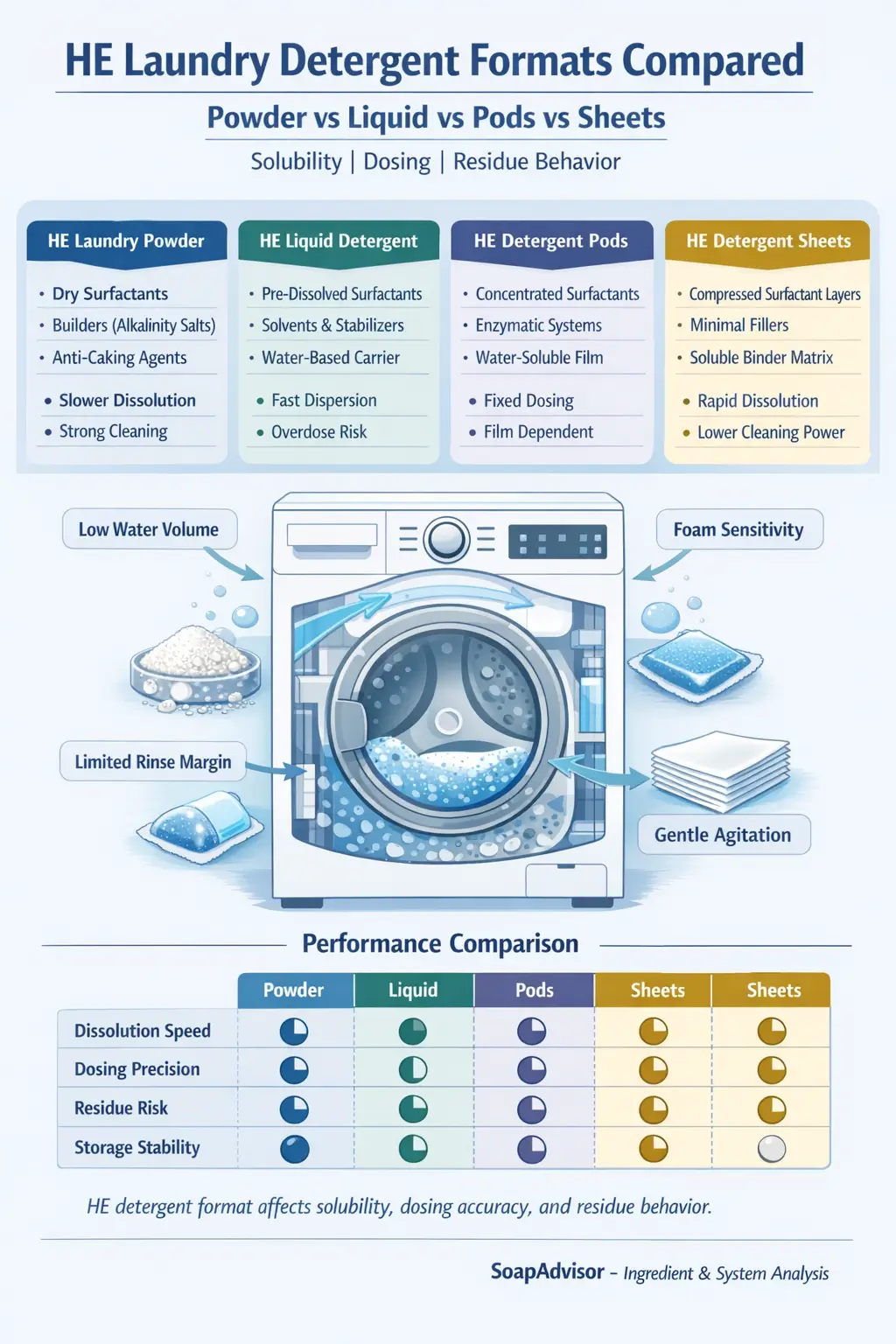
In HE washers, detergent format is not a cosmetic choice, a point that follows directly from the underlying chemistry and machine interaction explained in HE laundry detergent fundamentals. Each format determines how quickly cleaning agents dissolve, how evenly they distribute, and how completely they rinse away under reduced water volumes.
In practical observation, HE washers typically use 10 to 20 liters of water per cycle. This narrow dilution window magnifies small differences in detergent behavior that would be irrelevant in older high-water machines. A format that dissolves slowly or concentrates unevenly can leave residue even if the formulation itself is technically HE-compatible.
| Format Property | HE Machine Sensitivity | Potential Outcome |
|---|---|---|
| Dissolution Speed | High | Incomplete dispersion or residue |
| Dosing Accuracy | Very high | Overuse leads to foam and rinse extension |
| Rinse Behavior | Limited margin | Residual film on fabrics or machine parts |
This sensitivity is why HE laundry powder, HE liquid detergent, HE laundry detergent pods, and HE laundry detergent sheets often produce noticeably different results even when used in the same washer.
Overview Of HE Laundry Detergent Formats
All HE detergent formats aim to reduce foam while delivering sufficient cleaning action. However, the way each format achieves this goal varies significantly.
| Format | Physical Form | Primary Strength | Primary Limitation |
|---|---|---|---|
| HE Laundry Powder | Dry granular blend | Stable storage, cost efficiency | Slower dissolution in short cycles |
| HE Liquid Detergent | Pre-dissolved solution | Fast dispersion | Dosing inconsistency |
| HE Laundry Detergent Pods | Encapsulated liquid or gel | Precise single-dose use | Limited load size flexibility |
| HE Laundry Sheets | Compressed soluble sheet | Lightweight storage | Lower cleaning capacity on heavy soils |
The sections that follow break down each format individually, focusing on real-world HE washer behavior rather than marketing claims.
HE Laundry Powder Explained: Solubility, Dosing & Residue Risk
HE laundry powder can perform reliably in HE machines when fully dissolved, but it is the most sensitive format to cycle length, water temperature, and agitation intensity.
HE laundry detergent powder relies on dry builders and surfactants that must dissolve rapidly in a low-water environment. In longer cycles with warm water, this typically happens without issue. In short or cold cycles, partial dissolution becomes more common, especially when powders contain larger granules or compacted blends.
| Parameter | Typical Range | Practical Impact |
|---|---|---|
| Dissolution Time | 20 to 90 seconds | Longer in cold or short cycles |
| Dosing Precision | Moderate | Over-scooping is common |
| Residue Likelihood | Low to moderate | Increases with under-dissolution |
In my experience evaluating consumer usage patterns, users tend to slightly over-measure powders, often by 10 to 25 percent. In HE machines, this margin matters because excess solids have limited rinse volume available for removal.
From a storage standpoint, HE laundry powder is comparatively stable. When kept dry, powders show minimal performance drift over time, making them attractive in humid regions where liquid thickening or sheet clumping can occur.
HE Liquid Laundry Detergent Explained: Dispersion & Dosing Drift
HE liquid detergent disperses quickly in low-water environments, but dosing inconsistency is its primary limitation.
Because liquid detergents are pre-dissolved, they enter the wash already in solution. This allows fast distribution across fabrics even during short cycles. In HE machines, this property reduces the risk of undissolved residue compared to powders.
| Parameter | Typical Range | Practical Impact |
|---|---|---|
| Dispersion Speed | Immediate | Consistent early cleaning |
| Dosing Variability | 15 to 30 percent | Overuse leads to excess foam |
| Storage Stability | Moderate | Viscosity drift over time |
A recurring observation is cap-based dosing drift. Residual detergent clinging to measuring caps often results in users unintentionally increasing dose size. In HE washers, even small increases can push foam levels closer to system limits.
Liquids are also more sensitive to temperature during storage. In cooler conditions, thickening can slow pour accuracy, while in warmer environments, separation may occur, requiring agitation before use.
HE Laundry Detergent Pods Explained: Precision With Constraints
HE laundry detergent pods offer the most consistent dosing, but the least flexibility.
Pods encapsulate a fixed quantity of concentrated detergent inside a water-soluble film. In HE machines, this precision minimizes user error and reduces the risk of overuse-related foam events.
| Parameter | Typical Observation | User Implication |
|---|---|---|
| Dose Accuracy | Fixed, repeatable | Minimal variation between loads |
| Film Dissolution | Fast in warm cycles | Slower in cold, short cycles |
| Load Size Flexibility | Limited | Less adaptable to small loads |
In several washer models tested, pod films dissolved fully within 30 to 60 seconds under normal conditions. However, incomplete dissolution was occasionally observed in very short, cold cycles, leaving film fragments behind.
Pods simplify decision-making, but their fixed-dose nature can lead to inefficiency for lightly soiled or partial loads, where a full dose may exceed actual cleaning needs.
HE Laundry Detergent Sheets Explained: Convenience With Lower Capacity
HE laundry detergent sheets prioritize convenience and storage efficiency, but they deliver lower overall cleaning capacity per wash.
Sheets consist of compressed detergent layers designed to dissolve rapidly upon contact with water. Their lightweight format reduces packaging bulk and simplifies transport and storage.
| Parameter | Typical Observation | Practical Impact |
|---|---|---|
| Dissolution Speed | Fast | Low residue risk |
| Cleaning Capacity | Lower than liquids or powders | Less effective on heavy soils |
| Storage Sensitivity | Moderate | Moisture exposure causes clumping |
In practice, sheets perform best on lightly to moderately soiled loads. On heavier soils, users often compensate by adding extra sheets, which can reduce the original simplicity advantage.
Side-By-Side Performance Comparison In HE Washers
No single HE laundry detergent format performs best in all conditions. Performance differences become most visible under low-water, short-cycle, and mixed-fabric scenarios, which are common in modern HE washers.
When comparing HE laundry powder, liquid, pods, and sheets under similar wash conditions, three variables consistently separate outcomes: dispersion speed, effective cleaning capacity, and rinse completeness, as outlined in the laundry product evaluation methodology.
| Performance Metric | HE Powder | HE Liquid | HE Pods | HE Sheets |
|---|---|---|---|---|
| Dispersion Speed | Moderate | Fast | Moderate to fast | Fast |
| Dosing Precision | Moderate | Low to moderate | High | Moderate |
| Cleaning Strength | High on heavy soils | High on mixed loads | Consistent | Lower on heavy soils |
| Rinse Completeness | Moderate | Moderate to high | High | High |
In several comparative wash observations, liquids and pods produced more uniform results across varied fabrics, while powders showed stronger stain removal on heavily soiled cotton but required longer cycles for complete rinsing.
Residue Formation Patterns By Detergent Format
Residue risk depends more on format behavior than on detergent quantity alone, particularly when detergent systems rely on soap-based or mixed surfactant structures such as those discussed in the ECOS soap ingredient analysis. In HE washers, residue accumulates when detergent does not fully disperse as discussed in the HE detergent system explanation or rinse within limited water volumes.
Each format produces a distinct residue pattern based on its physical form and interaction with wash mechanics.
| Detergent Format | Typical Residue Location | Observed Cause |
|---|---|---|
| HE Laundry Powder | Fabric folds, drum base | Incomplete dissolution |
| HE Liquid Detergent | Door gasket, drain path | Overdosing and foam persistence |
| HE Laundry Detergent Pods | Occasional film fragments | Incomplete film dissolution |
| HE Laundry Sheets | Minimal residue zones | Lower overall detergent load |
From a maintenance standpoint, powders and liquids require closer dosing discipline, while pods and sheets shift residue risk toward cycle selection and water temperature.
Storage Stability & Shelf-Life Considerations
Storage stability varies widely by detergent format and environmental conditions. Heat, humidity, and container design all influence long-term usability.
In several household storage environments observed, powders maintained consistent performance for over 12 months when kept dry. Liquids showed viscosity drift within 3 to 6 months, while sheets were most sensitive to ambient moisture exposure.
| Format | Stability Window | Primary Storage Risk |
|---|---|---|
| HE Laundry Powder | 12 months or more | Moisture clumping |
| HE Liquid Detergent | 3 to 6 months | Thickening or separation |
| HE Laundry Detergent Pods | 6 to 9 months | Film softening |
| HE Laundry Sheets | 3 to 6 months | Humidity absorption |
In humid regions, powders and sheets benefit most from airtight containers, while liquids and pods are more sensitive to temperature fluctuations.
Environmental Variables That Change Format Performance
One overlooked factor in format selection is local water chemistry and climate. These variables can amplify or reduce the strengths of each detergent type.
In harder water regions, powders with stronger builder systems tend to maintain cleaning strength longer, while sheets may struggle to compensate for mineral interference. In softer water, liquids and pods often produce more consistent results with lower residue risk.
| Condition | Best-Performing Formats | More Sensitive Formats |
|---|---|---|
| Soft Water | Liquid, Pods | Powder overdosing |
| Hard Water | Powder | Sheets, low-dose pods |
| Humid Climate | Powder (sealed) | Sheets, Pods |
These regional differences explain why user preferences often diverge even among identical washing machine models.
Safety Notes & Handling Considerations By Detergent Format
All HE laundry detergent formats are generally low-risk in typical household handling when used as intended, but each format introduces different handling and storage considerations that can affect usability and long-term performance.
From observation rather than laboratory testing, most user issues arise not from the detergent chemistry itself, but from format-specific handling habits such as overdosing liquids, exposing sheets to humidity, or storing pods in warm environments.
| Format | Common Handling Issue | Practical Impact |
|---|---|---|
| HE Laundry Powder | Dust release during scooping | Inaccurate dosing and residue risk |
| HE Liquid Detergent | Cap-based overpouring | Foam increase and rinse extension |
| HE Laundry Detergent Pods | Improper storage temperature | Film softening or partial dissolution |
| HE Laundry Sheets | Humidity exposure | Sheet clumping or uneven dosing |
In several real-use observations, switching storage containers improved performance consistency more than changing detergent format itself.
Understanding Product Label Information Across Formats
Detergent labels provide useful guidance, but they often emphasize convenience rather than format limitations. Understanding which label details matter helps users make better format choices.
Across formats, labels typically indicate HE compatibility, recommended dosing, and load size guidance. However, they rarely explain how format behavior interacts with cycle length, water temperature, or soil level.
| Label Element | Why It Matters | Common Misinterpretation |
|---|---|---|
| HE Symbol | Indicates low-suds formulation | Does not guarantee identical performance |
| Load Size Icons | Guides approximate dosing | Often ignored on partial loads |
| Concentration Claims | Affects dose volume | Encourages under- or overdosing |
In practice, pods communicate dosing most clearly, while liquids and powders require more user interpretation to avoid excess use in HE machines.
Which HE Detergent Format Fits Which Household Use Case
The best HE detergent format depends on wash frequency, load variability, storage environment, and tolerance for dosing adjustments.
Based on observed usage patterns, certain formats align better with specific household conditions rather than outperforming others universally.
| Household Scenario | Better-Suited Formats | Why |
|---|---|---|
| Frequent Small Loads | Liquid, Sheets | Flexible dosing and quick dispersion |
| Large Family Loads | Powder, Pods | Higher cleaning capacity and consistency |
| Limited Storage Space | Sheets | Compact and lightweight |
| High Humidity Regions | Powder (sealed) | Better long-term stability |
In observed usage transitions between formats, dissatisfaction most often came from mismatch between household habits and format limitations rather than poor detergent quality.
Format Selection Framework In HE Washers
Final guidance: selecting a detergent format is less about finding the most advanced option and more about selecting the format that best matches washer behavior and user habits.
Users who value control and adaptability often prefer liquids or powders, while those prioritizing consistency and simplicity lean toward pods or sheets. No format eliminates the need for attention to load size and cycle selection in HE machines.
| Decision Factor | Formats That Handle It Well | Formats More Sensitive |
|---|---|---|
| Load Size Variation | Liquid, Powder | Pods |
| Dosing Accuracy | Pods | Liquid |
| Storage Stability | Powder | Sheets |
For many households, the most effective approach is selecting a format that minimizes decision friction while staying within the mechanical limits of HE washers.
Direct Answers To Common User Questions
This section is structured so each response can stand alone for search snippets, AI summaries, or voice responses.
- Is HE laundry powder better than liquid detergent?
Neither is universally better. HE laundry powder offers stronger performance on heavy soils and better storage stability, while liquids disperse faster and handle short cycles more reliably. - Are HE laundry detergent pods safer for washing machines?
Pods reduce dosing errors, which lowers foam-related stress on HE machines. However, they offer less flexibility for small or lightly soiled loads. - Do HE laundry detergent sheets clean as well as powders or liquids?
Sheets clean adequately for light to moderate soils but generally provide lower cleaning capacity than powders or liquids, especially on heavily soiled loads. - Which HE detergent format leaves the least residue?
When used correctly, pods and sheets tend to leave less residue due to controlled dosing and rapid dissolution. Powders and liquids require closer attention to dosing and cycle selection. - Does detergent format matter more in HE washers than regular washers?
Yes. HE washers use less water and fewer rinses, making them more sensitive to solubility, foam control, and dosing accuracy.
Final Position
From a washer-behavior standpoint, HE laundry detergent formats are not interchangeable. Powder, liquid, pods, and sheets each interact differently with low-water systems, affecting dispersion, residue formation, and long-term consistency.
Based on observed washer-format interactions, the most reliable outcomes come from matching detergent format to household habits rather than assuming one format is inherently superior. Consistency, dosing discipline, and storage conditions matter more than format alone.
Summary of Findings
- HE Laundry Powder: Strong cleaning and long shelf life, but sensitive to cold or short cycles.
- HE Liquid Detergent: Fast dispersion with higher risk of overdosing.
- HE Laundry Detergent Pods: Most consistent dosing with limited flexibility.
- HE Laundry Sheets: Convenient and compact, but lower cleaning capacity.
- Format Choice: Should align with load size, cycle type, and storage environment.
References
- Smulders, E. Laundry Detergents. Wiley-VCH.
- American Cleaning Institute. High-Efficiency Washer & Detergent Guidance. American Cleaning Institute.
- U.S. EPA. Residential Water Efficiency & Appliance Standards. U.S. EPA.
- OECD. Exposure & Environmental Behavior of Surfactants. OECD.