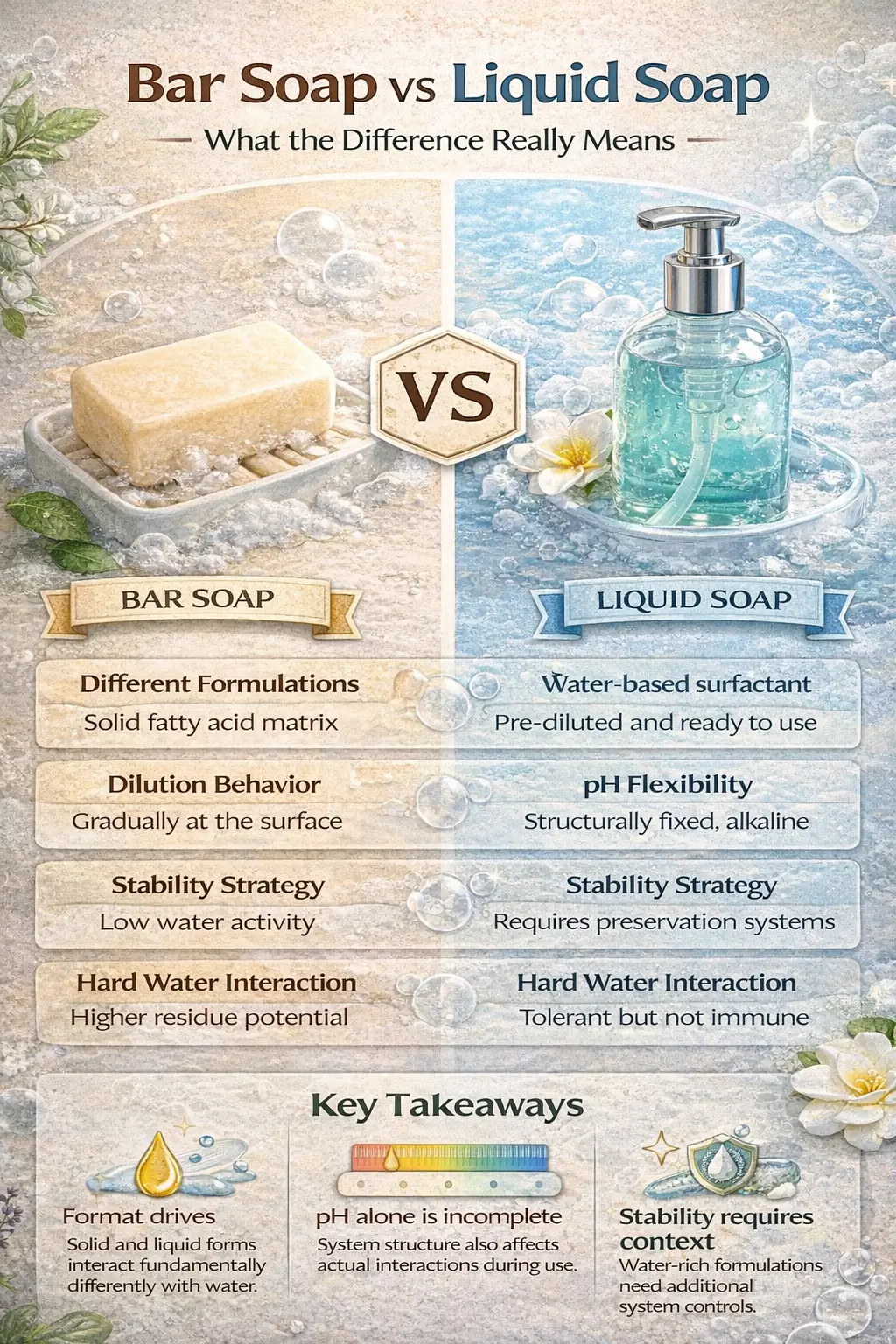
What A Soap System Is
A soap system is not just a list of ingredients. It is a stable arrangement of cleansing agents, water interaction, structural controls, and delivery format. The system determines how the product dissolves, spreads, rinses, and changes over time.
In bar soap, the system is built around a solid matrix formed by saponified fatty acids. For a deeper structural explanation, see our Bar Soap Formulation Basics. In liquid soap, the system is built around a water-dominant phase stabilized by surfactants and viscosity modifiers.
Because these systems operate differently at a physical level, many observed differences in feel, longevity, and handling emerge without any change in cleansing intent.
Why Physical State Changes Everything
The most fundamental difference between bar and liquid soap is physical state. A solid system behaves differently from a liquid one long before ingredients are considered individually.
Bar soap relies on gradual surface dissolution during use. Only the outer layer interacts with water at any given moment. Liquid soap is already fully dispersed, allowing immediate interaction across the entire applied volume.
This difference explains why bar soaps often feel slower to lather initially, while liquid soaps appear instantly active. The behavior reflects system geometry, not cleaning strength.
Core Ingredient Roles In Each System
In bar soap systems, fatty acid salts provide both structure and cleansing. The same molecules that clean also create the solid form. This dual role limits how much the system can be adjusted without destabilizing the bar.
Liquid soap systems separate these roles. Surfactants handle cleansing, while water, thickeners, and stabilizers manage flow and appearance. This separation allows more flexibility but introduces additional dependencies.
Ingredient-level surfactant breakdowns are available in the Ingredient Library.
These structural differences influence how each system responds to water hardness, storage conditions, and repeated use over time.
How Water Content Shapes Behavior
Water is not just a carrier in soap systems. Its proportion fundamentally changes how the system behaves before, during, and after use. Bar soap contains very little free water at the point of use. Liquid soap is predominantly water by design.
Because bar soap is introduced to water gradually, dilution happens at the surface layer only. The bulk of the bar remains chemically unchanged between uses. This localized dilution is why bar soap usage is inherently self-limiting.
Liquid soap enters use already diluted. The system is pre-expanded, which allows immediate spread and foam generation but also means that every pump delivers a predefined water-to-surfactant ratio regardless of context.
This difference explains why liquid soaps often feel more consistent across uses, while bar soaps can vary slightly depending on water exposure, storage humidity, and drying time between uses.
pH As A System Property, Not A Claim
pH is often discussed as an isolated number, but in soap systems it is better understood as a consequence of formulation structure. Traditional bar soaps are formed through saponification, which naturally results in an alkaline system.
Liquid soap systems can be built using different surfactant chemistries that allow a wider range of pH adjustment. This flexibility exists because cleansing and structure are separated roles in liquid systems.
However, pH alone does not determine how a soap behaves during use. Contact time, rinse dynamics, and dilution all influence how the system interacts with skin and water.
This is one reason pH comparisons between bar and liquid soap frequently lead to oversimplified conclusions. The number describes a condition, not an outcome.
Why Stability Requirements Differ
A dry bar soap is an inhospitable environment for microbial growth. Its low water activity provides inherent stability. As a result, bar soap systems can remain stable for long periods without additional preservation mechanisms.
Liquid soap systems, by contrast, contain sufficient water to support microbial activity if not properly controlled. This requires the inclusion of preservation strategies designed to maintain system integrity over time.
This difference is often misinterpreted as an additive versus natural distinction. In reality, it reflects basic physical chemistry. Water-rich systems require additional controls to remain stable.
The need for preservation does not indicate lower quality. It reflects the demands of maintaining a liquid system in varied storage and usage conditions.
System Constraints At A Glance
| System Aspect | Bar Soap | Liquid Soap |
|---|---|---|
| Primary Structure | Solid fatty acid salt matrix | Water-based surfactant dispersion |
| Water Content At Rest | Very low | High |
| Dilution During Use | Surface-only, gradual | Pre-diluted, immediate |
| pH Flexibility | Structurally limited | Formulation-dependent |
| Stability Strategy | Low water activity | Preservation systems |
How Lather Forms And Why It Feels Different
Lather is often treated as a proxy for cleansing, but in formulation terms it is a byproduct of how surfactants interact with air and water. Bar and liquid soap systems produce lather through different physical routes.
In bar soap, lather develops as the solid surface dissolves and releases fatty acid salts into a thin water layer. Agitation introduces air gradually, so foam builds progressively. This is why bar soap lather often feels denser and more paste-like.
Liquid soap already contains surfactants dispersed in water. When agitated, air is incorporated quickly across the entire applied volume. The resulting foam often appears faster and lighter, even when total surfactant content is comparable.
These differences are frequently interpreted as performance signals. In reality, they reflect how each system introduces air, not how effectively soil is removed.
Rinsing Behavior And Residue Perception
Rinsing behavior is shaped by how completely a cleansing system disengages from the surface once water flow resumes. Bar and liquid soaps release from skin differently because of their structural differences.
Bar soap residues, when present, are typically linked to mineral interactions rather than incomplete rinsing. Fatty acid salts can form insoluble complexes with calcium and magnesium ions, which may be felt as drag or film. Hard water interaction is further explained in our regulatory and labeling analysis.
Liquid soap systems often include surfactants less prone to forming insoluble salts. This can make rinse-off feel quicker or smoother in certain conditions, particularly in hard water regions.
These sensations are system responses to local water chemistry, not indicators of product quality or suitability.
How Hard Water Changes System Behavior
Water hardness is a persistent source of misunderstanding. In many European regions, high calcium and magnesium content alters how soap systems behave during use.
Traditional bar soap systems are more visibly affected by hard water because fatty acid salts readily interact with dissolved minerals. This can reduce lather volume and increase residue formation under certain conditions.
Liquid soap systems are often formulated with surfactants chosen for greater tolerance to mineral ions. This does not eliminate interaction entirely, but it changes how the system responds.
Neither response is inherently preferable. They represent different chemical strategies interacting with the same environmental variable.
Why Usage Patterns Influence Perception
Bar soap usage varies naturally. Amount delivered depends on pressure, contact time, and water exposure. This variability introduces small fluctuations in experience between uses.
Liquid soap systems deliver a more standardized dose per pump. This consistency reduces variation but also fixes dilution and surfactant concentration regardless of context.
These differences influence perception over time. What feels predictable or familiar often reflects system repeatability rather than inherent performance.
Where Each System Reaches Its Limits
No soap system behaves identically under all conditions. Bar soaps are sensitive to prolonged moisture exposure, which can soften the matrix and accelerate wear.
Liquid soaps are sensitive to dilution outside their intended range, such as through water ingress or extended exposure to heat, which can alter viscosity and stability.
These boundary conditions are not flaws. They define the operating range within which each system remains predictable.
Understanding these limits helps explain why experiences differ without resolving those differences into conclusions.
How Storage And Time Affect Each System
Soap systems continue to change outside of active use. For bar soap, exposure to ambient humidity and intermittent water contact gradually alters the outer matrix. Drying between uses allows the surface to reharden, while prolonged moisture can soften the structure and accelerate mass loss.
Liquid soap systems change more subtly over time. Water content remains constant, but viscosity can drift slightly with temperature fluctuation, evaporation at the dispensing point, or repeated air exchange in partially used containers.
These changes are often perceived as inconsistency. In practice, they reflect normal system aging rather than degradation or failure.
Environmental Interaction At A System Level
Both bar and liquid soap systems interact with their surrounding environment, but in different ways. Bar soap interfaces directly with air between uses, which affects drying rate and surface texture.
Liquid soap remains enclosed, limiting air contact but increasing sensitivity to container design, dispensing mechanisms, and temperature exposure.
Neither system is environmentally isolated. Each responds to context in predictable ways based on physical structure rather than formulation intent.
Common Interpretation Errors And Why They Persist
Several recurring misunderstandings shape how bar and liquid soaps are perceived. Faster lather is often assumed to indicate stronger cleansing. Firmer bars are sometimes read as higher quality. Thicker liquids may be interpreted as more concentrated.
These assumptions persist because visible cues are easier to evaluate than system behavior. Texture, foam, and viscosity provide immediate feedback, even when they do not correlate directly with underlying function.
Recognizing these patterns helps separate perception from formulation mechanics without assigning value judgments.
Summary of Findings
- Different systems, not variants: Bar and liquid soaps are built on distinct structural models.
- Physical state drives behavior: Solid and liquid formats interact with water in fundamentally different ways.
- Water content shapes stability: Low-water systems rely on structure, high-water systems require additional controls.
- Environmental context matters: Hard water, humidity, and temperature influence system response.
- Perception often outpaces mechanism: Lather and texture are visible cues, not direct performance measures.
References
- European Commission. Regulation (EC) No 1223/2009 on Cosmetic Products. Official EU Legal Text
- OECD. Consumer Product Exposure Scenarios and Environmental Interaction Frameworks. OECD Risk Assessment Portal
- Rosen, M. J. Surfactants and Interfacial Phenomena. Wiley-Interscience. Publisher Link
- Schramm, L. L. Surfactants: Fundamentals and Applications. Cambridge University Press. Publisher Link