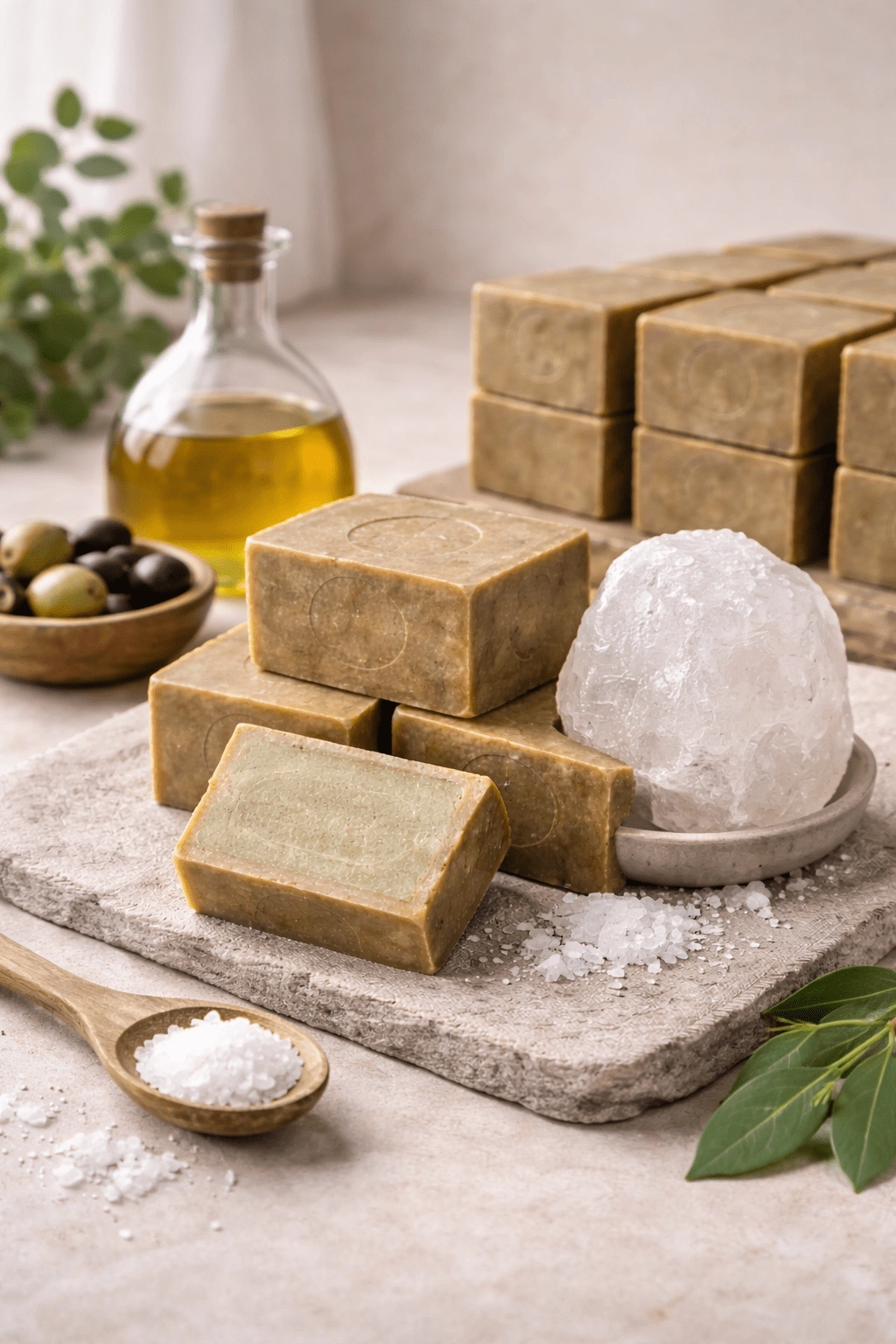
Traditional Context Of Aleppo Soap & Alum Stone
In historical Levantine and Mediterranean routines, Aleppo soap and alum stone were not alternatives, but sequential tools with distinct purposes. Soap removed surface oils and debris, while alum stone was applied afterward to modify skin feel.
This pairing appears in grooming, bathing, and post-cleansing practices, particularly where water quality and climate encouraged controlled cleansing rather than aggressive stripping.
| Material | Primary Role | Timing |
|---|---|---|
| Aleppo Soap | Cleansing via fatty acid salts | First step |
| Alum Stone | Astringent mineral action | Post-cleansing |
A regional observation: alum stone use persisted longer in arid regions, where its tightening effect helped offset soap-related dryness.
Material & Chemical Differences Between Soap And Alum Stone
Aleppo soap is an organic material formed through saponification, a process explained in the bar soap formulation basics guide. Alum stone, by contrast, is an inorganic crystalline mineral, typically potassium aluminum sulfate. Their interaction with skin is therefore fundamentally different.
Soap emulsifies oils and particulate matter. Alum stone interacts with surface proteins and moisture, creating a temporary tightening sensation without cleansing.
| Property | Aleppo Soap | Alum Stone |
|---|---|---|
| Material Type | Organic soap matrix | Mineral crystal |
| Primary Action | Cleansing | Astringency |
| Residue | Rinses away | Leaves microfilm |
A key distinction: alum stone does not replace soap, and soap does not replicate alum’s tightening effect.
Why Aleppo Soap And Alum Stone Are Used Together
The combined use of Aleppo soap and alum stone reflects balance rather than enhancement. Soap prepares the surface by removing oils. Alum stone then modifies the post-cleanse state, reducing slipperiness and altering tactile response.
This sequence is often misinterpreted as "treatment." In practice, it is a mechanical and sensory adjustment, not a corrective process.
| Step | Action | Purpose |
|---|---|---|
| 1 | Aleppo soap cleanse | Remove oils & debris |
| 2 | Rinse thoroughly | Prevent residue interaction |
| 3 | Alum stone application | Surface tightening |
A practical limitation: Overusing alum immediately after soap often creates dryness rather than refinement, a pattern consistent with the documented side effects of Aleppo soap use.
Aleppo Soap And Alum Stone Benefits: What Users Actually Observe
When Aleppo soap and alum stone are used together, the benefits are not additive in the way many modern routines suggest. Instead, each material contributes a distinct mechanical effect that changes how skin feels immediately after cleansing.
Aleppo soap performs the foundational work by removing oils and particulate matter. Alum stone then alters surface sensation through astringency. The perceived "benefit" comes from this contrast rather than from enhancement.
| Aspect | Aleppo Soap Contribution | Alum Stone Contribution |
|---|---|---|
| Skin Feel | Clean, low residue | Tighter, drier finish |
| Surface Control | Oil removal | Reduced slip |
| Sensory Balance | Soft cleansing | Firm after-feel |
A small experiential note: users who apply alum lightly tend to describe refinement, while heavy application often results in stiffness or chalkiness.
How To Use Aleppo Soap And Alum Stone Together
The effectiveness of this traditional pairing depends more on order and restraint than on repetition. Using alum stone on inadequately rinsed skin frequently amplifies dryness rather than delivering control.
The method below reflects observed best practices rather than ritualized instruction.
| Step | Action | Reasoning |
|---|---|---|
| 1 | Cleanse with Aleppo soap | Removes oils and debris |
| 2 | Rinse thoroughly | Prevents soap–alum interaction |
| 3 | Wet alum stone lightly | Controls mineral transfer |
| 4 | Glide once over skin | Avoids excess astringency |
In practice, repeating alum application does not improve outcomes and often reduces comfort.
How Alum Stone Is Traditionally Used After Hair Removal
Alum stone has a long history of use after hair removal, particularly shaving. Its role is often misunderstood as functional removal or inhibition. In reality, its observed effect is surface tightening and moisture reduction.
When applied after shaving or hair removal, alum stone creates a temporary dry film that reduces slip and weeping, altering how skin feels rather than changing hair growth behavior.
| Use Context | Observed Effect | Limit |
|---|---|---|
| After shaving | Tightened surface feel | Temporary only |
| Repeated use | Drier texture | Can over-dry skin |
A clarification worth stating: alum stone does not remove hair nor permanently affect regrowth.
Aleppo Soap, Alum Stone & The Cleopatra Narrative
References to Cleopatra often appear in discussions of natural beauty materials, including soap-like cleansers and mineral astringents. While historical records confirm the use of oils, salts, and minerals in bathing, direct evidence of Aleppo soap in its modern form does not exist for that period.
What does align historically is the concept: cleansing with fats or oils followed by mineral application to modify skin feel in hot climates.
| Element | Historically Supported | Modern Attribution |
|---|---|---|
| Oil-based cleansing | Yes | Linked to Aleppo soap concept |
| Mineral astringents | Yes | Comparable to alum stone |
| Named product use | No | Later interpretation |
A measured judgement: the Cleopatra association reflects continuity of practice, not proof of specific formulations.
Is Alum Stone Safe? Practical Safety Boundaries
Alum stone is widely considered safe when used sparingly on intact skin, but safety here is a matter of dosage and frequency rather than composition alone. As a mineral astringent, alum works by tightening surface proteins and reducing moisture at the skin interface.
In observed use, problems arise not from single applications, but from repeated or prolonged contact. The same astringency that produces a refined finish can gradually shift the skin toward excessive dryness if overused.
| Use Pattern | Typical Outcome | Safety Assessment |
|---|---|---|
| Light, occasional use | Temporary tightening | Generally well tolerated |
| Daily repeated use | Progressive dryness | Requires moderation |
| Heavy pressure application | Chalky residue, discomfort | Not recommended |
A consistent observation: reducing alum contact frequency often resolves discomfort without eliminating use entirely.
Potential Side Effects When Aleppo Soap & Alum Are Combined
When Aleppo soap and alum stone are used together, side effects typically reflect compounded dryness rather than irritation. Soap removes oils; alum reduces surface moisture, a drying pattern similar to those discussed in the Aleppo soap benefits and safety analysis. Used together without restraint, the result can feel overly restrictive.
These effects tend to appear gradually, making early signals-tightness, dullness, reduced flexibility-important indicators.
| Observed Effect | Likely Cause | User Adjustment |
|---|---|---|
| Persistent tightness | Overuse of alum | Reduce frequency |
| Surface dullness | Excessive moisture removal | Shorter contact times |
| Chalky residue feel | Heavy alum transfer | Lighter application |
One practical limitation: increasing soap gentleness does not offset excessive alum use.
Recommended Frequency & Usage Limits
Frequency determines whether the Aleppo soap–alum stone pairing feels balanced or burdensome. In practice, soap can be used regularly depending on formulation strength as discussed in the Aleppo soap complete guide, while alum benefits from intentional spacing between applications.
Users who decouple alum from daily routines often report more consistent comfort without losing its functional effect.
| Material | Suggested Frequency | Rationale |
|---|---|---|
| Aleppo Soap | Daily or as needed | Primary cleansing function |
| Alum Stone | 2–4 times per week | Avoid cumulative dryness |
A small experiential signal: alum stone often feels more effective when used less frequently.
Material Stability, Storage & Degradation
Alum stone is chemically stable but physically sensitive to moisture. When stored wet or enclosed without airflow, it can develop surface irregularities that affect glide and transfer.
Aleppo soap, by contrast, benefits from airflow and time, continuing to harden and refine its feel after purchase.
| Material | Poor Storage Outcome | Preferred Condition |
|---|---|---|
| Alum Stone | Surface pitting | Dry, ventilated storage |
| Aleppo Soap | Softening, faster wear | Airflow & drainage |
A minor but consistent observation: both materials perform better when treated as tools, not cosmetics.
Product Comparison: Aleppo Soap Variants & Alum Stone Types
Not all Aleppo soaps or alum stones behave the same way. Differences in oil ratios, curing discipline, and mineral form meaningfully affect how the pairing performs in real use.
Understanding these distinctions helps users avoid mismatches that can lead to unnecessary dryness or underwhelming results.
| Category | Variation | Observed Behavior |
|---|---|---|
| Aleppo Soap | High olive oil, low laurel | Milder cleanse, slower oil removal |
| Aleppo Soap | Higher laurel content | Stronger cleanse, higher dryness risk |
| Alum Stone | Potassium alum (natural crystal) | Smoother glide, lighter residue |
| Alum Stone | Compressed or blended blocks | Heavier transfer, uneven feel |
A practical judgement: milder Aleppo soap pairs better with alum than high-laurel variants.
How To Read Labels Without Over-Interpreting Claims
Labels for Aleppo soap and alum stone often emphasize tradition, purity, or historical references. While these cues can signal intent, they do not guarantee functional suitability for combined use.
The most reliable indicators remain composition and form, not descriptive language.
| Label Phrase | What It Implies | What To Verify |
|---|---|---|
| "Traditional Aleppo" | Historical method reference | Oil ratio & cure time |
| "Natural Alum" | Mineral origin | Crystal vs compressed form |
| "Cleopatra Beauty" | Symbolic narrative | No functional relevance |
A consistent finding: labels rarely predict how drying or forgiving the pairing will feel.
Traditional Beauty Practices vs Modern Adaptation
Historically, Aleppo soap and alum stone were used with restraint. Bathing frequency was lower, and environmental conditions shaped application habits.
Modern routines often increase frequency and coverage, which can amplify effects that were once moderated by context. Adapting the pairing requires scaling use down, not up.
| Aspect | Traditional Practice | Modern Adjustment |
|---|---|---|
| Cleansing Frequency | Intermittent | Regular but brief |
| Alum Application | Occasional | Limited, targeted |
| Environmental Factors | Dry climates | Variable indoor humidity |
A subtle insight: most modern discomfort comes from frequency mismatches, not ingredient incompatibility.
When The Aleppo Soap & Alum Stone Pairing Is Not Ideal
This pairing is not universally appropriate. Certain conditions and routines magnify its drying tendencies beyond practical benefit.
Recognizing these scenarios prevents unnecessary trial and error.
| Situation | Why It Fails | Better Adjustment |
|---|---|---|
| Very frequent washing | Cumulative moisture loss | Reduce alum use |
| High-laurel soap use | Excessive cleansing strength | Switch to olive-dominant soap |
| Cold, dry environments | Low ambient moisture | Increase recovery time |
A grounded conclusion: effective use depends on moderation rather than intensity.
Summary of Findings
- Different Materials, Different Roles: Aleppo soap cleanses through fatty acid salts; alum stone modifies surface feel through mineral astringency.
- Sequence Matters: Cleanse fully with Aleppo soap, rinse thoroughly, then apply alum lightly-never the reverse.
- Benefits Are Sensory & Functional: Users report cleaner skin with a firmer finish, not additive "treatment" effects.
- Restraint Prevents Side Effects: Overuse-especially of alum-drives dryness and chalkiness; spacing applications improves comfort.
- Tradition Requires Adaptation: Historical practices assumed lower frequency and arid climates; modern routines must scale usage down.
References
- European Commission Cosmetic Regulation (EC) No 1223/2009 – Ingredient Framework
- Journal of Surfactants and Detergents – Soap Cleansing Mechanisms
- European Commission CosIng Database – Potassium Aluminum Sulfate Profile
- International Journal of Cosmetic Science – Mineral Astringent Interaction Studies