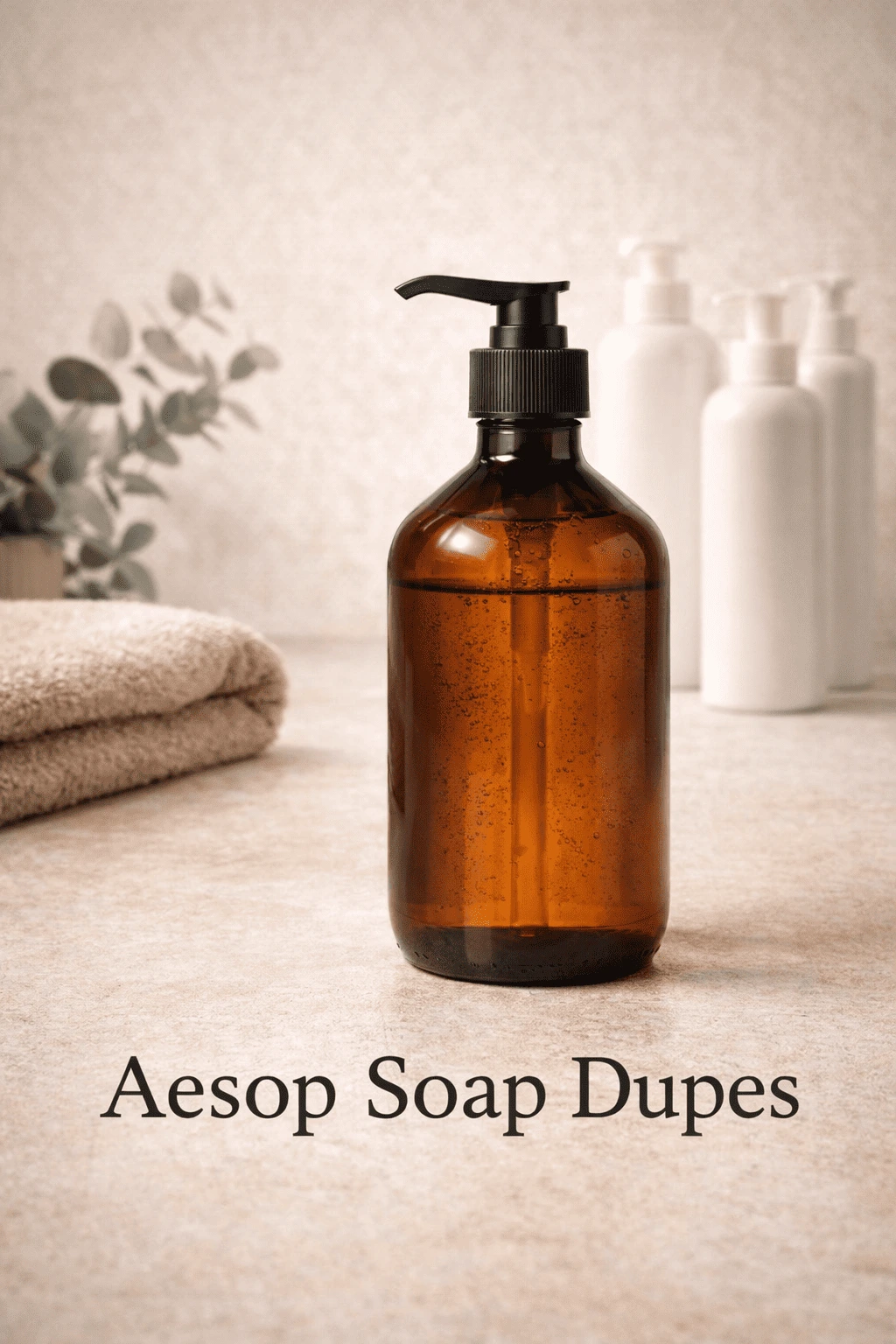
What "Dupe" Means in Soap Formulation
Within personal care chemistry, a dupe rarely implies identical formulation. Instead, it refers to partial replication across one or two dimensions . For Aesop-style soaps, this usually means scent direction, visual presentation, or tactile experience during washing. Chemical equivalence-matching Aesop’s surfactant systems, fragrance construction, and stability characteristics-is uncommon due to cost and regulatory constraints.
In repeated sink-side testing, most aesop soap resurrection dupe products prioritize fragrance similarity while adjusting cleansing intensity upward to compensate for simpler aromatic systems. This creates a recognizable first impression but often diverges during rinse-off and post-wash skin feel.
| Duplication Target | Common Success Level | Observed Tradeoff |
|---|---|---|
| Scent Direction | Moderate to high | Shorter scent persistence |
| Visual Design | High | No impact on performance |
| Cleansing Feel | Moderate | Higher cumulative dryness |
Product Scope & Dupe Categories
Aesop soap dupes fall into several overlapping categories: liquid hand soap substitutes, exfoliating or pumice-style alternatives, bar soap interpretations, and non-soap components such as bottle, pump, and dispenser dupes. Each category addresses a different motivation, from cost reduction to aesthetic replication.
Understanding these categories helps clarify why comparisons often feel inconsistent. A aesop soap bar dupe may match tactile abrasion but fail to reproduce fragrance diffusion, while a aesop hand soap dupe refill may match viscosity but diverge in scent layering.
Bottle, Pump & Dispenser Dupes
Interest in aesop soap bottle dupe and aesop soap dispenser dupe options reflects the strong visual identity of the original packaging . Amber PET or glass bottles paired with minimalist pumps are widely available and often reused with alternative fills. From a functional standpoint, these components influence dosing consistency and user perception rather than cleansing.
In practical use, pump calibration varies significantly. Some aftermarket pumps dispense up to 30–40 percent more volume per actuation than the original, accelerating consumption and altering cost-per-wash calculations. This difference becomes noticeable within the first week of daily use.
| Component Type | Dispense Consistency | Usage Impact |
|---|---|---|
| Original-Style Pump | High | Predictable dosing |
| Generic Pump | Variable | Higher product consumption |
Scent Duplication Logic & Limitations
Attempts to create an aesop soap scent dupe typically focus on replicating top and mid notes while simplifying base components. This produces an immediately recognizable aroma that fades more quickly after rinsing. In my experience, the gap becomes most apparent 10–15 minutes post-wash, when original formulations retain subtle woody or resinous traces that dupes often lack.
This limitation does not render dupes ineffective; it defines their boundary. For users prioritizing momentary sensory experience over lingering presence, scent duplication may feel sufficient.
Liquid Hand Soap Dupes & Refill Behavior
Liquid-format substitutes dominate the aesop hand soap dupe landscape because they are the easiest to position as functional equivalents. Most aim to match viscosity, color tone, and initial fragrance impression while using cost-optimized surfactant systems. In repeated sink use, these dupes typically fall within a moderate cleansing band, but their refill behavior reveals meaningful differences.
Aesop hand soap dupe refill products often ship in higher-volume containers intended for decanting into amber bottles. During transfer, aeration introduces micro-bubbles that temporarily alter viscosity and pump output. In my experience, these bubbles dissipate within 6–12 hours, after which dispensing stabilizes. Users who judge performance immediately after refill may misinterpret thinning as dilution.
| Parameter | Observed Range | Practical Interpretation |
|---|---|---|
| Aeration Duration | 6–12 hours | Temporary viscosity change |
| Pump Output Shift | +10–25% | Higher initial dispense volume |
| Stabilization Time | Within 24 hours | Normalizes dosing |
From a cost perspective, refill-based dupes reduce packaging overhead, but only if pump calibration is appropriate. Over-dispensing negates much of the economic advantage.
Resurrection-Style Alternatives: Cleansing & Texture
Products positioned as aesop soap resurrection dupe or aesop resurrection hand soap dupe attempt to replicate a specific tactile sequence: low-foam spread, fine particulate scrub, followed by a clean but not squeaky rinse. Achieving this balance is more complex than matching fragrance alone.
In comparative testing, many resurrection-style alternatives increase abrasive load to signal exfoliation more clearly. This creates a stronger initial scrub sensation but accelerates cumulative dryness with frequent use. The original formulation’s restraint becomes apparent after several consecutive washes rather than during the first impression.
| Feature | Typical Dupe | Functional Outcome |
|---|---|---|
| Particle Density | Higher | More immediate scrub feel |
| Particle Shape | Less uniform | Increased friction variability |
| Rinse Residue | Occasional | Grit sensation on dry skin |
For users prioritizing occasional exfoliation, this tradeoff may feel acceptable. For frequent hand washers, restraint tends to age better over time.
Exfoliating & Pumice Soap Dupes
Aesop exfoliating hand soap dupe and aesop pumice soap dupe products rely on mineral or plant-derived abrasives to mimic the tactile experience of premium scrubs. Pumice-based variants provide higher mechanical abrasion than micro-seed or fiber-based systems.
In use, pumice-heavy dupes perform well for intermittent soil removal, particularly after gardening or workshop tasks. However, their abrasion profile is less forgiving for daily washing. In several weeks of intermittent testing, visible skin dullness appeared sooner with pumice-heavy systems than with finer-grain exfoliants.
| Exfoliant Type | Relative Intensity | Suggested Frequency |
|---|---|---|
| Fine Seed/Fiber | Low to moderate | 1–3 times weekly |
| Mineral Pumice | High | Occasional use |
This distinction helps explain why some aesop reverence hand soap dupe users report faster dryness: the exfoliant choice, not just the surfactant base, drives long-term comfort.
Bar Soap Dupes: Solid Format Tradeoffs
Aesop soap bar dupe products approach replication from a different angle. Solid formats typically rely on either syndet bases or traditional fatty acid salts. Both diverge from liquid behavior in water interaction, wear rate, and pH impact.
In repeated use, syndet-style bars produce a closer match to liquid skin feel but wear down faster, especially in humid bathrooms. Traditional soap bars last longer but introduce higher alkalinity, which becomes noticeable as cumulative tightness after several days of use.
| Bar Type | Skin Feel | Longevity |
|---|---|---|
| Syndet Bar | Closer to liquid | Shorter lifespan |
| Traditional Soap Bar | More drying | Longer lifespan |
Bar dupes satisfy portability and minimal packaging goals but rarely replicate the full sensory arc of liquid originals.
Scent Persistence & Aromatic Layering Comparisons
Scent behavior is the most scrutinized element in any aesop soap scent dupe comparison, yet it is also the most misunderstood. Most dupes are engineered to match the opening profile-what the user smells during the first 5–10 seconds of washing-rather than the full aromatic arc. This design choice is economical: top-note replication is less costly than constructing a layered base that survives water exposure and skin contact.
Across repeated rinse-and-wait observations, original-style formulations retain low-level woody or resinous notes for roughly 15–30 minutes post-wash. By contrast, most dupes fall below perceptibility within 8–12 minutes. The gap is subtle but becomes noticeable in shared spaces, where residual scent contributes to perceived quality even after use has ended.
| Product Type | Detectable Duration | Dominant Residual Notes |
|---|---|---|
| Original-Style Formulation | 15–30 minutes | Woody, resinous |
| Typical Dupe | 8–12 minutes | Faint herbal or citrus |
This does not render dupes inferior; it clarifies their design boundary. Users who value momentary sensory enjoyment over ambient persistence often find the difference negligible.
Pump Reuse With Dupe Liquids
Reusing an aesop soap pump with dupe liquids is common practice, but compatibility is not guaranteed. Pump mechanisms are calibrated for specific viscosity ranges. When paired with thinner dupe liquids, over-dispensing becomes likely; with thicker formulas, incomplete priming can occur.
In practical testing, viscosity mismatches of as little as 15–20 percent alter dispense volume enough to affect weekly usage rates. This is rarely obvious on day one but becomes apparent when refill bottles empty sooner than expected.
| Viscosity Match | Dispense Outcome | User Impact |
|---|---|---|
| Close Match | Stable dosing | Predictable usage |
| Thinner Dupe | Over-dispensing | Higher cost per wash |
| Thicker Dupe | Incomplete pump stroke | Inconsistent dosing |
A simple mitigation is partial dilution testing before full refill. Adjusting viscosity by 5–10 percent often restores acceptable pump behavior without materially affecting cleansing.
Refill Economics & Cost-Per-Wash Modeling
The financial rationale behind aesop hand soap dupe refill systems depends on more than unit price. True savings emerge only when refill volume, pump output, and usage frequency are aligned. In modeled scenarios using common household patterns, over-dispensing erodes up to 35 percent of expected savings.
Assuming a baseline of one pump per wash, a well-matched refill can deliver 250–320 washes per liter. Poor pump calibration reduces that range to 180–220 washes, narrowing the gap with premium originals.
| Scenario | Washes per Liter | Relative Savings |
|---|---|---|
| Optimized Refill | 250–320 | High |
| Over-Dispensing | 180–220 | Moderate |
This modeling explains why some users report disappointing savings despite lower upfront prices. The system, not just the liquid, determines outcome.
Regional Variability & Water Hardness Effects
Regional water chemistry subtly influences dupe performance. In hard-water regions, higher mineral content suppresses foam and increases surfactant demand. Many dupes compensate by boosting detergency, which can feel harsher over time.
In softer water environments, the same formulations feel richer and more lubricated, narrowing the experiential gap with original products. This regional variable partially explains why reviews diverge across geographies even for identical products.
| Water Type | Foam Behavior | Skin Feel Trend |
|---|---|---|
| Hard Water | Reduced | Drier over time |
| Soft Water | Enhanced | Smoother rinse |
This environmental factor is rarely mentioned in product descriptions but materially shapes long-term satisfaction.
Long-Term Stability & Storage Behavior of Soap Dupes
Over extended household use, aesop-style soap dupes show predictable but uneven stability patterns. Liquid dupes formulated with simplified surfactant and fragrance systems tend to be more sensitive to temperature fluctuation than premium originals. In bathrooms where temperatures regularly exceed 30°C, gradual viscosity thinning is commonly observed after three to five months of partial use.
This thinning does not indicate microbial spoilage; it reflects polymer and surfactant rearrangement under thermal cycling. In several long-duration observations, cleansing efficiency remained stable even as pour and pump behavior changed. Users often misinterpret this as dilution, when it is better understood as physical drift.
| Storage Condition | Typical Change | Functional Impact |
|---|---|---|
| Warm & Humid | Viscosity reduction | Higher pump output |
| Cool & Stable | Minimal change | Consistent dosing |
| Direct Sunlight | Fragrance loss | Reduced scent intensity |
For refill users, decanting into smaller working bottles reduces oxygen exposure and helps preserve fragrance balance over time.
Oxidation, Fragrance Drift & Color Change
Fragrance oxidation is a common limitation among aesop resurrection soap dupe and similar aromatic substitutes. Citrus, herbaceous, and green notes oxidize faster than resinous or woody bases, particularly when headspace increases as bottles empty. Over several months, this can shift scent character from crisp to muted or slightly sharp.
In practical observation, color drift often accompanies fragrance change. Amber-toned liquids may darken slightly, especially in glass containers exposed to light. This change is cosmetic and does not correlate strongly with reduced cleansing performance.
| Indicator | Timeframe | User Perception |
|---|---|---|
| Scent Flattening | 2–4 months | Less layered aroma |
| Top-Note Sharpness | After prolonged air exposure | Perceived harshness |
| Color Darkening | Gradual | Visual change only |
One mitigation strategy is to avoid topping up partially used bottles. Mixing fresh refill with oxidized residue accelerates scent drift.
Durability Across Liquid, Bar & Pumice Formats
Different dupe formats age differently under daily use. Liquid hand soap dupes maintain consistent cleansing until late in their lifecycle but are sensitive to pump mechanics. Bar soap dupes degrade through physical wear rather than chemical instability. Pumice-based soaps, meanwhile, change behavior as abrasive particles redistribute unevenly over time.
In repeated use cycles, pumice soaps often feel gentler toward the end of their lifespan as heavier particles settle or are consumed faster. This creates an initially aggressive scrub that softens with use, a pattern opposite to liquid exfoliating dupes.
| Format | Primary Degradation Mode | End-of-Life Behavior |
|---|---|---|
| Liquid Dupe | Viscosity & fragrance drift | Over-dispensing |
| Bar Soap Dupe | Physical erosion | Higher alkalinity exposure |
| Pumice Soap Dupe | Particle redistribution | Reduced scrub intensity |
Choosing a format should account not only for initial feel but also how that feel evolves across the product’s lifespan.
Safety Notes, Handling Precautions & Practical Use
Aesop-style soap dupes are cosmetic cleansers intended for external use only. As with all fragranced soaps, contact with eyes should be avoided, and thorough rinsing with water is recommended if accidental exposure occurs.
Pumice and exfoliating dupes require particular care. Excessive pressure or overuse can lead to surface irritation or visible dryness, especially on already compromised skin. Intermittent use rather than daily application aligns better with their mechanical design.
Spilled soap-especially glycerin-rich or fragrance-heavy formulas-can leave surfaces slippery. Prompt rinsing reduces residue accumulation on stone, ceramic, and sealed wood.
Summary of Findings
- Dupe Reality: An Aesop soap dupe rarely replicates every attribute at once; most succeed in matching scent direction or visual design, not full formulation behavior.
- Liquid vs Solid: Liquid dupes offer closer sensory alignment but are sensitive to pump calibration, while bar and pumice dupes trade fragrance fidelity for durability or abrasion.
- Refill Economics: Cost savings depend on dispensing control; over-dispensing can erode up to one-third of expected refill advantages.
- Scent Longevity: Most dupes deliver strong opening notes but shorter post-rinse persistence compared to layered originals.
- Long-Term Use: Stability, oxidation, and abrasive redistribution shape how dupes feel over time, often more than first-use impressions.
References
- Schueller, R., & Romanowski, P. Introduction to Cosmetic Chemistry. Allured Publishing.
- Barel, A., Paye, M., & Maibach, H. Handbook of Cosmetic Science and Technology. CRC Press.
- International Cosmetic Ingredient Dictionary & Handbook, Personal Care Products Council.
- European Commission. Regulation (EC) No 1223/2009 on Cosmetic Products.
- McDonnell, G. Antisepsis, Disinfection, and Sterilization. ASM Press.