What Rinsing Means In A Soap System
Rinsing is often treated as a simple mechanical step that follows cleansing. In formulation terms, it is a distinct system phase where dilution, solubility limits, and surface affinity determine what remains after washing.
During rinsing, soap residues transition from a concentrated cleansing environment to a progressively diluted one. This shift alters molecular organization, ion balance, and surface attachment behavior.
Importantly, rinsing does not remove all material equally. Components that remain soluble under dilution tend to leave the surface, while insoluble or surface-bound fractions persist.
This selective removal explains why rinsing outcomes vary even when water quantity appears sufficient.
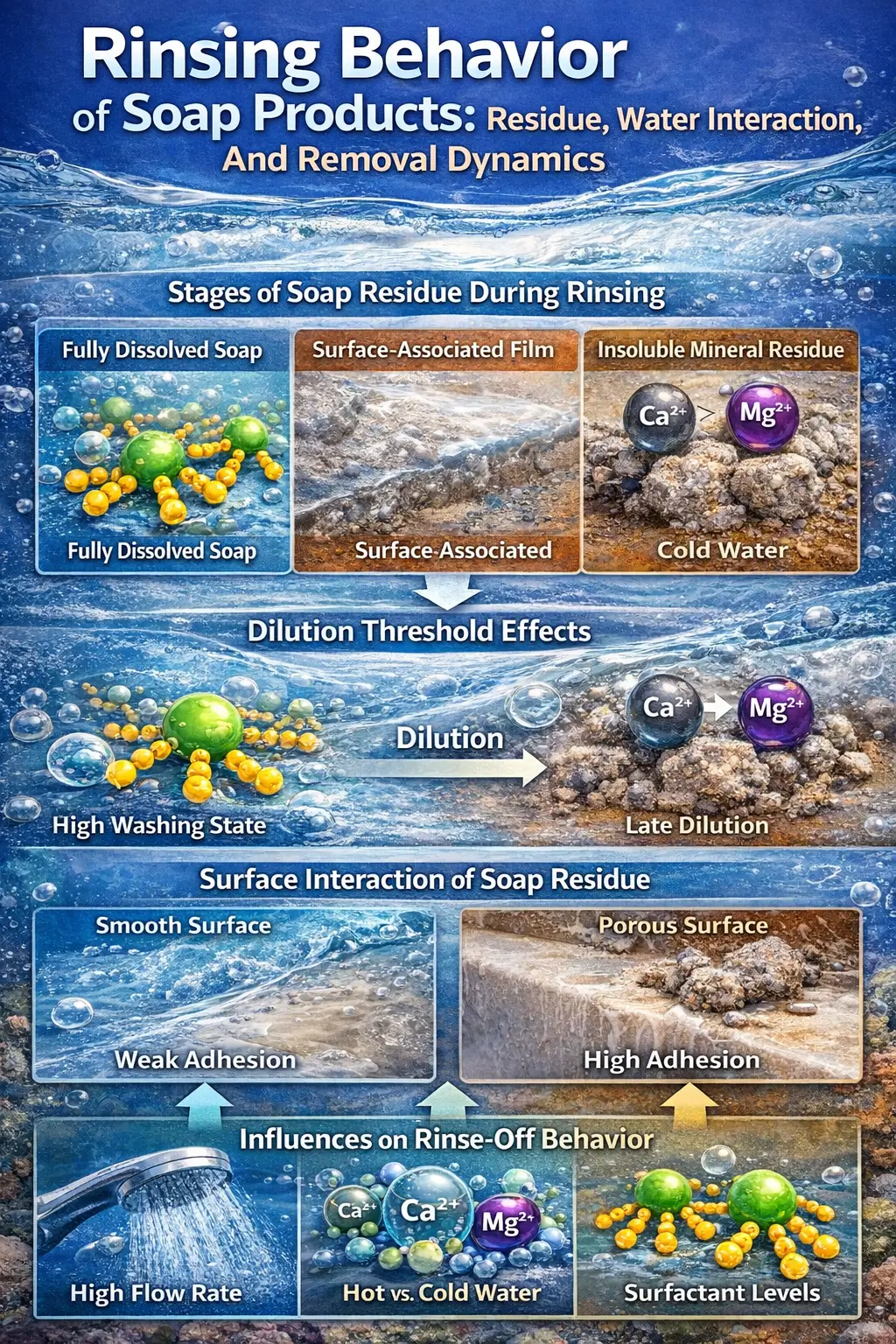
Different States Of Soap Residue After Washing
Soap residue is not a single uniform substance. After active washing, several states may coexist on a surface.
Some soap remains fully dissolved and mobile, readily carried away by flowing water. Other fractions exist as weakly associated films, while some have already transitioned into insoluble complexes.
These states arise from interactions between fatty acid surfactants (fatty acid soaps), dissolved minerals, oils, and surface properties.
| Residue State | Solubility | Rinse Removal Tendency |
|---|---|---|
| Fully dissolved soap | High | Rapid removal |
| Surface-associated film | Moderate | Gradual removal |
| Insoluble metal soap | Low | Persistent |
The relative proportion of these states determines perceived rinse completeness.
How Water Chemistry Shapes Rinse-Off Behavior
Water composition directly influences rinsing behavior by altering solubility and ion exchange dynamics, following the same mineral-driven constraints outlined in soap residue and hard water interaction systems.
In soft water, soap residues tend to remain soluble longer during dilution, allowing more complete removal. In mineral-rich conditions, calcium and magnesium ions promote early precipitation during rinsing.
This effect often becomes more pronounced during late rinse stages, when soap concentration drops but mineral concentration remains constant.
As a result, visible residue may appear after rinsing rather than during active washing, leading to misinterpretation of the rinsing process.
Why Dilution Changes Rinsing Outcomes Late In The Process
Rinsing behavior shifts most noticeably during late-stage dilution, when the soap system crosses critical solubility thresholds. At this point, soap concentration falls rapidly while mineral concentration remains effectively unchanged.
This imbalance alters ion pairing dynamics. Calcium and magnesium ions become relatively more available to interact with remaining soap molecules, increasing the likelihood of insoluble metal soap formation.
As a result, residue formation can intensify near the end of rinsing rather than diminishing steadily. This pattern is often counterintuitive, as increased water contact is expected to improve removal.
The phenomenon explains why surfaces may feel clean during rinsing but develop drag or haze after water flow stops.
How Surface Chemistry Affects Soap Removal
Rinsing efficiency depends not only on water and formulation but also on the surface itself. Surface energy, roughness, and chemical compatibility influence how strongly residues adhere.
Hydrophilic, smooth surfaces tend to release soluble soap films more readily. In contrast, porous or textured materials provide anchoring sites where residues persist despite continued rinsing.
On skin and hair, natural lipids introduce additional complexity. These lipids can trap soap residues, particularly insoluble fractions, slowing removal even when water flow is sufficient.
This variability contributes to differing user perceptions of rinse completeness across materials and body sites.
Temperature And Flow Rate Effects During Rinse-Off
Water temperature influences rinsing primarily through its effect on solubility and molecular motion. Warmer water can temporarily improve soap dispersion, aiding early rinse stages.
However, as water cools or evaporates, previously dispersed residues may re-aggregate. Temperature therefore alters timing rather than determining final residue presence.
Flow rate affects mechanical removal but does not override chemical constraints. Higher flow can dislodge loosely bound material, while strongly adhered residues remain unaffected.
These interactions explain why changes in rinsing conditions sometimes yield inconsistent results without changes in formulation or water chemistry.
Formulation Design Trade-Offs That Influence Rinsing
Soap Formulations vary in fatty acid profile, counterion choice, and inclusion of secondary components. These differences become clearer when compared against the broader design logic discussed in soap vs detergent formulation differences. Liquid soap systems introduce additional solubility and dilution controls explored in liquid soap formulation systems, which further influence how residues behave during rinsing.
Potassium soaps often maintain solubility slightly longer than sodium soaps, extending the rinse window before precipitation occurs a behavior leveraged more deliberately in liquid soap formulation design. Fatty acid chain length and saturation also affect residue cohesion and adhesion.
Some formulations include chelating or dispersing agents that temporarily bind minerals or destabilize aggregates. These components shift rinse dynamics but do not eliminate mineral-driven limitations.
From a system perspective, formulation design balances cleansing efficiency, sensory feel, and residue behavior rather than achieving complete removal under all conditions.
Boundary Conditions Where Rinsing Behavior Changes
In very soft or demineralized water, rinsing tends to be more complete because insoluble metal soap formation is limited. Residue persistence is therefore reduced.
In very hard water, rinsing behavior may plateau quickly. Additional water contact yields diminishing returns once insoluble residues dominate.
Extended contact time without sufficient dilution can also alter outcomes, allowing re-deposition of residues that were briefly mobilized.
These boundaries highlight that rinsing is not a linear process and does not respond uniformly to increased water exposure.
Common Misinterpretations Of Rinsing Performance
A frequent assumption is that residue indicates insufficient rinsing effort, an interpretation that often blurs formulation behavior with comfort expectations discussed in how different soaps are perceived on skin. In many cases, residue reflects chemical state rather than mechanical inadequacy.
Another misinterpretation is equating foam disappearance with complete removal. Lather collapse often precedes residue precipitation rather than signaling system completion.
These misunderstandings persist because rinsing is visually assessed, while key system changes occur at the molecular level.
Summary of Findings
- Selective removal: Rinsing removes soluble fractions more readily than insoluble residues.
- Dilution effects: Late-stage dilution can promote residue formation rather than prevent it.
- Surface influence: Material chemistry strongly affects residue persistence.
- Design trade-offs: Formulation choices shift rinse behavior but do not eliminate constraints.
- System limits: Rinsing outcomes exist on a continuum shaped by water, surface, and formulation.
All interpretations follow the analytical criteria described in our Ingredient Framework and Editorial Policy.
References
- McBain, J. W. Colloid Chemistry and Soap Systems.
- Rosen, M. J. Surfactants and Interfacial Phenomena. Publisher Page
- Myers, D. Surfactant Science and Technology. Publisher Page
- European Commission – Drinking Water Quality Data. Official Resource