Protocol 3 - Sweat Simulation & Bacterial Growth Test

By Rifat Jalal | Last Reviewed:

Quick answer: This protocol recreates warm, humid, sweat-like conditions that allow odor-causing bacteria to multiply. It tests whether antibacterial soaps slow, suppress, or modify bacterial growth when applied at realistic consumer-use doses.

Note: This protocol models "consumer-relevant sweat conditions," not clinical pathogen testing.

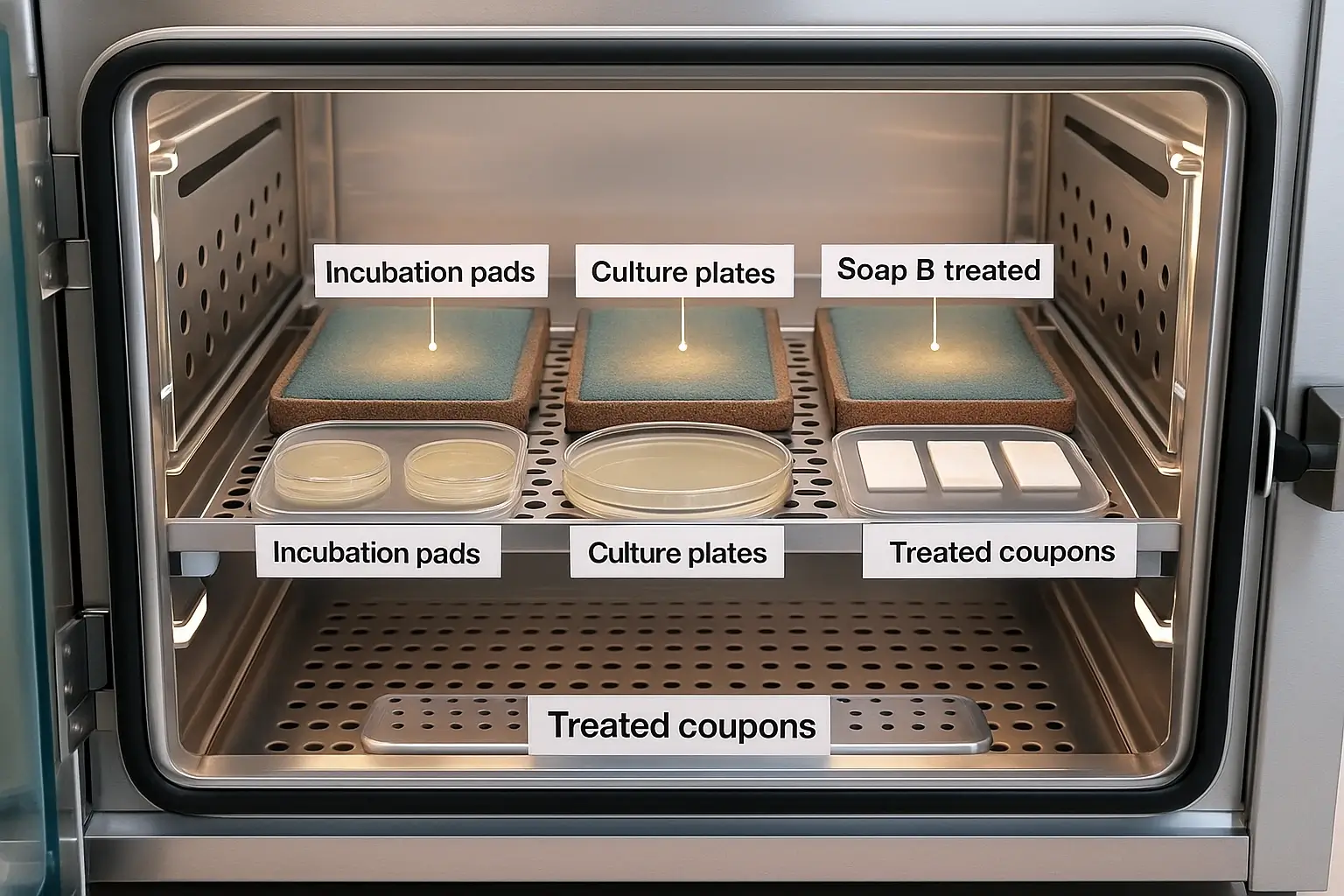
Controlled sweat-simulation chamber with warm pads, culture plates, and soap treatment surfaces
Sweat-simulation chamber showing incubation pads, culture plates, and treated coupons.

Purpose & Scope

This protocol evaluates whether soap residues meaningfully suppress odor-causing bacterial growth in sweat-like warm, humid environments.

  • Growth curves (6h, 12h, 24h)
  • Odor development patterns
  • Corynebacterium behavior under sweat
  • Film-residue interaction with humidity

Materials & Reagents

Required Materials & Equipment
ItemSpecificationPurpose
Sweat-Simulation Fluid0.9% saline + 0.1% lactic acid + 0.05% ureaMimics sweat chemistry
Incubation Chamber32–34°C · 80–90% humidityFoot-like conditions
Test SurfacesSterile 4×4 cm couponsUniform basis
Soap Samples0.3–0.5 g per couponComparative soaps
Bacterial SourceStandard foot-swab inoculumRealistic flora
MediaTSA & CMAGeneral + Corynebacterium
Odor Panel6–10 panelistsHuman odor scoring
VOC MeterOptionalInstrument reading

Test Design & Simulation Model

Replicates warm, sweaty, low-airflow foot environment.

Stepwise Procedure

  1. Prepare sweat-simulation fluid.
  2. Collect standardized bacterial inoculum.
  3. Prepare sterile 4×4 cm coupons.
  4. Apply soap (0.3–0.5 g).
  5. Apply bacterial inoculum (30 µL).
  6. Mist sweat fluid lightly.
  7. Incubate at 32–34°C & 85% RH.
  8. Sample at 6h, 12h, 24h.
  9. Odor panel rates 0–10 scale.

Endpoints & Metrics

Microbial Load

  • CFU on TSA
  • Corynebacterium CFU
  • Growth inhibition %

Odor Development

  • Panel score (0–10)
  • VOC reading
  • Descriptor shift

Moisture Interaction

  • Film integrity (0–3)
  • Rehydration behavior

Data Analysis Templates

CFU Reduction Template
Treatment6h12h24h% Reduction
Antibacterial Bar----
Antibacterial Liquid----
Zinc Soap----
Control---0%

Workbook: Sweat Simulation Data Sheets

Setup Log
ItemValue
Humidity
Temperature
Sweat Fluid Batch
Soap Dose (g)
Panelist IDs

Example Dataset (Demonstration Only)

Mock CFU Results
Treatment6h12h24h
Antibacterial Bar8.1×10³1.2×10⁴2.4×10⁴
Antibacterial Liquid6.9×10³1.1×10⁴2.2×10⁴
Zinc Soap7.2×10³9.5×10³1.6×10⁴
Control2.1×10⁴5.0×10⁴9.1×10⁴

Download Workbook (CSV & ZIP)

Download reproducible data sheets for the Sweat Simulation Test, including setup logs, growth-curve logs, and odor panel scoring sheets.

Download All Worksheets

⬇ Download Full Workbook (ZIP)

Research & Editorial Oversight

The CleanFormulation research initiative is led by founder . The project documents formulation behavior, ingredient interaction and regulatory classification within cleansing products.

Research articles and ingredient dossiers may be authored by contributing formulation scientists and researchers. All technical material is reviewed within the CleanFormulation editorial process before publication.

Primary reference sources include regulatory databases such as the European Commission CosIng database, EU Cosmetic Regulation (EC) 1223/2009, formulation chemistry literature and publicly accessible scientific databases including PubChem.
Meet the CleanFormulation research team

References

  1. Leyden JJ. "Foot odor and bacterial ecology."
  2. Egert M. "Microbiome of human feet."
  3. Alexander C. "Sweat composition & metabolism."
  4. Adapted consumer methods from ASTM E1207.