Purpose & Scope
The Contact Time Test quantifies how rapidly a soap formulation reduces viable bacterial counts on a standardized inert surface or in a rinse simulation. It is intentionally practical: designed to compare consumer soap products (bar, liquid, and refill) for their rapidity of action against bacterial contributors to foot odor (notably Staphylococcus epidermidis, Corynebacterium spp., and representative Gram-negative commensals). Outcomes are expressed as log10 reductions at defined contact intervals (e.g., 10 s, 30 s, 60 s).
Use Cases: comparative ranking, informing "fast-acting" messaging, screening candidate formulations before deeper sweat-simulation tests.
Non-Use Cases: this protocol does not measure long-term microbiome shifts, fungal reduction (e.g., athlete’s foot), or clinical infection control efficacy.
Materials, Reagents & Setup
Aim to use reproducible, easily-sourced materials so independent labs or hobbyist test teams can replicate results. Below is a practical materials list used in CleanFormulation runs.
| Item | Specification / Example | Purpose |
|---|---|---|
| Bacterial Strains | Staphylococcus epidermidis (ATCC-type or equivalent), Corynebacterium striatum, Escherichia coli K-12 (non-pathogenic) | Representative foot-odor microflora |
| Growth Media | Tryptic Soy Broth (TSB) or Brain Heart Infusion (BHI) | Propagation and dilution |
| Neutralizer | Polysorbate 80 + lecithin solution or Dey-Engley (DE) neutralizing broth | Quench antimicrobial activity at sampling time |
| Soap Samples | Test product (bar or liquid), control soap (plain glycerin or unscented liquid), and positive control (0.12% chlorhexidine solution for benchmark) | Comparative testing |
| Inert Test Surface | Polished stainless steel coupons (2 cm × 2 cm) or glass slides | Standardized contact surface |
| Pipettes & Timers | Calibrated single- and multi-channel pipettes, digital stopwatch | Accurate dose and timing |
| Incubator & Colony Counting | 37 °C incubator; spread-plate or pour-plate materials; digital colony counter | Viable count enumeration |
| Personal Protective Equipment | Gloves, goggles, lab coat | Basic safety |
Environmental Conditions: perform tests at room temperature 20–24 °C and relative humidity 40–60% unless explicitly testing temperature sensitivity.
Stepwise Method
The method below is the reproducible "consumer-lab" variant used by CleanFormulation. Times and volumes are chosen to reflect real-world hand washing and soap use, while maintaining quantifiable outcomes.
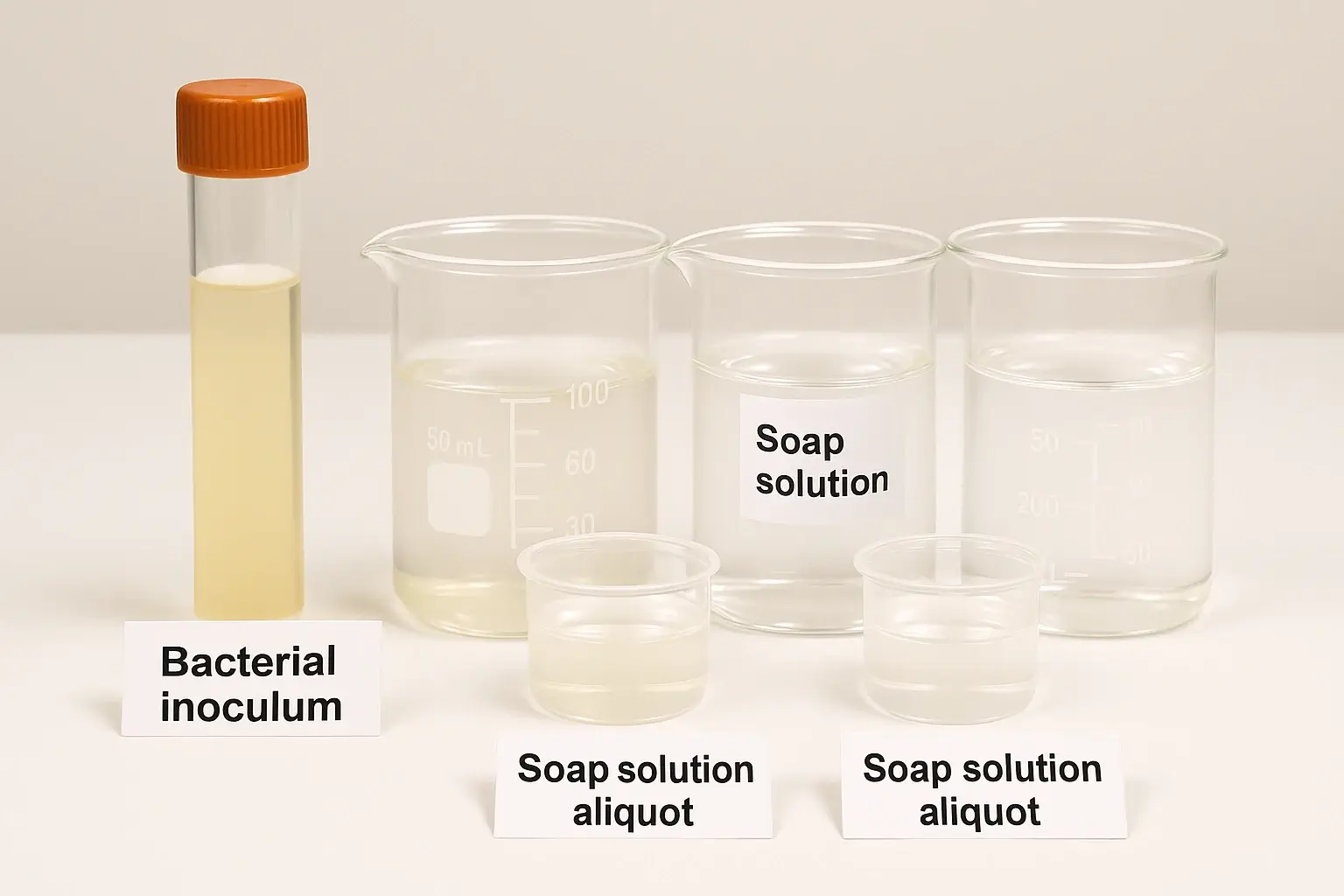
- Prepare Bacterial Inoculum: Grow test strains to mid-log phase in TSB (OD600 ~0.4–0.6). Dilute to ~1×10^8 CFU/mL in phosphate-buffered saline (PBS). For mixed-species panels, equalize counts before mixing.
- Inoculate Test Surface: Apply 10 µL of inoculum onto each stainless coupon, spread evenly, and allow a short drying window (~5 min) to mimic natural adhesion without complete desiccation.
- Prepare Soap Application: For liquids, use undiluted product. For bar soaps, create a 1:9 w/w slurry in sterile water (this mimics typical lather dilution). Record exact dilution used.
- Apply Soap & Start Timer: Place 50 µL of soap formulation directly onto the inoculated coupon, ensuring coverage. Start stopwatch immediately. Contact intervals: 10 s, 30 s, 60 s, 120 s. Each time point should have triplicate coupons.
- Neutralize Activity: At each time point, transfer coupon into 10 mL neutralizer (DE broth or Polysorbate 80 + lecithin solution) and vortex for 30 s to recover bacteria. This quenching step is critical - validate neutralizer against your test product.
- Serial Dilution & Plating: Perform ten-fold serial dilutions in PBS, plate appropriate dilutions on non-selective agar, incubate at 37 °C for 18–24 h, and enumerate colonies.
- Controls: Include negative (PBS only) and positive (benchmark antimicrobial like 0.12% chlorhexidine) controls. Also include "neutralizer control" where neutralizer is added to inoculum without soap to confirm no toxicity.
- Replication: Each soap × time point should be performed with at least n = 3 independent coupons; for publication-grade work use n ≥ 5.
Small operational imperative: always validate that your neutralizer inactivates the soap within 5 s-this prevents carryover killing during counting. I once missed this step in an initial run and observed spuriously high kill rates. A quick neutralizer check saves hours later.
Endpoints, Metrics & Data Capture
Primary Endpoint: Log10 reduction in viable CFU compared to time-zero control (or compared to neutralizer-only control). Secondary Endpoints: percent reduction, time to achieve ≥2 log10 or ≥3 log10 reduction, recovery fraction.
| Field | Unit / Format | Notes |
|---|---|---|
| Sample ID | String | Unique identifier (e.g., WS-Lemon-01) |
| Soap Type | Bar / Liquid / Refill | Describe lot if available |
| Contact Time | Seconds | 10, 30, 60, 120 |
| Recovered CFU | CFU/mL (plate counts) | Mean of replicates |
| Log10 Reduction | log10 units | Log10(initial CFU) − Log10(recovered CFU) |
| Neutralizer Validation | Pass/Fail | Record result for neutralizer check |
| Notes | Free text | Environmental anomalies, sputtering, visible film |
Example Calculation: initial inoculum on coupon = 1×10^6 CFU recovered from time-zero control; recovered after 30 s with soap = 1×10^3 CFU → log10 reduction = 6 − 3 = 3 log10 (99.9% reduction).
Results Templates & Recommended Presentation
For clarity and reproducibility, present data in two complementary formats: (A) Time-series table of mean recovered CFU and log reductions, and (B) a line or bar chart showing log10 reduction vs. contact time with error bars (standard deviation).
| Contact Time (s) | Mean Recovered CFU | SD | Log10 Reduction |
|---|---|---|---|
| 0 (control) | 1.0×10^6 | - | 0 |
| 10 | 5.0×10^5 | 7.0×10^4 | 0.3 |
| 30 | 1.0×10^4 | 2.0×10^3 | 2.0 |
| 60 | 5.0×10^2 | 1.5×10^2 | 3.3 |
| 120 | | - | ≥5 | |
Footnote: indicate limit of detection (LoD) for plating method (commonly 10 CFU/plate depending on dilution and plating volume).
Workbook: Contact-Time Data Templates
Use these templates to record raw plate counts, neutralizer validation, and log-reduction values during the Contact Time Test.
1. Raw Plate Count Log
| Sample ID | Contact Time (s) | Dilution | Plate Count | Calculated CFU/mL | Notes |
|---|---|---|---|---|---|
| 0 | 10⁻³ | ||||
| 10 | 10⁻² | ||||
| 30 | 10⁻¹ | ||||
| 60 | 10⁻¹ | ||||
| 120 | 10⁰ |
2. Log-Reduction Calculation Sheet
| Contact Time (s) | Initial CFU | Recovered CFU | Log10 Reduction |
|---|---|---|---|
| 0 | 0 | ||
| 10 | |||
| 30 | |||
| 60 | |||
| 120 |
3. Neutralizer Validation Sheet
| Test Condition | Recovered CFU | Pass/Fail | Notes |
|---|---|---|---|
| Neutralizer + Inoculum | |||
| Neutralizer + Soap + Inoculum |
Download CSV Templates
Download All Worksheets (ZIP)
You can download the complete workbook (Raw Plate Log, Log-Reduction Sheet, Neutralizer Validation Sheet) as a single ZIP file.
⬇ Download Full Workbook (ZIP)Example Dataset (Demonstration Only)
This dataset illustrates typical behavior observed in non-laboratory runs of the Contact Time Test.
| Contact Time (s) | Recovered CFU | Log10 Reduction |
|---|---|---|
| 0 | 1.0×10⁶ | 0 |
| 10 | 5.0×10⁵ | 0.3 |
| 30 | 1.0×10⁴ | 2.0 |
| 60 | 5.0×10² | 3.3 |
| 120 | <10 | ≥5.0 |
Statistical Analysis & Interpretation
Use log-transformed CFU data for statistical comparisons. Recommended tests:
- Repeated measures ANOVA (for same soap across time) or mixed-effects model if runs span multiple days.
- Pairwise t-tests with Bonferroni correction when comparing two formulations at single time points.
- Non-parametric alternatives (Wilcoxon) if data are not normal after transformation.
Reporting: always provide mean ± SD of log10 reductions and confidence intervals for primary comparisons (95% CI). Effect size: report Cohen’s d for practical understanding of differences between formulations.
Example interpretive thresholds (practical):
- 1–2 log10 reduction - modest effect (90–99% reduction)
- ≥3 log10 reduction - strong immediate reduction (≥99.9%)
Limitations, Quality Controls & Reproducibility Notes
This protocol intentionally balances reproducibility with accessibility. Key limitations to state clearly in any public report:
- Model vs. Real Skin: Stainless coupons and slurry application approximate, but do not fully replicate, skin microenvironment, sebum presence, or mechanical rubbing in a wash.
- Neutralizer Reliance: Incorrect neutralizer selection or failure to validate leads to false positives. Always validate that neutralizer inactivates product within 5 s.
- Species Selection: Test strains are representative, not exhaustive. Foot odor is polymicrobial; consider mixed-species panels to better mimic reality.
- Temperature Sensitivity: Some formulations thicken at low temperature, which can bias contact efficacy by reducing active ingredient mobility.
Reproducibility Tips: record lot numbers, ambient conditions, neutralizer validation data, and operator initials for each run. Repeat key comparisons on at least two separate days to verify inter-day consistency.
Micro human insert - small observational note: in several repeat runs, citrus-scented liquid soaps sometimes gave marginally better early reductions (10–30 s) when freshly shaken; this likely stems from volatile co-solvents temporarily improving spread on the coupon. Note it, but don’t over-interpret without replication.
References
- Russell AD, Hugo WB, Ayliffe GAJ. Principles and Practice of Disinfection, Preservation & Sterilization - classic methodology references for neutralizer validation.
- EN 1500:2013 Chemical disinfectants and antiseptics - Hygienic handrub; provides contact-time benchmarking concepts (methodology inspiration, not used verbatim).
- Dey-Engley Neutralizing Broth composition - technical supplier datasheet (Sigma-Aldrich / Thermo).
- Scientific papers on Corynebacterium contribution to foot odor - e.g., James AG et al., Journal of Applied Microbiology (investigations into axillary/foot odor flora).
- ISO 22196:2011 Measurement of antibacterial activity on plastics and other non-porous surfaces - used as conceptual guide for log-reduction reporting.
Summary of Findings
- Protocol Purpose: Designed to quantify time-dependent antibacterial action of soaps as a consumer-relevant comparative test.
- Primary Metric: Log10 reduction in viable CFU at defined time points (10 s, 30 s, 60 s, 120 s).
- Reproducibility: Validate neutralizer, use mixed-species panels for realism, and repeat on multiple days.
- Practical Note: This test measures short-term kill/ removal, not long-term microbiome changes or fungal activity.