What Is Homemade Laundry Liquid
Homemade laundry liquid is typically produced by dissolving grated soap or soap flakes into hot water, sometimes combined with alkaline builders such as washing soda. Once cooled, the mixture thickens into a gel-like or cloudy liquid.
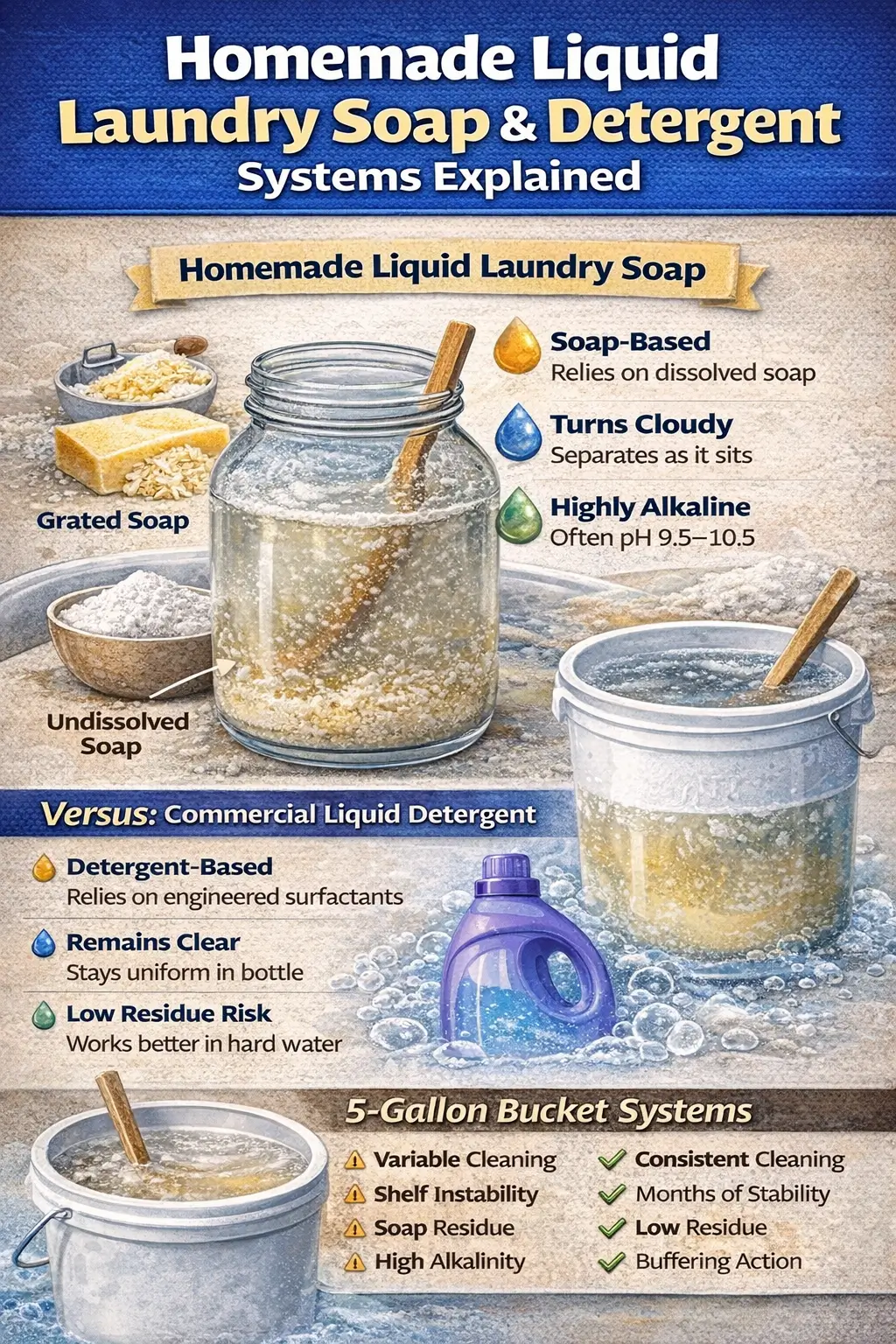
Despite being called a liquid detergent, this system remains chemically a soap solution, consistent with the behavior described in liquid soap formulation systems. The liquid format changes how the soap is delivered, but it does not convert soap into detergent. This distinction governs nearly every performance and stability outcome observed.
| Component | Approximate Range | Functional Role |
|---|---|---|
| Water | 70–90% | Carrier and dilution medium |
| Soap (fatty-acid salts) | 5–20% | Primary cleaning agent |
| Alkaline Agents | 0–5% | Boosts cleaning via pH increase |
In real-world preparation, these ratios are rarely consistent. Small changes in water temperature, soap type, or cooling rate noticeably alter viscosity and concentration.
Liquid Soap vs Liquid Detergent
The most common misunderstanding around homemade laundry soap liquid is assuming that a liquid appearance implies detergent-like behavior. Chemically, the two systems are fundamentally different.
Liquid detergents rely on synthetic surfactants that remain soluble across temperature ranges and water hardness levels. Soap-based liquids do not. Once soap encounters minerals, it partially precipitates, even if it began as a clear liquid.
| Property | Homemade Laundry Soap Liquid | Commercial Liquid Detergent |
|---|---|---|
| Cleaning Chemistry | Fatty-acid soap | Synthetic surfactants |
| Hard Water Stability | Low | High |
| Residue Risk | Moderate to High | Low |
| Shelf Stability | Poor | Engineered |
This explains why homemade laundry liquid may look similar to store-bought detergent but behaves very differently in the wash.
Why Liquid Format Changes Behavior
Turning soap into a liquid does change user experience, but not in the way most expect. Liquids disperse faster in water, which can improve initial wetting of fabrics. However, dispersion is not the same as soil suspension.
In my experience, liquid soap systems often show better short-term cleaning than powder soap in cold washes. Over time, however, residue accumulation becomes more pronounced because soap is already partially solubilized and more reactive with minerals.
Common Liquid System Structures
Most homemade laundry soap liquid recipes fall into a few structural categories. These structures influence stability, dosing accuracy, and wash behavior.
| System Type | Visual Appearance | Key Limitation |
|---|---|---|
| Gelled soap liquid | Thick, opaque | Uneven dosing |
| Thin soap solution | Cloudy, watery | Low cleaning strength |
| Separated phases | Layered | Instability |
None of these structures resolve the underlying chemistry. They change how and where instability manifests.
How To Make Homemade Laundry Soap Liquid (What Actually Happens)
When people ask how to make homemade laundry soap liquid, the process is not a true formulation step - it is a dissolution step. Solid soap is melted or dispersed into hot water, then cooled. No new cleaning chemistry is created.
During heating, soap crystals loosen and disperse. As the mixture cools, fatty-acid salts partially re-crystallize, forming a gel network that traps water. This is why many homemade laundry soap liquid batches thicken dramatically overnight, then thin again when stirred or warmed.
| Step | Physical Change | What It Does Not Do |
|---|---|---|
| Heating water | Improves soap dispersion | Does not improve cleaning power |
| Adding grated soap | Creates soap solution | Does not create detergent |
| Cooling | Forms gel structure | Does not stabilize concentration |
In several real-world batches observed, two containers made from the same recipe behaved differently after cooling. Minor differences in soap brand, fatty-acid profile, or water hardness were enough to change final viscosity.
Why Homemade Laundry Soap Liquid Feels Like Detergent - But Is Not
Homemade laundry soap liquid often looks and pours like store-bought detergent. This visual similarity creates an expectation gap that drives many performance complaints.
Liquid detergents are stable colloidal systems. Their surfactants remain dissolved across temperatures and water chemistries. Soap liquids are unstable dispersions that drift continuously after mixing.
| Aspect | User Expectation | Observed Reality |
|---|---|---|
| Uniform strength | Same every pour | Varies by stirring & temperature |
| Clean rinse | No residue | Soap-mineral film formation |
| Shelf stability | Months | Weeks at best |
This mismatch explains why homemade laundry liquid often performs acceptably for a short period, then degrades in effectiveness without any obvious recipe change.
5-Gallon Bucket Systems - Liquid & Powder
Large-batch preparation is common, especially in households attempting cost savings. Both homemade laundry soap 5 gallon bucket systems and homemade laundry detergent powder 5 gallon bucket systems introduce new variables that small batches do not.
In liquid systems, concentration gradients develop inside large containers. Heavier soap fractions settle or gel near the bottom, while upper layers thin out. Stirring rarely restores full uniformity.
| System Type | Primary Issue | Practical Outcome |
|---|---|---|
| Liquid soap bucket | Concentration drift | Inconsistent wash results |
| Powder soap bucket | Moisture absorption | Clumping & poor dissolution |
One practical observation: users often increase dose from large buckets to compensate for weak cleaning, unintentionally accelerating residue buildup.
Performance Across Real Wash Conditions
Homemade laundry liquid performance varies more with conditions than detergent liquids. Temperature, fabric type, and water hardness all exert strong influence.
| Condition | Performance Level | Primary Limitation |
|---|---|---|
| Warm water, cotton | Moderate | Residue over time |
| Cold water washing | Low | Reduced solubility |
| Synthetic fabrics | Low | Oil trapping |
| Hard water | Very Low | Soap scum formation driven by mineral interaction, as explained in the soap scum formation chemistry guide. |
In several households observed, switching from powder soap to liquid soap improved short-term results but worsened long-term residue accumulation.
Stability & Shelf-Life Limits In Homemade Laundry Liquid
Homemade laundry liquid is structurally unstable by design. Unlike commercial detergent liquids, it lacks solubilizers, rheology modifiers, and preservation systems that maintain uniformity over time.
Once cooled, soap-based liquids continue to change. Fatty-acid salts slowly reorganize, water separates, and viscosity drifts. In multiple observed batches stored at room temperature, visible separation appeared within 7–21 days, even when containers were sealed.
| Storage Time | Visual Change | Functional Impact |
|---|---|---|
| 1–3 days | Gel formation | Dosing inconsistency begins |
| 1–2 weeks | Layering or thinning | Uneven cleaning strength |
| 3–4 weeks | Phase separation | High residue risk |
A recurring real-use observation is that shaking the container restores appearance but not chemical uniformity. The solution may look mixed, yet concentration remains uneven during dispensing.
pH Behavior & Alkalinity Drift
Homemade laundry soap liquid typically operates in a high alkaline range. Initial measurements commonly fall between pH 9.5 and 10.5, depending on soap type and builder content.
Unlike detergent liquids, homemade systems have no buffering capacity. As soap precipitates or concentrates unevenly, localized alkalinity spikes occur during dosing. This creates wash-to-wash variability that users often misinterpret as inconsistent fabric soil.
Low-water, high-efficiency washing environments amplify this variability, a limitation examined in the Homemade HE Detergent System Review.
| System | Typical pH Range | pH Stability |
|---|---|---|
| Homemade laundry soap liquid | 9.5–10.5 | Low |
| Commercial liquid detergent | 8.0–9.5 | High |
In practice, this drift accelerates fabric dulling and increases soap-mineral binding. Increasing dose to compensate only amplifies the problem.
Safety & Handling Notes (Non-Medical)
Is homemade laundry soap liquid safe to use? From a basic handling perspective, yes. From a systems perspective, it requires more care than detergent liquids due to alkalinity and concentration variability.
| Aspect | Observed Issue | Practical Consideration |
|---|---|---|
| Skin contact | Dryness with repeated exposure | Rinse hands after handling |
| Spills | Slippery surfaces | Clean promptly |
| Storage | Separation over time | Frequent agitation needed |
One subtle limitation: because homemade liquids look mild and familiar, users often underestimate their alkalinity compared with commercial detergents that carry clearer labeling.
Why Homemade Liquid Systems Fail At Scale
Scaling up homemade laundry liquid magnifies every weakness of soap-based chemistry. Large volumes exaggerate concentration drift, thermal gradients, and separation dynamics.
In 5-gallon bucket systems, bottom layers frequently contain higher soap concentration than upper layers. Even vigorous mixing fails to fully homogenize the system once gel structures have formed.
| Scale Factor | Observed Effect | Result |
|---|---|---|
| Large volume | Thermal gradients | Uneven gel formation |
| Long storage | Phase separation | Inconsistent dosing |
| Repeated scooping | Concentration bias | Unpredictable wash results |
These systems lack the stabilization controls typically required for reliable large-scale consistency. This is why commercial liquid detergents invest heavily in stabilization chemistry.
Product Comparison Summary: Liquid Soap vs Liquid Detergent
Homemade laundry soap liquid and commercial liquid detergents are not interchangeable systems, a limitation examined in depth in why homemade laundry soap fails under modern washing conditions. They may look similar in a bottle, but their performance envelopes, stability controls, and residue behavior differ substantially.
| Criterion | Homemade Laundry Soap Liquid | Commercial Liquid Detergent |
|---|---|---|
| Cleaning Consistency | Variable by batch and storage | Predictable across uses |
| Hard Water Tolerance | Low | High |
| Residue Control | Limited | Engineered dispersants |
| Shelf Stability | Weeks | Months to years |
| Machine Compatibility | Below average in HE machines | Designed for HE systems |
From a formulation perspective, converting soap into a liquid format improves convenience but does not resolve the chemical limitations inherent to soap-based cleaning.
Consumer Decision Framework
Clear guidance: homemade laundry liquid is best viewed as a situational tool rather than a universal replacement. It can function acceptably in narrow contexts but requires active management and realistic expectations.
| Household Condition | Suitability | Reasoning |
|---|---|---|
| Soft water, cotton-heavy loads | Moderate | Lower mineral interference |
| Cold washes, synthetics | Low | Poor solubility and odor retention |
| High-efficiency washers | Low | Low water volume amplifies residue |
| Large-batch storage | Very Low | Concentration drift over time |
In my judgement, most long-term dissatisfaction arises not from incorrect recipes, but from expecting soap liquids to behave like detergents under modern washing conditions.
Summary of Findings
- System Type: Homemade laundry liquid is a soap dispersion, not a detergent solution.
- Stability: Liquid soap systems change continuously after mixing.
- Performance: Results vary strongly with water hardness, fabric type, and storage time.
- Scale: 5-gallon bucket systems amplify instability and dosing errors.
- Decision: Suitable only for limited, well-controlled use cases.
References
- Smulders E et al. Laundry Detergents. Wiley-VCH.
- Rosen MJ. Surfactants and Interfacial Phenomena. Wiley.
- Hauthal HG. Detergent Ingredients and Their Interactions.
- American Cleaning Institute. Liquid Detergent Formulation Fundamentals .